Young-jae
Living with 7 vampiresYoung-jae is a recurring and deliberately unstable figure in the supernatural conflict surrounding Y/N, the vampires, and the other world. His importance lies less in a fully explained biography than in the contrast between Jin’s memory of him as someone kind and the coercive, threatening presence associated with him later. Through that contrast, Young-jae becomes a sign of how familiar identity can be overtaken, concealed, or weaponized.
Identity and Introduction
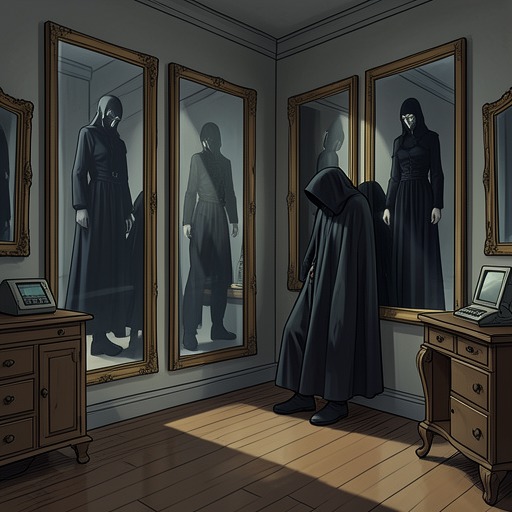
Young-jae is first identified by Jin after a frightening encounter involving shadows and a mirror. Jin is dragging Y/N through the halls while unseen figures pursue them, and the hallway abruptly appears normal again. Jin then names the figure connected to the disturbance as Young-jae, prompting Y/N to ask who he is. Jin answers that Young-jae used to be kind. The remark supplies no complete history, but it establishes a decisive before-and-after: Young-jae is not presented as an entirely unknown monster, but as someone whose earlier character has been lost, altered, or obscured.
The surrounding supernatural rules make that uncertainty significant. J-Hope explains that another world exists near the vampires’ world and that beings from it sometimes take over vampire bodies when the vampires sleep. Young-jae therefore belongs to a narrative environment where appearance cannot guarantee identity and where a recognizable person may also be the vehicle of an invading presence. The evidence does not state the exact mechanism of Young-jae’s condition, but it places him close to the green-eyed and shadow-related danger that repeatedly threatens Y/N.
Function in the Plot
Young-jae’s role is connected to pursuit, capture, and the removal of Y/N’s freedom. In one scene, shadows demand that Jin release Y/N and call for her to come with them. The threat turns a hurried escape into a confrontation with an enemy whose power is expressed through pursuit and possession rather than ordinary conversation. The later identification of Young-jae gives the apparently shapeless danger a personal name, while Jin’s comment makes the threat more tragic: the danger may be coming through someone who was once trusted.
Young-jae appears again when Y/N is caught in a trap. A rope raises her from the ground and leaves her hanging upside down from a tree. A voice celebrates what has been caught, and Y/N recalls the names of the captors, including Young-jae. This moment places him directly among the agents who treat Y/N as captured prey. The scene also shifts him from an ominous name in Jin’s account to an active participant in the physical restriction of Y/N.
His violence becomes still more explicit during the throne sequence. Jungkook attempts to speak, but Young-jae orders him to shut his mouth. Something attached to one of the throne’s armrests is then involved in binding Y/N’s other hand, while the corresponding restraint already covers her right hand. Young-jae is thus associated not merely with surveillance or intimidation but with a ritualized apparatus of confinement. The throne, the bindings, and the command to silence transform the encounter into an exercise of authority over both body and speech.
Relationship with Y/N and the Vampires
Young-jae’s relationship with Y/N is defined by asymmetry. Y/N is abandoned by her mother, attacked, drawn through a mirror that feels like water, pursued by shadows, and repeatedly placed in situations where other beings determine where she may go. Young-jae belongs to this larger pattern of control. His presence helps make Y/N’s body and movement central stakes in the story: she is seized, suspended, restrained, and brought toward forces whose purposes she does not yet understand.
His relationship with Jin is more complicated because Jin remembers a different Young-jae. The statement that he used to be kind functions as both personal testimony and narrative evidence. It suggests that the conflict cannot be reduced to a simple division between known allies and inhuman enemies. Jin’s recognition also makes the danger intimate; the vampires are not confronting an abstract threat alone, but a transformed or compromised figure from within their circle of familiarity.
Young-jae’s connection to the vampires is further framed by the story’s repeated uncertainty over what counts as human, vampire, or invader. Y/N initially identifies herself as human, while the others reveal that they are vampires. J-Hope later explains that beings from the nearby other world can take over vampire bodies. Against this background, Young-jae embodies the instability of social recognition: a name may remain constant even when the person, body, or agency behind it has changed.
Change, Threat, and Narrative Significance
The available scenes do not provide a confirmed resolution for Young-jae, nor do they fully explain whether his actions result from possession, allegiance, transformation, or deliberate choice. That absence is part of his narrative function. The character is built through fragments: a remembered kindness, a shadow pursuit, a capture in the woods, and an order delivered at the throne. Each fragment narrows the distance between the familiar figure Jin recalls and the dangerous agent Y/N encounters without definitively reconciling them.
Young-jae therefore operates as a figure of corrupted familiarity. His story parallels the book’s larger anxieties about mirrors, bodies, and hidden entrances. A mirror can pull Y/N into another realm; shadows can pursue her through apparently ordinary corridors; and a person recognized by name can stand on the side of those who bind and silence her. The resulting tension comes from the possibility that the enemy is not simply outside the group but has emerged through a known identity.
His scenes also intensify the book’s recurring movement from confinement toward resistance. Y/N is first treated as someone who can be abandoned, hunted, captured, or restrained, but later she pushes Gehan away and concentrates on opening the gates of hell. Young-jae’s restraints belong to the earlier structure of domination against which that later action gains force. Even without a recorded ending for Young-jae himself, his presence helps define the danger Y/N must eventually overcome: not only physical imprisonment, but the authority of beings who claim the right to control her body, voice, and destination.