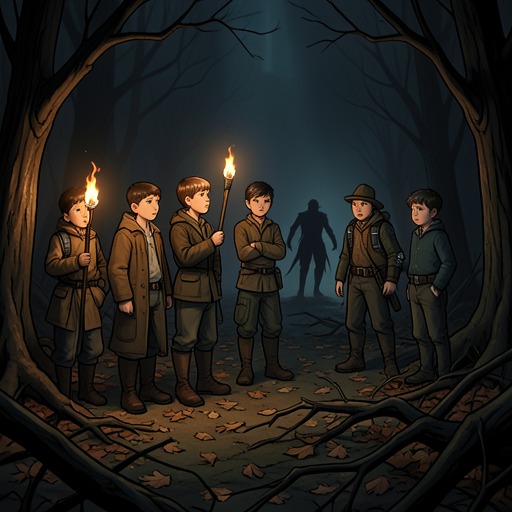
Assembly over rules and the beast descends into disorder
Lord of the FliesThe assembly over rules and the beast is the point at which Ralph’s attempt to repair the boys’ common life becomes a public contest over who has the right to command it. Convened to address neglected work, fear, and the signal fire, the meeting begins with practical rules and ends with Jack Merridew openly rejecting their authority. The beast remains unconfirmed, but the gathering makes another danger unmistakable: the boys no longer agree on what binds them together.
Background and Ralph’s agenda
Ralph addresses the boys amid a growing gap between decisions made at meetings and what happens afterward. Water that was meant to be carried from the stream in coconut shells has run out; the shelters have been left to uneven efforts, and one is particularly unstable. The agreed lavatory area beyond the bathing pool is being ignored, so he reminds the youngest boys to go to the rocks rather than near the fruit or shelters. These details make the meeting’s crisis concrete: common arrangements exist, but they are not being maintained.
The signal fire is Ralph’s most urgent concern. He insists that smoke, not the hunters’ success in killing pigs, is their best means of rescue. With the fire out or unattended, the boys cannot count on being seen by a passing ship. He recalls that their first blaze nearly set the island alight and argues that fires should be restricted to the mountain, even for cooking. His rule is an effort to make rescue a shared responsibility and to prevent individual convenience from undoing it. But his insistence that he is chief and that the others must obey also reveals the limit of his authority: a rule can be announced at the assembly without being enforceable beyond it.
Ralph then names the change he cannot explain. The boys began well, he says, but fear has unsettled them. He admits that he is frightened at times, while trying to persuade the assembly that fear is groundless and that they can become happy again. The effort to discuss fear is therefore bound up with his attempt to restore the practical order he has just described. He wants the boys to agree that the danger is imaginary, then return to keeping the fire and other obligations.
Dispute over the beast and fear
Jack Merridew takes the speaking shell and redirects the conversation. He blames the youngest boys for starting the talk of fear, mocks them as unhelpful and cowardly, and argues that fear cannot harm anyone any more than a dream. He also draws a distinction between fear and the beast: the boys may be frightened, but he insists that no beast lives in the forest. As a hunter, he claims authority from his experience, saying he has searched the island alone and would have seen one. His certainty briefly reassures the assembly, which applauds.
Piggy agrees that there is no beast in the forest, but rejects the idea that fear should simply be endured. He appeals to reason and to the reassuring structure of adult knowledge, insisting that there are explanations and people who can set things right. Yet the meeting cannot keep the discussion within those boundaries. Maurice recalls his father’s claim that unknown sea creatures may exist, and the assembly begins arguing over what might inhabit the water. The speculation shows how little the boys know about their surroundings; reassurance based on familiar categories cannot settle a question that remains open to them.
Ralph sees the argument as a loss of sanity and calls for silence with the shell. Simon, who has been close by, says hesitantly that there may be a beast. When Ralph asks whether he believes it, Simon answers that he does not know, then struggles to express a different possibility: “maybe it's only us.” The remark does not offer the assembly a manageable external threat or a clear plan. It points instead toward something within the boys themselves, and his attempt to explain is drowned in hostile cries and laughter. Simon shrinks back, unable to make himself understood. The episode thus places his uncertain insight beside the crowd’s demand for a simpler answer—and shows how quickly an assembly can punish a contribution that unsettles its assumptions.
The rules lose their hold
Darkness intensifies the meeting’s disorder. The youngest boys huddle together, wind moves through the palms, and trunks scrape with a sound that seems newly menacing. Piggy declares that he does not believe in ghosts; Jack Merridew angrily insults him, and the shell is pulled between them in a brief struggle. Ralph takes it back and acknowledges that he called the meeting too late. He proposes a vote on ghosts, then admits that he does not believe in them, although the thought frightens him in the dark. When he asks who thinks ghosts may exist, hands appear in the gloom. Piggy immediately objects that he did not vote for them, but his protest cannot restore certainty or order.
The argument turns from the supernatural to political authority. Piggy asks what the boys are becoming, contrasting their responsibility to adults with hunting, neglecting fires, and now voting over ghosts. Jack Merridew answers by attacking Ralph’s right to direct anyone: he questions what Ralph has accomplished and argues that being chosen chief should make no difference. Ralph counters that he was elected, while Piggy invokes the shell as his right to speak. What began as a discussion of fear has become a struggle over the legitimacy of leadership and the procedure meant to protect it.
Ralph appeals to the rules, insisting, “Because the rules are the only thing we've got!” Jack Merridew rejects them and offers a rival source of authority: strength, hunting, and the promise to hunt down the beast. His declaration is not merely an objection to a particular rule. It replaces shared procedure with the power of a group capable of acting together through force. The boys respond to his excitement with noise and movement, and the assembly scatters from the palms toward the water. The meeting ends not in a decision about ghosts, but in the collapse of the setting in which the boys were supposed to decide together.
Aftermath and significance
Ralph does not sound the shell to call everyone back. He fears that the boys might not return, leaving the fire without keepers and the hope of rescue still weaker. The hesitation captures the bind at the center of his leadership: the call depends on the group’s willingness to recognize it, while using it and receiving no answer would expose how little authority he has left. Piggy urges him to be firm, but also warns that if Jack Merridew became chief the boys would hunt while the fire went out. Their exchange makes the consequences of the assembly’s collapse immediate: the dispute is not only about status, but about which duties will survive.
The scattered boys gather on the sand and chant as they move together, while younger children leave the group crying. Ralph and Piggy can hear and see the crowd, but cannot make it answer to the assembly’s rules. Ralph’s lingering doubts about ghosts and the beast persist even as Piggy insists that the world must make sense. The meeting therefore changes the terms of the conflict without resolving its supernatural question: fear is no longer just a subject for discussion, but a force that can draw the boys away from deliberation and into collective action.
The episode sets two kinds of authority against each other. Ralph’s depends on election, the speaking shell, common duties, and the hope of rescue; Jack Merridew’s appeal rests on hunting, confidence, and the promise of force. Neither the shell nor the title of chief is enough, by itself, to make others obey. The assembly’s failure exposes the difference between agreeing on rules and having the power to uphold them—and foreshadows the widening division between Ralph’s effort to preserve cooperation and Jack Merridew’s increasingly coercive leadership.