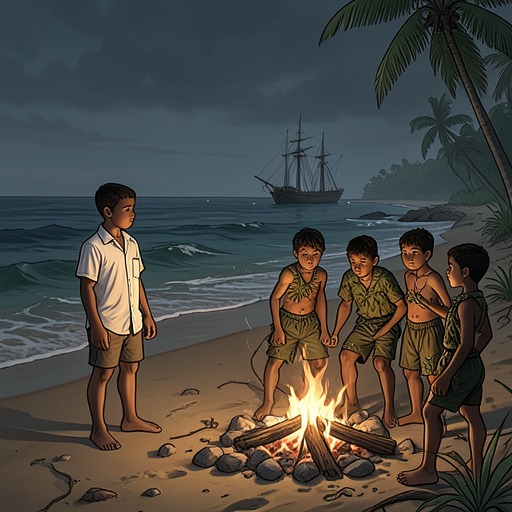
Breakdown of the Boys' Social Order
Lord of the FliesThe Breakdown of the Boys' Social Order is the gradual collapse of the boys’ attempt to govern themselves through elected leadership, common rules, and duties shared for the sake of rescue. It is not a single rupture: the institutions first appear meaningful, then lose practical force as hunting, fear, and factional authority compete with them. The final destruction of Piggy and the conch at Castle Rock makes that change physical, while the officer’s arrival on the beach brings an outside authority into a society already transformed by violence.
An improvised common order
The boys begin without adults and with little certainty about where they are or how they will be found. At their first meeting, Jack Merridew arrives at the head of a uniformed choir, wearing a gold badge that distinguishes him from the other boys. His group’s disciplined entrance gives him the air of an established leader, but the boys choose Ralph after a proposal to vote. The result is not simply a contest of personalities: Ralph’s possession of the conch and his role in calling the gathering make the new procedure itself a source of authority. Jack is given charge of the choir, which becomes a group of hunters, keeping him inside the initial arrangement even as leadership is divided between them.
Ralph’s first account of the situation makes self-government a practical necessity. The boys have seen water all around them and no houses, smoke, boats, or people; there are no adults to take responsibility for them. At the meeting, the conch is proposed as a way to regulate speech: whoever holds it may speak without interruption, subject to Ralph’s authority. Jack welcomes rules, and the boys initially accept the idea that the shell, the assembly, and elected leadership can organize their common life. But the arrangement depends on people continuing to honor it. Its force is never independent of their consent.
That gap between agreed rule and actual conduct appears early in the work of maintaining the signal fire. On the mountain, Piggy’s glasses are used to kindle a blaze, but the boys produce flame without the smoke that would make it a rescue signal. When Piggy tries to claim his speaking turn, Jack says the conch does not count there. Ralph responds by extending the assembly’s rule to the mountain and proposing special responsibility for keeping the fire. Jack then publicly agrees to divide the hunters into groups for fire-watching, and the boys assent to a rotation. The ceremony of agreement is intact, but the incident already shows how readily a rule can be treated as binding in one place and disregarded in another.
Duties compete with desire
The order weakens as common responsibilities repeatedly lose out to immediate appetites and interests. Ralph and Simon work on shelters while others leave to bathe, eat, or play; Jack’s hunters pursue the desire for meat. Jack describes being consumed by the thought of tracking and killing a pig, while Ralph insists that shelter-building matters. Their disagreement exposes more than competing tasks: the chief’s plan depends on sustained cooperation, whereas Jack’s authority increasingly draws on the excitement and prestige of the hunt.
Ralph later tries to make the priorities explicit. He insists that the signal fire matters more than repeated pig kills, restricts fires to the mountain, and returns to the need for smoke as a means of rescue. His speech also connects everyday rules, such as using the rocks as a lavatory, to the possibility of living together without turning the whole island into disorder. Yet the hunters giggle as he speaks, and his attempt to make his authority effective has to become more forceful. Rules remain easy to state; neither his position as chief nor the assembly can guarantee that the boys will carry them out.
The meetings over fear sharpen this weakness. Jack dismisses the youngest boys as useless and insists there is no beast in the forest, drawing on his standing as a hunter to support his claim. At a later assembly, Ralph asks whether there may be ghosts. When hands rise in response, Piggy protests that he did not vote for them, and the conch is snatched away during the argument. The question has exposed the assembly’s inability to settle fear by procedure. Jack then openly rejects the rules and answers the prospect of a beast with the promise that the boys will hunt it down. As the boys scatter from the platform into a mock hunt, the meeting’s formal authority gives way to an excited, frightening crowd.
Rival authority and the failed vote
The conflict becomes a direct struggle over who has the right to decide. During a search for the beast, Jack says that the conch is no longer needed and that some boys should keep quiet while others make decisions. Ralph answers that Jack does not have the conch and that the chief’s authority still stands. In this exchange, political participation itself is at stake: Jack’s proposed order does not merely offer a different decision-maker; it excludes some of the boys from deciding at all.
At a later assembly, Jack tries to remove Ralph by asking the boys to raise their hands against him. No one does. The silence humiliates Jack, who lays down the conch, declares that he will no longer be part of Ralph’s group, and runs off toward the forest. His departure turns an internal contest into a division between groups. He invites boys to hunt with him, and his subsequent appearance with painted followers at the fire makes the separation visible: the paint gives him cover from shame, while an invitation to a feast offers membership in a new collective. The group no longer depends on a single shared assembly; it is reorganizing around competing loyalties.
The break also leaves practical obligations exposed. Ralph fears that the others no longer care about the fire and wonders whether he might become indifferent himself. Jack and his hunters arrive at the remains of the fire, take half-burnt branches, and announce their settlement and feast. Their offer of meat supplies an immediate attraction that the weaker, more demanding work of maintaining the rescue signal cannot match. Ralph’s authority continues to carry an argument, but it no longer commands enough people to make that argument effective.
Coercion at Castle Rock
At Castle Rock, the rival order is no longer sustained chiefly by persuasion or shared agreement. Ralph arrives with Piggy and others to demand the return of Piggy’s glasses and to argue that a proper signal fire is the boys’ only hope of rescue. Jack’s group laughs at them. When Jack orders Sam and Eric to step back and then to be seized and tied up, the tribe first hesitates; the twins’ capture follows when the group recognizes the power it has in its hands. Jack takes their obedience as proof of his command, while Ralph’s demand and the earlier rules provide no protection for them.
Piggy raises the conch and asks whether it is better to keep rules or to hunt and kill. The shell briefly gathers attention, but its familiar claim to authority is now surrounded by jeering and a building threat of attack. Roger releases a great rock from above. It strikes Piggy, who falls to the rocks below and is swept away by the sea; at the same moment the conch breaks into fragments. The paired destruction is decisive: the death of the boy most associated with reasoned argument and the shattering of the object that once regulated speech mark the end of the old assembly’s remaining symbolic power. Jack immediately declares himself chief and throws a spear at Ralph, making his claim inseparable from physical force.
The twins are left bound and terrified. Jack demands that they join his tribe, and Roger advances on them with an authority that does not depend on any meeting, election, or recognized speaking rule. Ralph, wounded and pursued, escapes into the forest. The subsequent hunt shows how far the boys’ collective activity has shifted: they use violence against one of their own and set the island ablaze as they pursue him. The fire that had been maintained as a signal of hope has become part of the danger driving the chase, even as its smoke attracts the naval officer to the beach.
Interruption, not restoration
When Ralph reaches the beach, the pursuit’s cries falter at the sight of the naval officer, his cutter, and the armed ratings. The officer says they saw the smoke; behind him, the painted boys stand silent, their sharp sticks still in hand. His arrival ends the immediate hunt and introduces the adult authority absent since the crash. It does not restore the boys’ former arrangements: Piggy is dead, the conch is gone, and Ralph’s group has been displaced by a tribe whose authority has been enforced through capture and threat.
The social collapse therefore turns on the difference between having rules and being able to uphold them. Elections, assemblies, the conch, and shared duties give the boys an initial means to coordinate, but those forms cannot survive when participation is rejected, obligations are abandoned, and force becomes a more reliable source of compliance. The smoke that signals rescue is also the fire that enables the final pursuit. Its arrival brings outside intervention, but only after the boys’ own order has been dismantled.