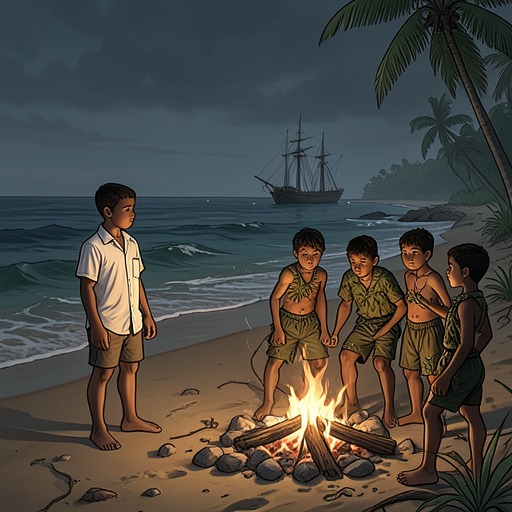
Civilization and Savagery
Lord of the FliesCivilization and Savagery is the novel’s central tension between a society maintained through shared rules and one organized around force, hunting, and group excitement. It develops not as a contest between separate kinds of people but as a change in what the same boys permit, admire, and obey. Assemblies and The conch initially give cooperation a form; face paint, hunting rituals, and Jack Merridew’s authority gradually make violence easier to join and harder to resist. The ending brings these trajectories together: the conch and Piggy are destroyed, while the fire that threatens the island also produces the smoke that makes rescue possible.
Building an Order Without Adults
The boys begin without adult supervision, but their first response to that absence is to create procedures rather than simply submit to whoever is strongest. At the first assembly, Ralph is chosen chief after a vote, despite Jack’s claim that his position as head boy and chorister makes him the proper leader. Ralph’s election draws force from more than his appearance: he has blown The conch and waited on the platform, so the shell and the meeting already connect him with a recognizable public order. Jack is given responsibility for the choir, which becomes a group of hunters. The arrangement grants him a role within the new society while also establishing a rival source of identity and influence.
At a later assembly, Ralph explains that the boys are alone and must look after themselves. He proposes that speakers hold The conch and not be interrupted, adapting a familiar school procedure to a community without grown-ups. Jack enthusiastically calls for rules too. The point is not that the boys lack authority altogether, but that authority must be made collectively intelligible: a rule works because the group accepts a procedure and agrees to treat it as binding. Their early confidence in this project remains fragile. The boys can repeat the language of order more easily than they can sustain the shared labor and restraint it requires.
The signal fire makes that difference concrete. Ralph treats it as a common duty because smoke may bring a ship; the first fire instead becomes an overwhelming blaze, and the boys’ effort is driven by the immediate excitement of keeping flames high. Later, after there is flame but no smoke, Piggy is told that The conch does not count on the mountain and is ordered to be quiet. Jack then takes up the shell, declares that they must obey rules, and assigns hunters to take turns tending the fire. His appeal to English superiority gives the obligation a national and moral gloss, but the hunters are also allowed to let the fire burn out for the night. The episode shows both the possibility and the limits of institutional language: agreement is voiced, yet the rescue duty can still be subordinated to convenience.
Restraint, Status, and the Appeal of Hunting
The contrast between civilization and savagery is especially visible in Roger’s treatment of Henry. Roger throws stones near the younger boy, but leaves a space around him in which he dares not aim. The narrative connects this hesitation to the old protections of parents, school, police, and law. Those institutions are absent from the island, yet their restraint persists for a time as a habit. Roger’s stones therefore register not simply a private intention but the weakening reach of a social boundary: the force that once checked his arm has not vanished, but it is becoming less secure.
Jack’s first face-painting gives the competing attraction a vivid outward form. Using white clay, red clay, and charcoal, he makes a hunting disguise and sees in the water not his ordinary face but a stranger. Behind the mask, he dances and laughs with a new freedom from shame and self-consciousness; the others’ attention follows. Paint is useful as camouflage, but it also changes how Jack can present himself and how the group responds to him. Hunting consequently offers more than meat. It provides visible distinction, excitement, and a release from the ordinary restraints that the boys’ earlier social identities carried with them.
That release becomes dangerous when play adopts the structure of a hunt. After Ralph wounds a boar, the boys turn Robert into a pretend victim. They encircle and jab at him, chant a killing refrain, and continue as his mock fear gives way to real pain. Afterwards they call it a game, but the distinction is unsettled by the violence and by their discussion of adding a drum or using a real pig. Jack even suggests a younger boy could take the part. The scene makes savagery a group practice before it becomes an organized political order: excitement is shared, responsibility is dispersed among the circle, and the boundary between imitation and injury narrows in the act itself.
Rival Authority and the Breakdown of Rules
Fear intensifies the struggle over what kind of order the boys will accept. During an assembly about ghosts, Ralph tries to settle the question by procedure, but the meeting becomes confused and argumentative. Jack turns the dispute into a challenge to Ralph’s right to lead, insisting that strength and hunting matter more than his election. When Ralph answers that rules are all the boys have, Jack rejects them and promises to hunt down the beast. The assembly breaks apart into noise and mock hunting. The change is political as well as emotional: a common meeting can no longer reliably gather the group, and a rival leader can appeal directly to action, fear, and force.
Ralph and Jack’s conflict also concerns competing measures of usefulness. Ralph emphasizes shelters and the signal fire; Jack is absorbed by tracking and killing. He describes the desire to pursue prey as a compulsion, while Ralph points out that the hunters have returned from the hunt and gone swimming instead of helping with the shelters. Their disagreement is not resolved by a lack of shared vocabulary: both can speak of duties and leadership. Instead, each activity offers a different reward. Shelters and smoke demand sustained work for a future rescue; hunting gives immediate purpose, meat, and the prospect of recognition.
Jack’s break with Ralph follows a failed attempt to remove him by vote. When no one raises a hand against Ralph, Jack lays The conch down, weeps, and announces that he will no longer be part of Ralph’s group. He invites anyone who wants to hunt to join him. Later, painted and accompanied by hunters, he raids Ralph’s camp for fire and announces a separate tribe on the beach, offering a feast and meat to those who join. The invitation turns belonging into a bargain: protection from The beast, food, and participation in a more exciting group are set against Ralph’s insistence on maintaining the signal fire. The boys are not simply coerced into the new order; its attractions help win their assent.
Destruction and Rescue
When Ralph’s group goes to Castle Rock to demand Piggy’s glasses and remind Jack’s tribe about the signal, Ralph argues that smoke may bring a ship, whereas without it the boys could wait for years. He contrasts law and rescue with hunting and the breaking of things. Piggy raises The conch and tries to make the same case for rules, but the shell’s authority now depends on a group increasingly disposed to mock and menace its speaker. Roger releases a great rock. It strikes Piggy, who falls to his death, and shatters The conch. Jack then claims the chief’s authority through force and attacks Ralph. The loss of the shell is therefore both material and political: the object that once marked a shared right to speak no longer exists, and the attempt to appeal to a common rule has been answered by lethal violence.
The final pursuit carries the change to its extreme. Jack’s tribe hunts Ralph and sets the island ablaze, turning destruction into a means of driving him out of hiding. Yet the fire’s smoke is seen by a naval officer, who arrives on the beach with a cutter and takes charge of the boys’ rescue. The signal that Ralph’s group had struggled to maintain is finally supplied by the very blaze that consumes their refuge. This reversal does not make the destructive act a successful form of social order: it brings an outside authority back into the scene only after the boys’ own system has collapsed and two boys have died.
Meaning of the Conflict
The novel makes civilization depend on repeated acts of recognition and cooperation, not merely on names, uniforms, or declarations. The conch can organize speech only while the boys accept that it does; a chief’s election cannot compel obedience once the group no longer respects the procedure; and a fire can serve as a rescue signal only when someone maintains it for that purpose. Conversely, the movement toward savagery is made through choices that have immediate appeal—hunting, feasting, protection, disguise, and the energy of the group—before it culminates in organized pursuit and death.
The ending refuses a clean return to the boys’ earlier innocence. Faced with the naval officer, Ralph remembers that they were once together, then breaks down in grief for the end of innocence, the darkness of the human heart, and the loss of Piggy. The officer’s arrival restores adult authority and offers physical rescue, but it cannot undo what has happened among the boys. Civilization and savagery remain joined in the same people and the same history: the survivors are rescued from the island, while Ralph’s grief marks the cost of discovering how readily social restraints can fail.