Face Paint as a Mask
Lord of the FliesFace Paint as a Mask is both camouflage and a changing social identity. First devised by Jack Merridew to help hunters approach prey unseen, the paint transforms his visible face into a disguise behind which he feels freed from shame and self-consciousness. As the boys’ society fractures, that concealment becomes more than a hunting tool: it marks allegiance, unsettles recognition, and accompanies the shift from shared rules to the authority of Jack’s tribe.
From Choir Leader to Hunter
Before Jack Merridew paints his face, his authority is already contested. At the first election, he claims leadership on the grounds that he is head boy and a chorister who can sing C sharp. The vote instead makes Ralph chief, though Ralph assigns Jack command of the choir and allows him to choose its new purpose. Jack chooses hunting. This early change in role gives hunting a place in the boys’ organization, but it does not yet give Jack the status he wants.
The practical pressure of hunting grows alongside conflict over the boys’ work. Ralph complains that the others abandon shelter-building, while Jack insists that the group needs meat and describes the compulsion he feels to keep tracking and killing. He has wounded a pig but failed to hold it, and he plans to improve his spear with a barb. The face paint emerges within this pursuit: it is meant to help hunters get close enough to kill, but it also changes how Jack and the others experience the hunt.
Making and Wearing the Mask
Jack prepares the paint at a pool where Sam and Eric, Bill, and Roger are waiting. He has gathered white clay and red clay in separate leaves, with a stick of charcoal beside them. He explains that the disguise is for hunting, compares it to dazzle paint used in war, and describes the advantage of looking like something else. The materials and method are deliberate: he first lays down white on one cheek and around one eye socket, puts red over the other half of his face, and draws a black stripe from his right ear to his left jaw.
At first, Jack dislikes the effect and washes the paint away. He then paints himself again and studies the result in the pool. His breathing troubles the reflection; when sunlight falls on his face and appears in the water, he looks at an awesome stranger rather than at himself. He spills the water, jumps up laughing, and dances. His laughter becomes a bloodthirsty snarl, and the painted face seems to move independently of the boy beneath it. The scene makes the mask’s psychological effect visible: the disguise does not merely hide Jack from prey; it gives him a way to act without the restraint he associates with his unpainted self.
Roger smiles at the transformation, while Bill initially laughs and then falls silent and blunders away through the bushes. Jack calls the twins to join the hunt, saying he will creep up and stab. The paint thus changes the atmosphere around him as well as his own appearance. Its force is social: it attracts attention, unsettles observers, and makes the hunt seem newly possible.
The Mask as Tribal Emblem
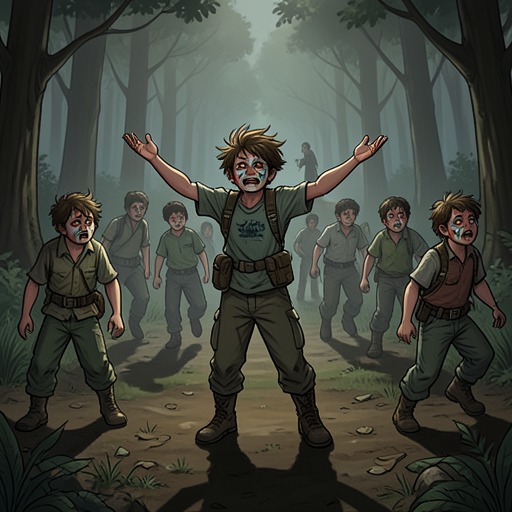
Later, Jack and painted hunters rush out of the forest to Ralph’s fire, seize half-burnt branches, and race away. Jack returns to announce that he and his hunters live by a flat rock on the beach, where they hunt, feast, and have fun; he invites the others to join his tribe, while making clear that admission is at his discretion. The mask is now part of a public performance of leadership. Behind its paint, Jack can look at the boys in turn without the shame or self-consciousness that had constrained him. His invitation joins the freedom of the disguise to the promise of food, hunting, and belonging.
At the feast, Jack sits above Ralph and Piggy, who remain standing on the sand below the seated boys. He offers food and protection from the beast as inducements to join his tribe. Ralph answers with the claims of his elected leadership, the signal fire, and the conch, but Jack dismisses the shell’s authority at this end of the island. The painted face accompanies a political contrast: Ralph appeals to obligations and shared procedures; Jack uses food, protection, and the spectacle of his hunters to gather followers. The mask is not the sole cause of this division, but it makes Jack’s new identity legible and reinforces the difference between the rival groups.
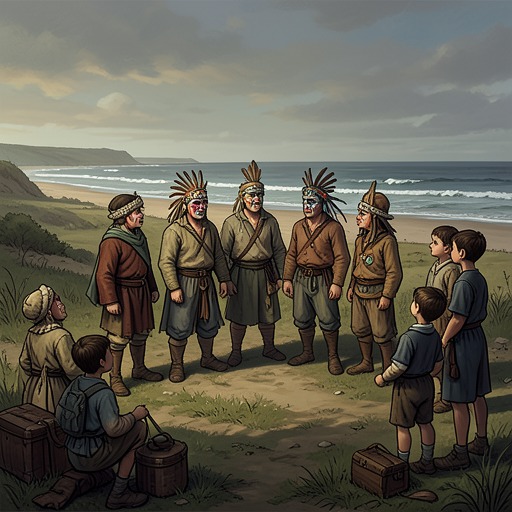
When Ralph’s party goes to Castle Rock to demand Piggy’s spectacles and speak about the signal fire, the guardians at the entrance are painted out of recognition. They carry spears and defend the narrow approach. Ralph repeatedly calls for an assembly, trying to invoke the old procedure, but the painted guards do not let his appeal restore the former order. Jack arrives in black and green paint, accompanied by hunters, and commands Sam and Eric to return to his tribe. When they do not obey, the group takes their spears and ties them up. Jack points to their submission as proof that the boys do what he wants. The mask now belongs to a collective display of force: it obscures individual identity while making the tribe’s obedience and power visible.
Refusal, Recognition, and Aftermath
Ralph and the twins refuse to paint themselves for the journey to Castle Rock. Ralph insists that they are not savages, even as Sam and Eric warn that Jack’s party will be painted and may not think much of them. Their choice makes the paint a contested boundary. Jack’s group uses it to claim the freedom and authority of hunters; Ralph treats refusing it as a way of holding to a different understanding of who they are. Yet he is entering a place where paint and armed guards already determine who controls the approach.
At the rescue, the officer finds a semicircle of boys painted with coloured clay, carrying sharpened sticks, while the island burns. Their painted appearance is the final public sign of how far the boys have moved from the ordered group that first assembled on the beach. The officer sees a scene he calls games and a war; Ralph, by contrast, breaks down in grief for what has happened. The paint’s meaning has therefore widened from camouflage to emblem: it first conceals a hunter, then helps stage a rival authority, and finally marks the transformed society encountered at the story’s end.