Fear of the Beast
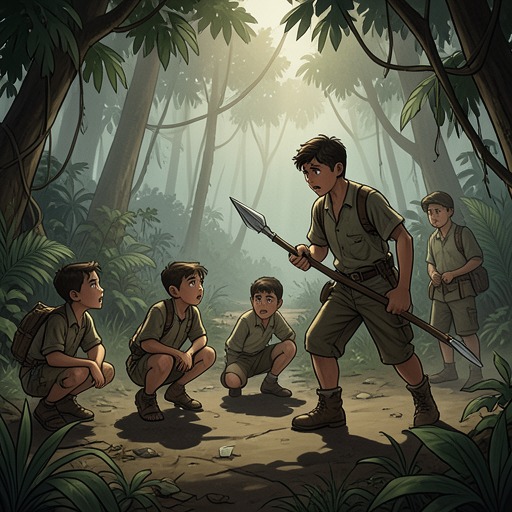
Lord of the FliesFear of the Beast is the growing anxiety that an unseen creature may inhabit The island. First expressed through The littluns’ nightmares and sightings in the dark, it becomes a test of the boys’ competing ideas about evidence, safety, and authority. Their inability to settle what the beast is matters as much as the imagined threat: fear unsettles meetings, competes with the work of rescue, and makes force seem like an answer.
Origins in an Uncertain Place
After exploring, Ralph tells the boys that The island is uninhabited: they have seen water all around but no houses, smoke, footprints, boats, or people. That apparent emptiness does not reassure everyone. With no grown-ups present, the boys must interpret their surroundings and manage their own safety. The prospect of rescue depends on keeping a signal fire alight, but the unknown landscape gives fearful thoughts room to grow alongside that practical duty.
The first reports take the form of nighttime disturbance rather than settled knowledge. Ralph tells Jack Merridew that The littluns talk and scream in their sleep, and Simon recalls that they fear a beastie or snake-like creature. Jack recognizes a related feeling from hunting alone: at times in the forest, he has felt as if something were behind him and he were being hunted. He dismisses the feeling as having no real cause, yet his own admission complicates the confident claim that fear belongs only to childish imagination. Even a hunter can experience the forest as threatening without being able to name a visible danger.
Reports, Reassurance, and Disagreement
At the assembly about fear, Jack rebukes The littluns for being frightened and argues that dreams cannot hurt them. He insists that no beast lives in the forest, reasoning that he has searched The island and would have seen one. Piggy likewise rejects the idea of a clawed animal and invokes a scientific understanding of the world. But his reasoning reaches a limit: he concedes that the boys may become frightened of people. The distinction between a beast and a human threat is present in the discussion before the boys can confront what it means.
Phil’s account gives the fear a specific, unsettling shape. He describes dreaming of fighting twisty things in the trees, waking outside the shelter in the dark, and then seeing something large and horrible moving among the trees. Ralph explains the sight as sleepwalking, but Phil insists that he was awake when he saw it. The assembly cannot verify either account. The details make the fear vivid while leaving its cause unresolved: the boys hear a sincere report, but neither the meeting nor the available evidence can establish what Phil saw.
The arguments widen beyond the forest. When Jack reports that Percival says the beast comes from the sea, Maurice invokes his father’s warning that the sea may contain enormous, still-unknown creatures. He says he does not believe in the beast, but also acknowledges that the boys cannot be certain of everything. Speculation about a sea creature prompts fresh argument rather than a shared conclusion. Ralph sees the debate as a loss of sanity: fear keeps returning in new forms just when he tries to make the assembly agree on practical priorities.
Fear and the Breakdown of Order
Simon’s tentative suggestion that there may be a beast provokes an angry reaction. He tries to express a more troubling possibility: that the source of danger may lie within the boys themselves. The assembly answers with ridicule and shouting, so his thought does not become a shared explanation. Fear is thus not only a subject the boys discuss; it also governs which ideas they will hear and whose words they will allow to carry weight.
The meeting’s disorder exposes the weakness of the rules. When Jack announces that the boys will hunt the beast if it exists, he turns the unknown into a target for collective action. Ralph insists that the rules matter, while Jack rejects their authority and claims the strength of the hunters. The assembly scatters amid mock-hunting, chanting, and real terror. Ralph hesitates to call the boys back with the conch: if they ignore it, he fears, they will abandon the fire and their hope of rescue. Fear has therefore begun to damage the very cooperation the boys need to stay safe.
The conflict also prepares the way for political division. Later, Jack presents the supposed beast as something he and the hunters have seen, and uses the failed encounter to attack Ralph’s leadership and the hunters’ courage. In the confrontation, fear is no longer merely a frightened child’s report; it becomes part of a struggle over who can claim knowledge and command the group. Jack’s growing emphasis on hunting offers action and protection where Ralph’s appeals to meetings and rules have failed to settle the boys’ anxieties.
From Imagined Beast to Human Danger
The boys’ later conduct gives Piggy’s fear of people a grim force. At Castle Rock, Ralph asks Jack’s tribe to return Piggy’s glasses and warns that without a proper signal fire they may wait years for a ship. The encounter turns coercive: Jack orders Sam and Eric seized and tied up, while the tribe’s obedience demonstrates how far authority has shifted from shared procedure toward command. The immediate threat in that scene is not a beast in the forest but the armed group confronting Ralph’s party.
The final pursuit of Ralph makes the reversal unmistakable. Wounded and fleeing through the forest, he runs from hunters whose cries follow him as fire spreads through the vegetation and sets a shelter alight. He emerges onto the beach and encounters a naval officer; the officer and the cutter interrupt the pursuit, while the smoke from the burning island has brought the rescuers. This scene does not confirm the monster the boys feared. Instead, it places human violence and the fire’s destruction before the reader as concrete dangers, while rescue arrives through an outside authority.
Fear of the Beast is therefore important both for what the boys imagine and for what that imagination does among them. The creature remains disputed, but the fear is consequential: it consumes attention, weakens agreement, and makes hunting and force attractive substitutes for uncertain discussion. The boys cannot establish what Phil saw, or reach consensus about the beast, before fear helps transform their society into the danger they had been trying to locate elsewhere.