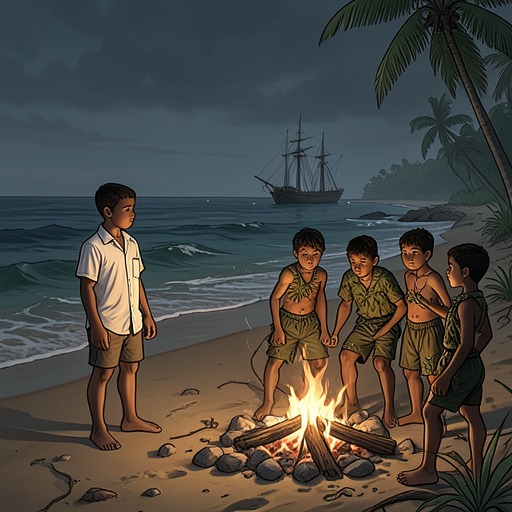
Henry
Lord of the FliesHenry is one of the younger boys on the island, a child whose brief appearances reveal both the ordinary concerns of childhood and the limits that still restrain the boys’ growing violence. He wants to go home, then becomes absorbed in controlling tiny creatures at the water’s edge. In the scene that follows, Roger targets him with stones but repeatedly throws wide: the space around Henry remains protected by the remembered authority of parents, school, and law.
Identity and Early Appearances
At the first assembly, Henry is among the boys whose names are being gathered. When the meeting turns to the problem of rescue, he says that he wants to go home. Ralph tells him to be quiet absently and moves on. The exchange is brief, but it places Henry among the children who depend on the older boys’ decisions while having little influence over them. His wish is direct and domestic: the island’s larger questions of leadership and rescue reach him as the simple fact of being away from home.
Henry later appears among The littluns, the youngest boys, who have built small sandcastles beside a river. He is the biggest of the three children playing there, with Percival and Johnny, and for a while he takes the lead. The castles are carefully surrounded by tracks, walls, and other marks meaningful at the children’s level. Henry’s importance in this scene is not political authority but a temporary, local leadership: he is the oldest of this small group, and the others are at peace while play holds their attention.
The narration also connects Henry to the boy with the mulberry-marked face who has not been seen since the first great fire. Henry is that child’s distant relative, but he is too young to understand the disappearance. The story suggests that even if someone told him the missing boy had gone home in an aircraft, he would accept the explanation without fuss. The contrast is stark: an event that carries grave consequences for the reader has not become a comprehensible loss to Henry. His limited understanding is presented as a fact of childhood, not as indifference.
Play at the Water’s Edge
After the other children’s game breaks up, Henry wanders along The beach, keeping away from the shade because he is too young to protect himself from the sun. He settles at the edge of The lagoon, where the incoming tide carries minute transparent creatures over the sand. Their almost invisible bodies move through the newly flooded shallows, and Henry watches them closely, poking among them with a piece of stick.
His play develops into an experiment in control. He makes little runnels for the tide to fill and tries to crowd the tiny creatures into them. As the water advances and retreats, his footprints form small bays in which the creatures are trapped. The action gives him an illusion of mastery: he talks to the creatures, urges them, and orders them, as if he can direct their movements. The detail makes Henry’s play more than idle distraction. He is testing what he can make the living world do, though the tide itself remains beyond his control.
The scene slows around this absorption. Henry is so focused on the creatures that he does not notice Roger at first. Even when stones begin plopping into the water, he sees only the widening rings and turns toward them too late to catch a stone in flight. When he finally sees one, he laughs and looks for the friend he supposes is teasing him. His response is trusting and playful; the threat is visible to the reader, not to him.
Roger and the Boundary of Violence
Roger follows Henry along the shore and watches him from behind a palm. He first throws a stone to miss, then gathers and throws more. The stones land around Henry, but Roger avoids a space about six yards across. The narration identifies that distance as the lingering taboo of the old life: the child is still, in effect, surrounded by the protections once supplied by parents, school, police, and law. Those institutions are absent from the island, yet their restraint has not entirely disappeared from Roger’s actions.
The contrast between the boys shapes the episode. Henry is intent on making the tide’s creatures obey; Roger, concealed nearby, has the power to frighten or injure him. But Roger does not yet aim directly at the child. Henry remains unaware of the danger and interprets the stones as a game, while Roger’s retreat behind the palm shows that he does not want to be seen. The scene thus gives the violence a boundary before it becomes open: the island has removed adult supervision, but the habits of civilization still exert force within the boys.
When Henry loses interest in the stones and wanders away, Roger’s pursuit ends without a confrontation between them. Henry has not understood that he was being tested as a target, and he leaves the episode as innocently as he entered it. The imbalance of awareness is central to the moment: what is ordinary play to Henry is an occasion for Roger to approach the edge of cruelty without fully crossing it.
Narrative Significance and Limits
Henry’s appearances are brief, but their placement links the children’s ordinary play to the novel’s changing moral landscape. At the assembly, his wish to go home is brushed aside by the demands of collective decision-making. At the shore, a child’s private game becomes the setting for Roger’s concealed aggression. The shift is not in Henry’s behavior so much as in what the surrounding world permits: his play continues under conditions in which the old protections are weakening.
Henry is not shown understanding the island’s political conflicts, the danger posed by Roger, or the significance of his relative’s disappearance. Nor do the scenes establish a distinct later action or individual fate for him. What they do establish is a child who can lead a small game, become absorbed in the minute life of the tide, and take an alarming sound for friendly teasing. The narration uses that limited perspective to expose the distance between childhood’s unguarded attention and the violence gathering around it.