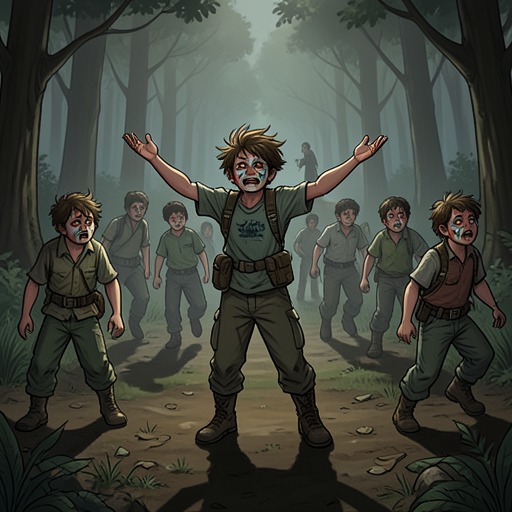
Jack Leaves Ralph and Forms a Rival Tribe
Lord of the FliesJack Leaves Ralph and Forms a Rival Tribe marks the collapse of the boys’ shared political order: Jack’s unsuccessful challenge to Ralph becomes a secession, and the promise of hunting and protection begins to replace common rules. The break is not a single change of leaders. It separates the boys around rival ideas of authority, duty, and fear, until Jack’s breakaway group is willing to use violence against Ralph and those who remain with him.
The contest beneath the rupture
Jack’s departure follows a conflict already present in the first election. He had claimed the chief’s role on the strength of being head boy and a leading chorister, but the boys chose Ralph, whose possession of The conch helped set him apart. Ralph then gave Jack command of the choir, which became the hunters. The arrangement offered Jack a recognized position within the new order, but it did not remove the difference between his hunting priorities and Ralph’s broader responsibilities.
The strain sharpened around work. While Ralph and Simon labored on shelters, Jack’s attention was absorbed by the hunt. He acknowledged that he had left other hunters to swim and described the drive to track and kill as difficult to resist; he expected the next attempt to bring meat. Ralph, by contrast, insisted that shelters mattered and worried that the boys were frightened. Their dispute was therefore more than a quarrel about effort: each treated a different need as urgent, and the group had no dependable way to make either obligation prevail.
The signal fire had already exposed the weakness of that arrangement. After it burned without producing the needed smoke, Ralph argued for assigned fire-watchers and for the rule that The conch should govern meetings even on The mountain. Jack publicly agreed to rules and took responsibility for dividing the hunters into fire-duty groups. That agreement, however, sat uneasily beside the hunters’ focus on meat and Jack’s growing investment in hunting. The secession makes plain how little formal agreement can accomplish when cooperation depends on people continuing to accept shared duties.
A failed vote and a public break
At the assembly where the separation begins, Jack takes The conch and announces that the boys have seen The beast. He uses the mountain expedition to attack Ralph’s fitness to lead, calling attention to Ralph’s retreat and presenting him as a coward and an ineffective hunter. Ralph disputes Jack’s account, including the claim that he stayed back; the argument becomes a contest over who has the right to define what happened as much as a contest over who should command.
Jack then asks the assembly to raise hands against Ralph’s leadership. No one does. The silence leaves Jack exposed before the boys he had expected to persuade. His face reddens, his grip on The conch shakes, and tears run down his cheeks. Rather than accept the result or continue the contest under the group’s procedure, he places The conch carefully in the grass and announces that he will no longer be part of Ralph’s group. He says he will go by himself and that anyone who wants to hunt with him can come.
The action changes the meaning of the meeting. The conch had made a challenge and a vote possible, but it cannot compel Jack to remain within the order that recognizes its authority. Jack runs from The platform into The forest, weeping as he goes. Ralph predicts that he will return when the sun goes down, while Piggy argues that the boys can manage without him. Their responses register the immediate uncertainty: the break has been declared, but its practical outcome is not yet settled.
Building a rival group
Jack’s first meeting with the former choir boys shows how he turns departure into leadership. He tells the small group that he will be chief, and they accept the proposal without the contested vote that had just ended in failure. He offers them hunting and says they will forget The beast. The promise meets their private fear with a firm instruction not to dwell on it, even though Jack does not claim that the threat has been disproved.
He also offers a feast and directs the boys away from The conch and the obligations associated with Ralph’s leadership. Jack’s group goes into The forest to hunt; finding a fresh pig track, Jack signals the hunters to move quietly and organizes their approach. He plans to leave some of the kill for The beast in the hope that it will not bother them. The proposed offering turns fear into part of the tribe’s hunting practice: rather than settle the question of The beast through shared discussion, Jack makes a bargain with it on behalf of his followers.
The breakaway’s appeal becomes more visible at a later feast. Jack sits above the boys as they eat and asks who will join his tribe, offering food and his hunters’ protection from The beast. Ralph objects that Jack has abandoned the signal fire, but Jack points out that Ralph has no conch with him and rejects the idea that its authority applies there. The exchange puts the division into practical terms: Jack can offer immediate food and protection, while Ralph invokes rescue and a rule whose force depends on the group’s continued consent.
From secession to open conflict
The separation does not make Ralph’s group disappear, nor does it restore cooperation between the two leaders. When The signal fire has been stolen, Ralph and Piggy discuss going to Jack’s group to demand Piggy’s glasses. Piggy intends to carry The conch as evidence that he is appealing to what is right, not asking for a favor. He knows Jack’s group is stronger and expects danger, but still treats the shell as a claim to a common standard. The plan shows how the old order persists as an ideal even after its authority has become precarious.
At Castle Rock, that ideal is confronted by the tribe’s physical power. Piggy raises The conch and argues for rules and rescue; Roger releases the great rock from above. The rock kills Piggy, and The conch shatters. Jack immediately declares himself chief and throws a spear at Ralph. The moment gives the earlier departure its stark consequence: the failed challenge to Ralph has become a rival command, and the symbol associated with assembly and shared speech is destroyed as Jack asserts rule through force.
The conflict continues as Jack’s group hunts Ralph through the burning forest. Ralph escapes the pursuit onto the beach, where a naval officer arrives after seeing the smoke. The boys’ rescue ends the immediate chase, but it does not undo the division that produced it. Jack’s secession has transformed a disagreement over work and leadership into a struggle in which protection, food, fear, and coercion are organized around a separate chief.