Jack’s first face-painting
Lord of the FliesJack Merridew’s first face-painting is a decisive transformation: camouflage becomes a mask through which he can act without shame or self-consciousness. The painted face excites him and unsettles those around him, giving visible form to the shift from choir leader and elected chief’s rival to hunter and tribal leader.
Background and Purpose
The painting follows a growing conflict over what the boys should do. While Ralph works with Simon on the shelters, Jack Merridew admits that he has left the other hunters to swim and continued tracking a pig alone. He describes the urge to follow and kill as a compulsion, and insists that the group needs meat; Ralph counters that the shelters are unfinished. Their disagreement exposes competing priorities: the labor of maintaining a place to live and the immediate excitement of the hunt.
Jack Merridew’s first stated purpose for the paint is practical concealment. At a small pool, he gathers Sam and Eric, Sam and Eric’s fellow hunters, and Roger; two large leaves hold white clay and red clay, and a stick of charcoal taken from the fire lies beside them. Jack Merridew explains that animals see him even when they cannot smell him, and compares the intended camouflage to the patterns of moths on a tree trunk. The materials are improvised, but the aim is deliberate: to make his face harder for prey to distinguish.
Making the Mask
Jack Merridew first smears on the clay, then wipes the attempt away with water, exposing his freckles and sandy eyebrows again. He works out a more striking design: one cheek and eye socket white, the other half red, with a black stroke of charcoal running from his right ear to his left jaw. He studies the pattern in the pool, but his breathing disturbs the reflection. When he asks Sam and Eric for an empty coconut shell and looks into the water again, he sees not merely his familiar features altered, but an unfamiliar figure.
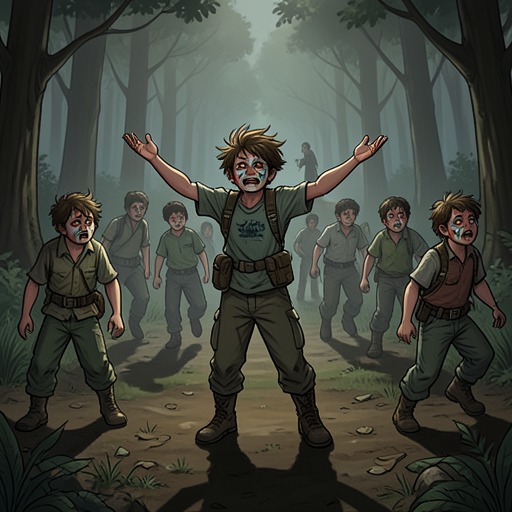
His response makes the change more than cosmetic. Jack Merridew spills the water, jumps up, and laughs; then he dances, and his laughter turns into a bloodthirsty snarl. The painted face seems to stand apart from him, while he hides behind it, released from shame and self-consciousness. Roger smiles at the spectacle, but the twins are hesitant, and Bill starts laughing before suddenly falling silent and blundering away through the bushes. The mask’s effect is thus both exhilarating and disquieting: it draws the others’ attention while changing the emotional tone of the group.
From Disguise to Authority
The painting immediately propels the hunters into action. Jack Merridew summons Sam and Eric to join the others, who are forming a line, and announces his intention to creep up and stab. The twins’ faltering protests do not stop him; the mask seems to compel them to follow. Camouflage has become more than a hunting tool. It gives Jack Merridew a face suited to the pursuit and a forceful image around which the hunters can gather.
The contrast with his earlier claim to leadership sharpens the episode’s significance. At the election, Jack Merridew had argued that his position as head boy and choir leader qualified him to be chief, but Ralph was chosen instead. The painted face offers a different basis for influence: not school office or formal selection, but hunting prowess, daring, and the capacity to draw others into action. Later, masked and armed, Jack Merridew invites boys to join his tribe, promising food and protection from the beast, while Ralph invokes his election, the signal fire, and the conch. Jack Merridew dismisses the conch’s authority at that end of the island. The mask is not the sole cause of the split, but the scene of its creation anticipates how hunting and the painted persona will lend his challenge a compelling public form.
Significance
The first face-painting makes an inward change visible. Jack Merridew’s hunger to hunt had already been growing, but the moment he sees the stranger in the pool marks a release from the restraints that had made him self-conscious. What begins as a practical attempt to evade prey becomes a persona associated with excitement, menace, and command. The face’s power lies in that double use: it conceals the hunter from the animal while enabling the boy to appear, to himself and the others, as someone newly capable of violence.