Masks and Face-Painting
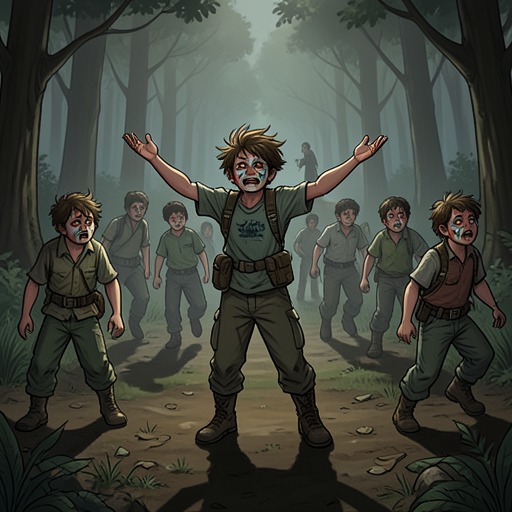
Lord of the FliesMasks and Face-Painting develop from a hunting disguise into a visible instrument of altered behavior and authority. When Jack Merridew paints his face, camouflage does more than hide him from prey: the reflection confronts him with an unfamiliar figure, and he responds with excitement, dance, and a bloodthirsty snarl. Later, wearing paint before his followers, he uses the authority of his tribe to contest Ralph’s claim to leadership. The mask thus links the physical act of disguise to the loosening of social restraint and the rise of a rival political order.
The Face as Hunting Camouflage
Jack Merridew experiments with face paint at a pool near the river, where Roger, Sam and Eric, and Bill are waiting. He explains that the paint is for hunting and compares its disruptive pattern to wartime dazzle paint and to creatures that blend into their surroundings. His materials are simple: white clay, red clay, and charcoal brought down from the fire. He wishes he had green as well, showing that he is thinking about how the colors will work against the forest.
The first attempt does not satisfy him. After smearing on clay, Jack Merridew washes his face with water, then applies white to one cheek and around one eye, red across the other half, and a black charcoal stroke from his right ear to his jaw. He studies his reflection in the pool, but his breathing disturbs the water. When he looks again, he is astonished by the stranger the pattern seems to present. The image is no longer simply his own face made less visible; it has become an arresting presence in its own right.
Transformation and the Group’s Response
Jack Merridew’s reaction marks the change from camouflage to mask. He spills the water, leaps up laughing, and dances; his laughter becomes a snarl as he capers toward Bill. The painted face seems to move independently, while Jack Merridew hides behind it, freed from shame and self-consciousness. The description makes disguise psychologically consequential: the new appearance changes not just how others might see him, but how he acts in front of them.
The others respond to that transformation. Bill starts laughing, then falls silent and blunders away through the bushes. Jack Merridew turns to Sam and Eric, who have been trying to protest, and orders them to come with him; when they hesitate, he presses them to join the hunt. The mask’s effect is conveyed through this change in the group’s conduct as well as through Jack Merridew’s own excitement. It makes his invitation to hunt feel urgent and compelling, even to followers who initially resist.
From Disguise to Leadership
The painted face later accompanies Jack Merridew’s challenge to Ralph’s leadership. In front of boys seated in rows, Jack Merridew stands with his spear and addresses them as the leader of his tribe. He offers food and protection from the beast, asking who will join him. Ralph reminds the group that he was chosen as chief and invokes the signal fire; Jack Merridew counters that Ralph has run after food too and points out that he has left the conch behind. He then declares that the conch does not count at this end of the island.
The contrast is sharp: Ralph appeals to election, the conch, and the shared duty of maintaining the fire, while Jack Merridew appears before an assembled group as a painted chief offering meat and protection. The paint is not the sole cause of the split, but it gives his rival authority a visible form. His earlier hunting disguise has become part of a public performance in which belonging, protection, and power are offered together.
Mask, Violence, and the Limits of Order
The face paint belongs to a wider pattern in which hunting begins to absorb the boys’ attention and compete with collective work. Jack Merridew admits that he has gone on after the other hunters returned because he thought he might kill. His insistence on meat stands against Ralph’s demand that the boys finish the shelters. The hunting mask gives this appetite a practical rationale, but its effect in the pool scene also shows how easily a functional disguise becomes a source of exhilaration and a means of gathering others into action.
The later mock hunt of Robert makes the danger of that gathering visible. The boys form a ring, seize Robert, and jab at him as the chant rises; Jack Merridew holds him by the hair and brandishes his knife, while Roger pushes to get closer. Ralph is also caught up in the violence, which ends with Robert hurt and the boys panting. The episode does not establish that paint is being worn in this scene, but it echoes the earlier movement from hunting play toward bloodlust. Across these moments, face paint is a concentrated image of a broader change: outward disguise can help loosen the restraints of ordinary identity, while the group’s excitement turns an individual performance into collective force.