Naval Officer Arrives to Take the Boys Away
Lord of the FliesThe rescue of the boys interrupts a hunt that has become an attempt to kill Ralph, and it ends their isolation through the very smoke that accompanies the island’s destruction. A naval officer arrives on the beach after spotting the fire, finds Ralph and the painted boys, and promises to take them away. The rescue restores the possibility of outside authority, but not the order or lives lost before it: Ralph breaks down as he recognizes how far the boys have fallen from their first efforts to live together.
From shared rules to a broken order
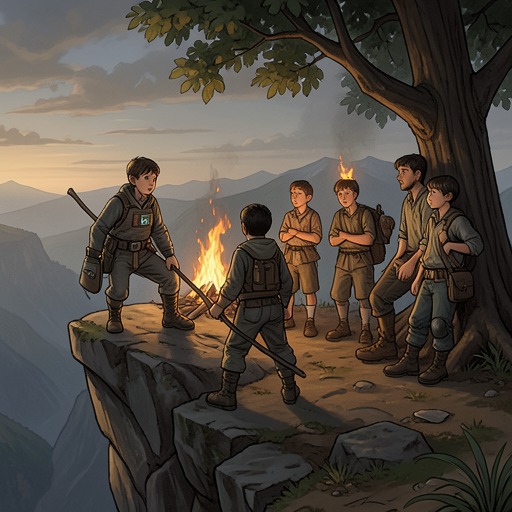
At the beginning, the boys face the absence of adults by trying to make decisions together. They elect Ralph as chief, while Jack Merridew’s choir becomes a group of hunters. Ralph proposes that the conch regulate who may speak, and he treats the signal fire as the means by which a passing ship might find them. These arrangements make authority depend on shared recognition: the chief is chosen, the shell gives a speaker a hearing, and the fire requires work from the boys who hope to be rescued.
The arrangements prove fragile. When the first great fire on the mountain dwindles, Piggy points out that flames alone do not make an effective signal and that the boys have not kept the fire properly. Ralph calls for designated fire-watchers, and Jack agrees to divide his hunters into groups responsible for maintaining it. Yet the duty is not sustained. Later, as fear of the beast overtakes the meeting, Jack rejects the authority of the rules and rallies the boys around hunting instead. The assembly breaks apart into a chanting, excited crowd; Ralph fears that calling them back may fail, while Piggy warns that a chief under Jack would mean hunting without a fire. The rescue will come through smoke, but not through the dependable signal system the boys once meant to maintain.
The final rupture before rescue
By the time Ralph reaches Castle Rock to demand the return of Piggy’s glasses, the contest between elected authority and coercive power has become lethal. Piggy appeals to the conch and argues for rules and rescue. Roger releases a boulder from above. It strikes Piggy, and the conch is shattered; Piggy falls to the rocks below and is carried away by the sea. Jack declares himself chief and throws a spear at Ralph, whose side is cut. Ralph escapes into the forest as Jack’s tribe advances.
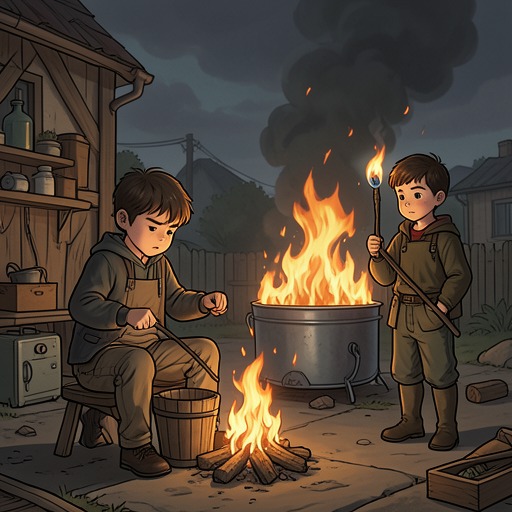
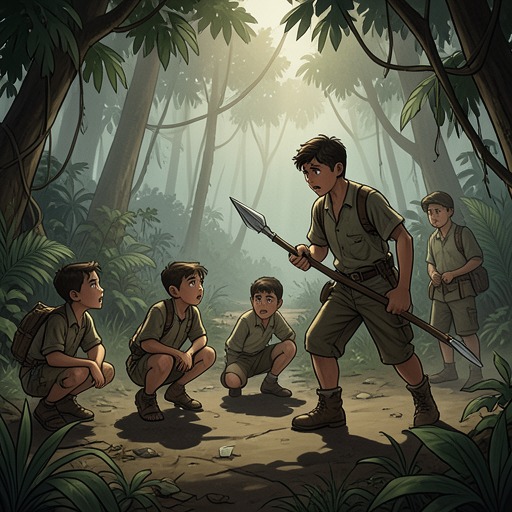
The island’s last chase turns the hunters’ violence against the place they occupy. Ralph hides in a thicket, holding a stake sharpened at both ends, while a hunter searches for him nearby. When Ralph breaks into the open, he runs as the others pursue him with cries and spears. The fire spreads through the forest and consumes a shelter; Ralph forgets his wounds, hunger, and thirst as he runs toward the beach. The hunters’ ululation presses close behind him, while flames race alongside his route. The blaze is no longer a controlled signal fire on the mountain, but it creates the smoke that draws attention from the sea.
The officer reaches the beach
Ralph rolls onto the warm sand and looks up at a naval officer in uniform, with a revolver at his side. A cutter has been hauled up on the beach, and a rating in its stern holds a sub-machine gun. As the officer questions Ralph, the ululation falters and stops. Behind Ralph, the fire reaches the coconut palms and engulfs them; flames also climb toward the platform, and smoke darkens the sky. The rescue arrives at the edge of a catastrophe the boys themselves have set in motion.
The officer asks whether there are any adults with Ralph and sees the painted boys standing in silence, their sticks still in their hands. At first he mistakes what he sees for a game and asks whether the boys have been having a war. Ralph nods. Asked whether anyone has been killed, he says that two have died and that their bodies are gone. The officer looks closely at him, then at the boys; the burning island behind them makes the scale of the disaster impossible to miss. The officer says that they will take the boys off the island, then asks how many there are. Ralph cannot say. The act of rescue has begun, though the scene does not follow the boys aboard or describe their journey away.
Ralph’s recognition and the ending
When the officer asks who is in charge, Ralph answers that he is. A boy wearing the remains of a black cap and carrying the remains of a pair of spectacles at his waist starts forward, then stops. The broken glasses recall Piggy, while Ralph’s answer asserts a position that the boys’ society has effectively destroyed. The officer’s questions make him confront the gulf between the organized group he remembers and the painted, silent crowd before him. Ralph begins to explain that they had been together at first, but cannot finish the thought.
The officer invokes the image of an orderly adventure, but Ralph looks back toward the island and remembers that Simon is dead and Jack has become part of the violence. He begins to sob, and the other boys start crying with him. The rescue therefore ends the immediate pursuit without erasing its cost. Ralph’s grief gathers the deaths, Piggy’s lost friendship, and the collapse of the boys’ innocence into the final image of the scene. The officer turns away to give them time, while the burning wreckage remains behind them and the cruiser waits offshore. The boys are to be taken from the island, but their return to adult authority begins amid mourning rather than triumph.