Piggy
Lord of the FliesPiggy is the island’s most persistent advocate for practical judgment, shared rules, and the possibility of rescue. Asthma and dependence on spectacles make him physically vulnerable, while other boys turn those vulnerabilities into grounds for ridicule and exclusion. Yet he repeatedly supplies the plans and clear-eyed warnings that Ralph’s leadership depends on. His death at Castle Rock, coinciding with the destruction of The conch, joins the loss of an individual voice to the annihilation of the boys’ public order.
Identity and First Encounters
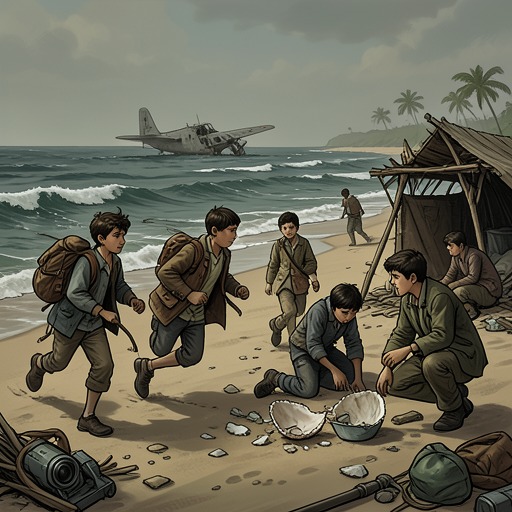
When Ralph meets him in the wreckage, Piggy explains that the plane was attacked and that he saw flames coming from another part of it. He reasons that the pilot cannot simply land on the island, and that the storm carried part of the aircraft out to sea. His account is an early counterweight to Ralph’s more hopeful assumption that the pilot will return. Piggy also gives concrete details about himself: his aunt has warned him not to run because of his asthma, and he has worn spectacles since he was three. He follows Ralph despite struggling to keep pace, then stops to wipe his glasses and adjust them.
Their first exchange establishes an unequal pattern. Piggy wants the boys’ names recorded and proposes a meeting, but Ralph initially ignores the suggestion. Piggy confides that children at school called him Piggy and asks that Ralph not repeat it. Ralph immediately turns the name into a joke, dancing and pretending to be a fighter plane while Piggy pleads with him to stop. Piggy nevertheless grins at receiving even this attention. The scene shows both the hurt caused by public mockery and his longing to be included; Ralph’s later disclosure of the nickname to the assembled boys makes Piggy the focus of collective laughter.
Piggy is also the first to recognize the shell in The lagoon as a conch and to see its practical use. He proposes that it could summon the scattered boys to a meeting, and explains how it must be blown. Because his aunt would not let him blow it on account of his asthma, Ralph performs the call. The distinction is telling: Piggy identifies the tool and its purpose, while Ralph becomes its audible representative. The conch’s authority will later help Ralph win the chief’s election, even though much of the useful reasoning behind the gathering has come from Piggy.
Practical Judgment and the Rescue Effort
Piggy’s central objective is to turn the boys’ survival into an organized effort rather than a sequence of impulses. He presses Ralph to find the others and make plans, and he is distressed by the prospect that they may remain on the island indefinitely. At the first assembly, he insists on taking names, but the children disperse before he can make a reliable list. When Ralph challenges him over the missing count, Piggy explains that he cannot identify everyone while the younger boys scatter into the sea and forest. His failure is logistical, not indifference: he is left to manage a task that the group will not help complete.
That same concern becomes urgent during the first forest fire. Piggy asks where the small boy with a mark on his face has gone and points out that he had been near the flames. The other boys fall silent; the burning trees continue to collapse around them, but no one can account for the child. The boy’s disappearance remains unresolved in these scenes. Piggy’s question, however, makes visible what the excitement of building a fire has obscured: the boys have created danger without keeping track of those most exposed to it.
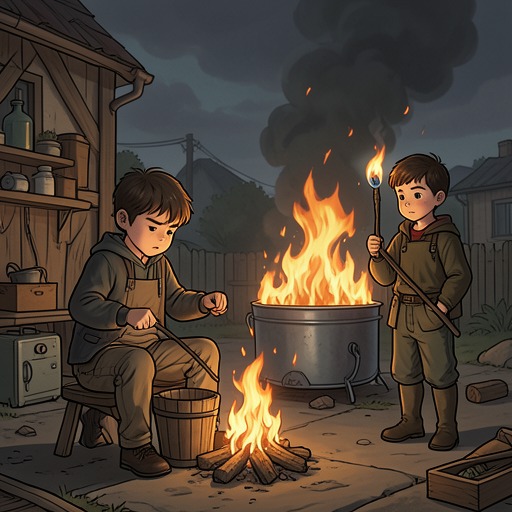
Piggy’s spectacles are essential to the practical work of rescue. Their lenses provide the means to kindle fire, while the fire itself is the smoke signal on which the boys’ chance of being seen depends. The object is therefore both an aid to Piggy’s sight and a resource the whole group needs. As order deteriorates, these functions become entangled: the boys who need the lenses take them from him, leaving Piggy with impaired vision and the group without a dependable signal. He continues to argue that rescue requires attention to the fire, even when hunting and immediate appetite command more interest.
Relationships, Authority, and Exclusion
Piggy’s relationship with Ralph develops from ignored advice into a form of trust. Ralph may be elected chief, but Piggy repeatedly helps articulate what the office ought to require: planning, attention to the younger boys, and maintenance of the rescue fire. Later, when Ralph fears that even he may stop caring about the signal, Piggy answers that they must carry on. Asked why things are breaking apart, he identifies Jack Merridew as the cause; Ralph accepts the judgment. The exchange gives Piggy a rare position not simply as Ralph’s adviser but as someone to whom Ralph can admit fear and uncertainty.
That reliance never removes the difference in their public standing. In the election, Ralph wins through the boys’ attraction to his appearance, composure, and association with The conch; Jack Merridew’s standing as head boy and chorister does not secure the wider vote. Piggy’s contribution is not similarly rewarded. When Ralph exposes Piggy’s school nickname, the assembled boys laugh together, and Piggy is briefly isolated from their fellowship. Later, at Jack Merridew’s feast, Ralph and Piggy remain standing on the lower sand while Jack sits above the gathered boys and invites them to join his tribe. Piggy is offered meat, but the division in status and authority remains unmistakable.
Jack Merridew’s conflict with Piggy sharpens as the common rules weaken. During the argument over the fire, Piggy tries to explain that he could not keep track of the scattered children alone and warns that the marked boy is missing. Jack silences him, and Piggy also complains that his spectacles have been taken. At Castle Rock, the rivalry becomes a direct contest between persuasion and coercion. Piggy asks for his glasses back not as a favor or a test of generosity, but as a matter of what is right. He acknowledges the difference in strength and sight between himself and Jack Merridew, yet insists that those differences do not cancel his claim. His appeal treats justice as binding even where power is unequal.
The Conch, the Glasses, and the Last Appeal
After the night raid leaves Piggy unable to see properly, he joins Ralph and the twins at The platform. He urges Ralph to call an assembly and takes The conch to speak. Piggy explains that he can no longer see and needs his glasses returned; he also affirms Ralph’s effectiveness as chief and asks him to address what has happened. Ralph, in turn, identifies the stolen fire as a threat to rescue and recalls that a passing ship was missed when the earlier signal failed. Piggy insists that discussion must lead to a decision, while his loss of sight makes his dependence on the others painfully concrete: he needs help finding food and must be led on the journey to Castle Rock.
Piggy nevertheless chooses to carry The conch into Jack Merridew’s stronghold. He imagines presenting it as proof that the boys must answer to fairness rather than strength, and agrees to go despite the danger. At Castle Rock he holds the shell aloft and tries to make the tribe listen. His appeal contrasts a society governed by rules and rescue with one organized around hunting and destruction. The tribe’s response is hostile, but for a moment Piggy’s claim to speak draws its curiosity; The conch still has enough authority to make the crowd pause.
Roger releases the great rock from above. It strikes Piggy, and The conch explodes into fragments. Piggy falls forty feet onto the red rock below; the sea washes his body away. The sequence makes his death more than the removal of an unpopular boy: the object through which he speaks and the person who has insisted on the force of rules are destroyed in the same instant. Jack Merridew immediately declares himself chief and turns on Ralph, while the remaining boys advance with spears. Piggy’s death thus marks the point at which argument and shared authority no longer have practical protection.
Narrative Role and Significance
Piggy’s spectacles and The conch connect individual vulnerability to collective survival. His glasses are indispensable to the signal fire but can be taken from the boy who needs them; The conch gives him a means to address the group but cannot shield him from the rock. In each case, a useful object becomes a measure of whether the boys will respect one another’s needs and limits. The failure is social as well as practical: the group takes what Piggy can provide while repeatedly discounting what he says.
His role is not simply that of a sensible observer opposed to every impulse. Piggy can be anxious, proud to receive recognition, and insistent on formal procedure; he depends on Ralph’s protection and sometimes cannot make himself heard. But his repeated attempts to account for the children, sustain the fire, and secure the return of his glasses give concrete form to the obligations the group abandons. By joining his death to the breaking of The conch, the narrative makes the end of Piggy’s claim to be heard inseparable from the end of the boys’ shared civic order.