Raid on Ralph's Camp for Fire
Lord of the FliesThe raid on Ralph’s camp for fire makes a practical necessity the prize in a struggle over leadership. Jack Merridew’s hunters take half-burnt branches from the fire that Ralph’s group needs to keep The signal fire alive; Jack then presents his breakaway tribe as a place to hunt, feast, and join on his terms. The theft leaves Ralph’s group facing not only the loss of fuel but the sharper question of whether its members will choose rescue or Jack’s rival community.
Background: Fire and the weakening of common rules
The fire’s importance had been made plain from the boys’ first efforts to signal for rescue. With no adults on The island, Ralph had argued that the boys needed hunters for meat as well as a fire that could attract a ship. When Piggy explained how his glasses could help kindle it, the fire became both a shared resource and a test of whether the boys could organize themselves. Ralph later insisted that designated watchers maintain it, since a ship might appear beyond the horizon at any time.
That common duty had become increasingly fragile. Ralph worried that the others did not understand the danger of letting the fire go out, and feared that he too might stop caring. In the discussion immediately preceding the raid, he and Piggy identify Jack as the force behind the group’s disintegration. The raid turns that growing division into a concrete act: Jack’s followers do not merely leave the old camp; they take away material needed for its central purpose.
The seizure of the fire
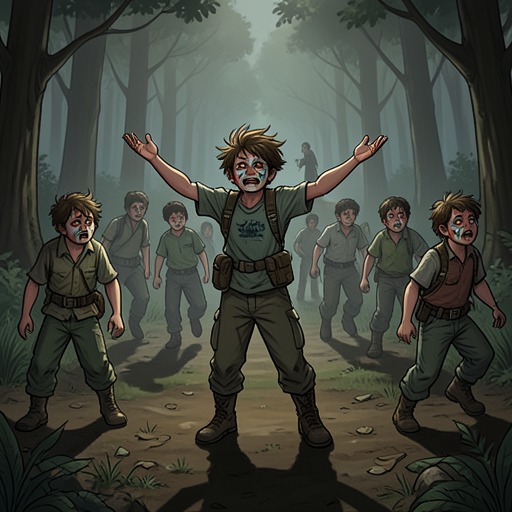
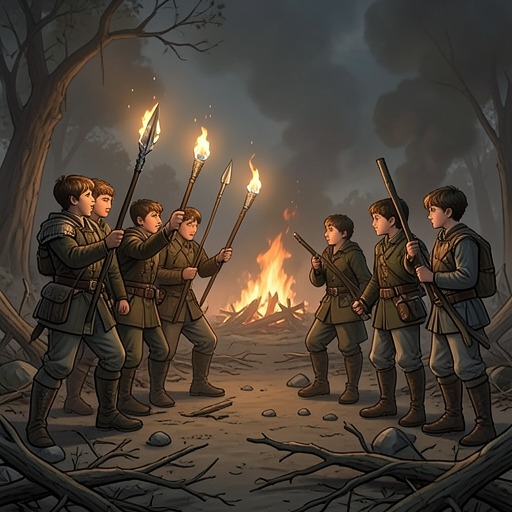
Painted figures rush out of The forest. Two seize half-burnt branches from beside Ralph’s fire and run along The beach, while Jack and the others remain to face Ralph. Jack, naked except for paint and a belt, announces that he and his hunters are living by a flat rock, where they hunt, feast, and have fun. He makes membership conditional, telling the boys that they may come to join him but that he may or may not accept them.
The branches give the announcement immediate force. Jack’s new group is not simply a proposal or a rival claim to authority: it has carried away fire from the place where Ralph’s party needs it. The raid also reveals that the breakaway group can act together outside the old assembly’s procedures. Ralph challenges Jack, but Jack ignores him and addresses the others as a separate audience.
An invitation backed by meat and authority
Jack’s offer is made more enticing by a specific promise: that night his group will hold a feast, and the boys can come because the hunters have killed a pig and have meat. The appeal joins food and excitement to the act of leaving Ralph’s group. Jack does not ask the boys to accept a rule or a shared duty; he offers a choice of belonging, with himself as the person who decides who may join.
Maurice and Robert accompany him as painted companions. When Jack urges them to speak, they declare in unison that the chief has spoken, giving his claim a small but unmistakable public ceremony. Their coordinated words make Jack’s authority sound established even as the three of them retreat. The episode thus shows the breakaway tribe acquiring both a place and a form of allegiance: a camp by The beach, an invitation to feast, and followers who publicly affirm their chief.
Reactions and consequences
Sam and Eric approach together in an awed whisper, admitting that they had been frightened. Piggy, still holding the conch, says that when he saw Jack he expected him to seize it too. That he does not take it matters: the shell remains with Ralph’s group, and the boys look at it with renewed respect. When Piggy carries it back to The platform, the youngest boys recognize the familiar object and begin to return. The raid has removed firewood, but it has not yet displaced every sign of the former order.
Ralph initially struggles to name what has happened. Once the group has reassembled, he realizes that the immediate issue is the fire: without smoke, they cannot be rescued. The contrast is the raid’s decisive consequence. Jack turns fire into fuel for his new group, while Ralph tries to restore its meaning as a collective signal. The stolen branches expose how far the boys’ common obligation has weakened, and make the competition between Jack’s tribe and Ralph’s party a contest over the practical means of survival as well as over who will lead.