Ralph
Lord of the FliesRalph’s leadership begins with a meeting and a shell, and ends amid fire, flight, and grief. Elected chief on the strength of his presence and his association with The conch, he tries to make the boys’ survival depend on shared rules and a maintained signal fire. His authority can give those principles a voice, but it cannot reliably make the boys act on them; as Jack Merridew’s hunting tribe gains power, Ralph’s project of rescue and cooperation is reduced to a defiant appeal and then a desperate struggle to survive.
Identity and Election
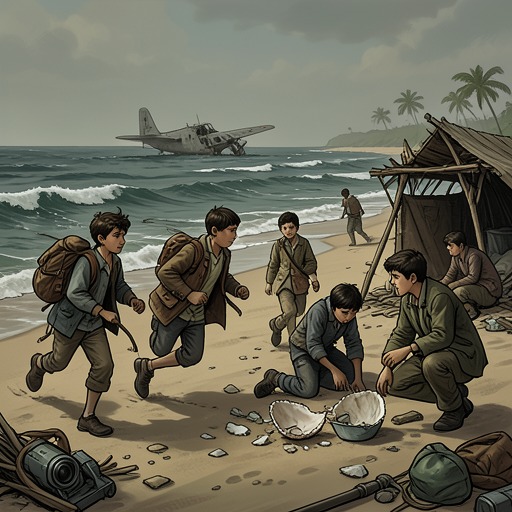
At the first assembly, Ralph takes part in establishing a society where the boys have no adults to direct them. Jack Merridew is the conspicuous rival: he claims leadership through his position as head boy and choir leader. Roger suggests a vote, but the gathering quickly turns to Ralph. His size and appearance distinguish him, while The conch he has blown and held gives him a particular association with the meeting and its authority. Even the choir boys, apart from their leader, vote for him; Piggy raises his hand grudgingly. Jack is mortified, but Ralph gives him charge of the choir, which becomes a group of hunters. The arrangement lets the election end without immediately stripping Jack of status, and the two boys initially smile at one another.
Ralph’s early conduct is not simply a performance of authority. When Jack calls Piggy Fatty, Ralph objects and announces Piggy’s name to the group, but that intervention also exposes Piggy to the crowd’s laughter. Piggy is left outside their shared amusement, bowing his head and cleaning his glasses. The episode gives an early measure of Ralph’s position: he can speak up for another boy, yet he does not prevent the group from making that boy an object of ridicule. At the same assembly, Piggy supplies much of the practical intelligence, while Ralph is chosen as the leader. Their different contributions—Piggy’s reasoning and Ralph’s public authority—remain important to the way Ralph tries to govern.
Building an Order Around Rescue
Ralph announces that the boys are on an uninhabited island after the expedition has seen water all around and no houses, smoke, footprints, boats, or people. Since there are no grown-ups, the boys must look after themselves. He proposes that only one person speak at a time, with The conch passed to the next speaker and protection from interruption, except by Ralph. The shell thus becomes both a practical meeting device and a visible sign of the order he wants the boys to accept.
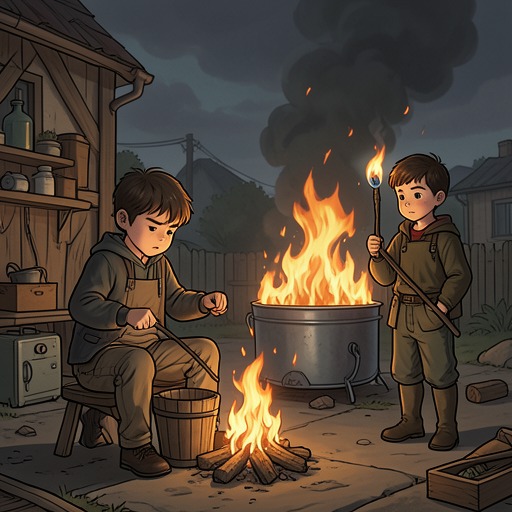
The first fire shows both the promise and weakness of that order. When the boys’ great blaze produces flame but no useful smoke, Ralph recognizes that its purpose is not simply to burn. He argues that a ship might be passing and that smoke could bring rescue, then proposes assigning particular boys to maintain the fire. He also insists that The conch’s authority applies on the mountain as well as at the meeting place. Jack initially agrees to rules and takes responsibility for dividing the hunters into groups to tend the fire, but the boys also decide it can be allowed to go out at night and restarted later. The decision exposes the gap between declaring a shared obligation and carrying it out consistently.
Ralph continues to treat rescue as the measure of the boys’ priorities. At a later assembly, he insists that smoke matters more than the meat the hunters bring back and argues that the fire must be kept on the mountain, where it can serve as a signal rather than becoming a series of scattered cooking fires. He connects this demand to the earlier danger of setting the island ablaze. His rules are not abstract: they respond to a missed chance of rescue, the risk of fire, and the practical need to keep the camp usable. Yet the assembly’s resistance, and the hunters’ laughter when he stresses the danger of letting the signal fail, show how little his office alone can secure agreement.
Conflict with Jack and the Erosion of Authority
The conflict is rooted in competing ideas of what the boys need. Ralph works with Simon on shelters while other boys leave to swim, play, or hunt. He reminds Jack that the shelters remain unfinished and that the hunters have already returned from the hunt, but Jack says he had to continue tracking a pig and believed he might kill. Ralph’s frustration is concrete: the boys need shelter, yet the work falls largely to him and Simon. Jack, meanwhile, is increasingly drawn to the hunt and promises to improve his spear. The dispute over labor becomes a contest over which activity deserves the boys’ loyalty.
The first painted face intensifies the difference. Jack uses clay and charcoal to make a hunting disguise, explaining it as camouflage. Looking at his reflection, he sees an unfamiliar figure and begins to dance and laugh; the mask frees him from shame and self-consciousness. Ralph is not shown adopting that disguise. The contrast matters because Jack’s new appearance helps him draw others into hunting, while Ralph continues to argue in the language of shared rules and rescue. Hunting also begins to shape Ralph himself. After he wounds a boar with his spear, he takes pride in the achievement and the respect it earns, even as Jack disputes what happened. At a later mock hunt, Ralph joins the boys as they surround Robert, first in play and then with enough force to make Robert cry out in real pain. Ralph is swept into the circle and joins the chant. The scene complicates any simple division between Ralph’s principles and the group’s violence: he resists the hunters’ priorities, but can also be carried along by their excitement.
At the assembly over ghosts and the beast, the difference becomes open defiance. Jack declares that the boys are strong and can hunt the beast, rejecting the force of rules; the assembly breaks apart into noise, mock hunting, and chanting. Ralph holds back from blowing the conch because he fears the boys may not return, leaving the group without even the appearance of a functioning meeting. He asks whether there are ghosts or beasts, and his uncertainty reveals that his commitment to rational order does not make him immune to fear. Piggy argues that Jack would have hunting but no fire, stating the practical consequence of Ralph’s alternative leadership.
When Jack establishes his tribe, Ralph tries to defend his legitimacy by recalling that he was chosen chief and that the boys had agreed to keep the fire going. At the feast, Jack invites the boys to join him, offering food and protection from the beast. Ralph points out that the conch has been left behind and insists that its authority should still count, but Jack rejects it as irrelevant at his end of the island. Ralph’s office, once confirmed by a vote and embodied in the shell, now lacks the obedience that made it effective.
The Stolen Glasses and the Last Appeal
After Jack’s group raids the camp and takes Piggy’s glasses, Ralph calls an assembly among those still with him. Piggy, unable to see properly, asks Ralph to speak and recalls that he voted for him because he was the one who got things done. Ralph’s account links the theft to the larger failure of the rescue effort: the signal is out, ships may be passing, and the boys who took fire could have asked for it rather than stealing. He proposes going to Jack’s group washed and with their hair brushed, to insist that rescue is not a game. His plan still appeals to the possibility that an orderly approach can make a difference, even though he knows the situation has become dangerous.
At Castle Rock, Ralph demands Piggy’s glasses and argues that a signal fire is the boys’ only hope of being noticed by a ship. He contrasts a visible smoke signal with the prospect of waiting years for a vessel to pass by chance. When he points out that the fire before them is only a cooking fire, Jack’s group does not accept the argument. The twins are seized and tied up, while Ralph’s appeal to The conch and to the original rules cannot prevent the violence. Piggy then raises the shell and asks whether it is better to have rules and agreement or to hunt and kill. As Roger releases the great rock, Ralph hears it before he sees it. The rock strikes Piggy and shatters The conch; Piggy falls to his death, and the shell’s destruction coincides with the final collapse of the authority Ralph has tried to preserve. Jack claims the position of chief and hurls a spear at Ralph, who is forced to flee.
Flight, Rescue, and Meaning
Ralph’s final movement is a hunted one. Jack’s tribe pursues him through the forest, and the fire spreads until flames burst across his path and consume shelters. Driven out toward the beach, Ralph comes upon a naval officer and a cutter with ratings. The officer has seen the smoke and asks what the boys have been doing; Ralph can only acknowledge that it was like a war. The smoke that once represented a carefully tended hope of rescue now rises from the island’s destruction, but it is smoke all the same, and the officer has followed it.
When the officer asks who is in charge, Ralph says that he is. The claim recalls his election, but it no longer describes a society he can command: the boys are painted, armed with sticks, and gathered amid the burning island. Asked whether they have put up a better show, Ralph begins to answer that they were together at first, then stops. The thought of the island as it had once seemed, Simon’s death, and what has happened to Jack bring him to tears. The other boys begin to sob too. Ralph’s grief is not a victory speech or a return to the authority he possessed at the first assembly; it registers the loss of comrades, the failure of their common order, and the violence that rescue has interrupted rather than undone. His trajectory makes leadership inseparable from its limits: he can articulate what the boys need and keep faith with rescue, but neither election nor rules can by themselves restrain a group that has chosen force.