Ralph and Simon's Relationship
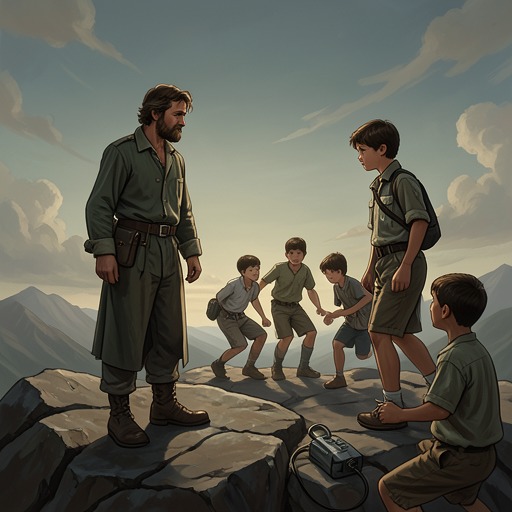
Lord of the FliesRalph and Simon's relationship is defined by a sharp contrast between Simon’s efforts to help the group understand what is happening and Ralph’s belated recognition of what the group has done. Simon turns toward Ralph’s community with proposals and a warning about the supposed beast, while Ralph’s most explicit response to Simon comes after his death, when he names the killing as murder. Their relationship thus becomes visible not through an extended private friendship, but through Simon’s concern for the others and Ralph’s distress at the consequences of their collective actions.
Unequal Visibility and Simon’s Proposal
At the assembly, Simon takes the conch from Piggy and attempts to speak. The circle’s half-jeering response makes him shrink, and the pressure of the meeting again takes his voice away. Nevertheless, he seeks Piggy’s sympathy and proposes that the boys climb to where they believe the beast is. His suggestion is not a bid for status: he is trying to find something the group can do when fear has left it uncertain and divided. Ralph addresses him by name and asks what he has to say, but the scene gives little evidence of private intimacy between them. Instead, it shows Simon trying to intervene in a community Ralph leads, with Ralph present as the person whose leadership and decisions shape the situation.
Piggy dismisses the proposal by pointing out that Ralph and the others have already gone looking without accomplishing anything. Simon answers quietly that he sees no alternative. He then lets Piggy take the conch and withdraws to the edge of the gathering. The exchange places Simon’s persistence beside his social isolation: he offers a course of action for the boys, yet the assembly’s response leaves him speaking in a whisper and sitting apart. His concern reaches beyond a simple exchange with Ralph, but it concerns the same danger Ralph’s group is struggling to manage.
Simon’s Understanding and the Threat to His Attachments
Later, alone, Simon faces the vision of the pig’s head, The Lord of the Flies. Its voice taunts him as foolish and insists that he is unwanted; it also names Ralph and Piggy among the boys who will harm him. In this encounter, the voice asks whether Simon likes Ralph, Piggy, and Jack Merridew. That claim comes from the threatening apparition, not from an ordinary conversation between Simon and Ralph. Its force lies in turning Simon’s ties to the others into a means of intimidation: the presence that speaks as The beast presents itself as inseparable from the human group Simon might hope to reach.
Simon answers the voice by identifying the object before him as a pig’s head on a stick. The vision insists that The beast is not something that can simply be hunted and killed, then warns Simon that he will meet it among the others. Simon loses consciousness before he can return to them. The scene makes a consequential distinction between the danger Simon understands and the danger the boys imagine: the apparition speaks of itself as part of Simon and threatens him through the names of the group, while Simon’s response recognizes the pig’s head as a physical object. The relationship with Ralph is therefore caught inside a wider crisis of knowledge and belonging: Simon has learned something that matters to Ralph’s group, but he is isolated from the people who need to hear it.
The Truth Simon Tries to Carry Back
When Simon reaches the mountain, he examines the lines and materials holding the parachutist’s body in place. The wind lifts the figure again, but he understands how its appearance has been made and sees that the supposed beast is harmless, though horrible. He recognizes that the others must hear this. From above, he sees smoke rising from a fire farther along the shore and realizes that the boys have moved away from the place where they had been. He starts down, but his legs give way and he can manage only a stagger.
This attempt to return with the truth is central to the relation’s stakes. Simon is not simply discovering an answer for himself; he wants to reach the others with news that could undo their fear. Yet the group has shifted, and his body cannot carry him quickly enough. The narrative gives no scene in which Ralph hears Simon explain what he found. Instead, Simon’s effort to reconnect with the community is interrupted before the message can arrive, leaving Ralph among those who do not understand the truth when Simon returns to them.
Ralph’s Recognition After Simon’s Death
When Ralph comes back to the platform, dirty, limping, and visibly injured, he asks whether Piggy is the only one there. After Piggy answers, Ralph says Simon’s name. Piggy gives a solemn nod. The spare exchange makes Simon’s absence immediately present: Ralph does not need to explain why the name matters, and Piggy’s response confirms that both boys know the subject is death.
Ralph then takes up the conch and asks what they are going to do. When Piggy suggests calling an assembly, Ralph laughs sharply; Piggy reminds him that he is still chief. The exchange places Ralph’s former authority beside the collapse of the order that authority was supposed to sustain. Ralph returns to Simon’s death and says, “That was murder.” Piggy protests and tries to explain the killing through the darkness, storm, and fear surrounding the dance. Ralph refuses that explanation. He reminds Piggy that Piggy stood outside the circle and did not see what they did. His insistence marks a change from confusion to moral recognition: fear may describe the circumstances, but, for Ralph, it does not erase responsibility.
Grief and the Meaning of the Bond
At the arrival of the naval officer, Ralph is asked whether anyone has been killed. He confirms that two have died. When the officer remarks on the boys’ condition and evokes the kind of adventure story the group might once have resembled, Ralph briefly recalls the island’s earlier glamour. That image gives way to the knowledge that Simon is dead and that the boys’ world has been transformed by what they have done. Ralph begins to sob, and the other boys join him.
The closing grief does not make Simon and Ralph’s relationship a conventional friendship, nor does the evidence establish that the two shared an extensive private life. It does show that Simon’s death has become one of the facts through which Ralph understands the loss of innocence and the darkness of human conduct. Simon had tried to carry the truth back to the group; Ralph, too late to receive it from him, becomes the one who calls the death murder. Their relationship is completed by that recognition: Simon’s concern for the others is answered, after his death, by Ralph’s refusal to let fear turn the killing into something harmless or accidental.