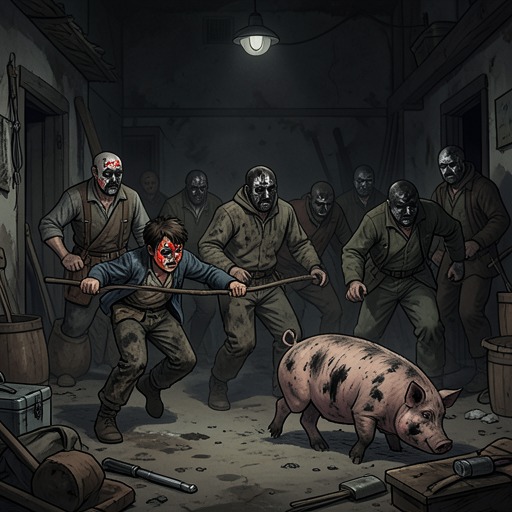
Ralph wounds a boar
Lord of the FliesRalph’s encounter with a boar marks his first tangible success as a hunter: when the animal charges down a pig track, he throws his wooden spear and strikes its snout. The boar veers into cover rather than falling, but the brief wound gives Ralph a new claim to the hunters’ respect—and sharpens his rivalry with Jack Merridew over what counts as courage and competence.
The Encounter on the Hunt
The boar bursts along the pig track as the boys scatter into the creepers. Ralph sees Jack Merridew nudged aside and fall, then measures the charging animal’s distance. At about five yards, he throws the wooden stick he is carrying. It hits the boar’s snout and hangs there briefly; the animal squeals, swerves off the track, and escapes into the undergrowth. Ralph has acted decisively, but the group has not killed its quarry.
When the boys regroup in an open space by the sea, Ralph repeats that he hit the boar and seeks confirmation that the others saw it. Maurice verifies the strike, and Ralph takes visible pleasure in the attention and respect his action earns. Jack Merridew counters that the animal was only a boar and challenges Ralph for throwing instead of waiting to seize it. His own forearm bears a bloody rip from the boar’s tusks; Simon observes that it is a wound and advises him to suck it. The encounter thus gives Ralph a real, if limited, hunting achievement, while Jack’s injury and criticism keep the contest between them unresolved.
Hunting, Authority, and the Mock Hunt
The boar encounter belongs to a wider contest over what the boys should do to survive. At an early assembly, Jack Merridew argues that they need hunters to provide meat, while Ralph also insists on maintaining a signal fire so that a passing ship might rescue them. The two duties briefly appear compatible: Jack even offers to divide the choir into groups responsible for the fire. Later, however, he rejects the rules Ralph invokes and declares that the boys will hunt if there is a beast. Against that shift, Ralph’s strike at the boar is more than a private feat: it gives him direct experience of the pursuit that Jack presents as the basis of his own authority.
The hunt’s excitement soon spills into a mock attack on Robert. As the boys form a ring and Robert first imitates a pig, their play turns painful: he cries out that they are hurting him, but Ralph, caught up in the surge, takes Eric’s spear and jabs at him. Jack holds Robert by the hair and raises his knife, while Roger pushes toward the center. The boys end the episode panting around Robert’s frightened attempts to recover his composure. Set beside the real boar hunt, the scene shows how hunting can move from a practical pursuit of food to collective violence—and how Ralph, despite his commitment to rules and rescue, is drawn into its excitement.
The Boar and the Beast
Ralph’s excited suggestion that the boar might be the beast is corrected by Jack Merridew: it was an animal they could pursue, not proof that the island’s feared creature had been found. The distinction becomes more consequential as fear grows. At a later assembly, Simon tentatively suggests that the beast might come from within the boys themselves, but the crowd’s laughter overwhelms his attempt to explain. Alone with the sow’s head offered to the beast, Simon encounters The Lord of the Flies, which insists that the beast is not something the boys can hunt and kill and identifies it as part of them. Read against that recognition, Ralph’s wound to the boar is a genuine but limited achievement: a spear can strike an animal, yet physical hunting cannot settle the deeper fear that has gathered around the name of the beast.
From Hunter to Quarry
The boar scene is framed by a sharp break from Ralph’s remembered childhood home: snow settling over the ground, a bright copper kettle, and familiar books beside the bed. That ordered domestic world gives way to the pig track, where danger is measured at close range and answered with a thrown stick. The contrast makes the encounter more than a test of aim: it places Ralph’s remembered security beside the island’s abrupt physical peril, where competence is proved in the moment rather than guaranteed by the old world.
Later, the roles reverse. Jack Merridew’s tribe pursues Ralph through the forest, and the island fire races after him until he reaches the open beach, where a naval officer appears. The earlier boar hunt does not cause this pursuit, but the parallel gives Ralph’s brief participation in hunting a stark afterimage: the boy who once faced a charging animal becomes the quarry of other boys. Smoke from the burning island brings the officer to shore, turning the destructive fire into the means of rescue.