Ralph–Jack rivalry
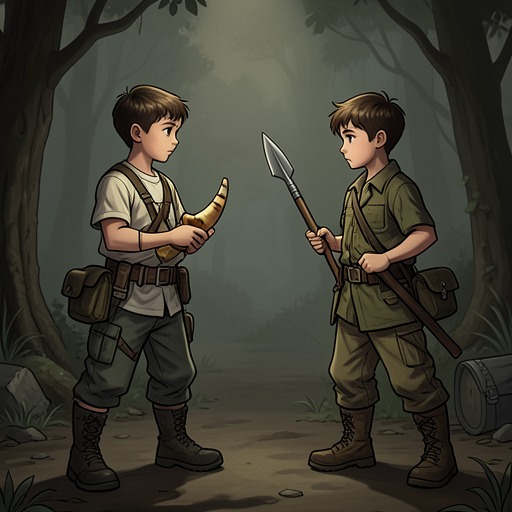
Lord of the FliesRalph–Jack rivalry begins with an election that briefly makes cooperation possible, then develops into a contest between two forms of leadership. Ralph’s claim rests on being chosen and on keeping the boys oriented toward rescue; Jack increasingly commands through hunting, food, and the promise of protection. Their conflict is not a simple opposition between an untouched civilized leader and a wholly separate hunter: Ralph is drawn into the hunt’s excitement, while Jack can acknowledge obligations to the group. The rivalry turns on which desire—the hope of rescue or the immediate pull of hunting—will organize life on The island.
Election and Uneasy Alliance
At the first assembly, Jack presents himself as the natural choice because he is head boy and a choir leader, and even boasts that he can sing C sharp. When Roger proposes a vote, however, the boys acclaim Ralph. Ralph’s size and appearance contribute to the choice, but so does his association with The conch: he had blown it and waited on the platform, giving him a visible connection to the assembly’s order. The choir members vote for Jack; every boy outside the choir raises a hand for Ralph except Piggy, who raises his grudgingly after the others. Ralph counts the votes and declares himself chief.
The result humiliates Jack, whose freckles disappear beneath a blush, but Ralph immediately offers him authority over the choir. Jack chooses to make them hunters. The concession turns a threatened defeat into an initial division of responsibilities: Ralph is chief, while Jack leads the group that can provide meat. The boys smile at each other with shy liking, and their alliance begins in something more complicated than open hostility. Jack also says he had tried to cross the hill to determine whether water surrounded them, but The conch called him back. Even at this early stage, exploration and assembly pull against one another, though neither boy has yet abandoned the shared purpose of finding out where they are.
Work, Hunting, and the Missed Ship
The division of responsibilities becomes a source of resentment as the shelters remain unfinished. Ralph says that only two are standing and one is already a ruin, and that he and Simon have done most of the work. Jack replies that he and his hunters have been excepted from shelter-building. He admits that he continued tracking a pig after the other hunters returned, describing the possibility of killing it as a powerful pull. Ralph answers that the hunters have not yet brought back meat and that the shelters are needed; Jack insists that meat is what they want and promises to improve his spear with a barb.
Their disagreement sharpens because each sees the other’s priority as a failure of leadership. Ralph points out that the others have gone swimming instead of working and emphasizes the boys’ need for shelters and rescue. Jack treats hunting as both practical provision and compelling pursuit. When Ralph spots the smoke and thinks of a ship, Jack instead imagines hunters concealed on high ground and proposes painting their faces so they can approach unseen. Ralph’s anger breaks into the open: he has been working with Simon while Jack talks about pigs and fails to notice the shelters. They race along the beach, and their competing accounts of what matters leave them unable to communicate.
The cost of that divide becomes undeniable after Jack’s first successful hunt. He returns exhilarated, describing how the hunters encircled and killed a pig; Ralph answers that Jack let the signal fire go out. A ship had passed while the fire was unlit, and Ralph insists that they might have been seen and taken home. Jack has to face the consequence of having put the hunt ahead of the watch fire, while Ralph’s anger exposes how much of his authority depends on getting the others to sustain a rescue effort. Jack apologizes for the fire, but the hunters admire his apology and appear to regard Ralph as the one in the wrong. Ralph cannot accept that reversal: the fire is dead and the ship is gone, regardless of Jack’s manner.
The reconciliation is practical rather than secure. Ralph tells Jack to relight the fire, then takes Piggy’s glasses to do it. With The conch and the fire’s work momentarily shared, the boys gather around the flames and eat the pig. Yet Jack’s power over the meal also marks a division: he tells Piggy that he did not hunt, while Piggy points out that Ralph and Simon did not hunt either. The immediate pleasure of meat draws the group together, but the question of who has earned a place in Jack’s hunting world carries forward their struggle over authority and belonging.
Rules, Fear, and the Break in Authority
At the assembly about The beast, Ralph tries to keep discussion within the rules and centered on what the boys can know. Jack’s growing authority comes from a different offer: if The beast exists, the hunters will pursue it. As fear unsettles the meeting, Simon hesitantly suggests that perhaps the threat is “only us.” The assembly mocks and overwhelms him. Its disorder exposes the fragility of Ralph’s method: the conch can still be raised, but it cannot make the boys listen or reach agreement simply by being present.
The conflict becomes explicit when Ralph asks the assembly whether there may be ghosts. Piggy objects to the vote and invokes the abandoned duties of hunting and fire-watching. Jack turns the dispute into an attack on Ralph’s right to command, asking why being chosen should make any difference and mocking Ralph’s inability to hunt or sing. Ralph answers that he was chosen and insists that Piggy has The conch. Jack dismisses the rules and promises that the hunters will close in on The beast and beat it. His departure brings the assembly apart into shouting, excitement, and fear; Ralph hesitates to blow The conch again because, if the others refuse to return, the signal fire may not be kept going. The fear that has damaged orderly discussion is thus also an opening for Jack’s rival authority.
Ralph does not remain untouched by the culture Jack represents. During the mock hunt of Robert, the boys form a ring and jab at him while he first plays at fear and then cries out in real pain. Ralph joins in, swept up in the collective excitement, and afterward describes it as a game uneasily. Jack’s leadership of the circle and the ritual chant make hunting attractive even to the boy who argues most strongly for order and rescue. The scene complicates their rivalry: Ralph opposes Jack’s priorities, but the impulse to join the group’s violence is not confined to Jack or his followers.
Competing Claims to the Boys
At Jack’s feast, the rivalry becomes a direct contest for allegiance. Jack sits above the others and invites them to join his tribe, offering food, fun, and protection from The beast. Ralph answers that he is chief because the boys chose him and recalls the plan to keep the fire going. Jack counters that Ralph also ate the meat, then argues that The conch does not count at this end of The island because Ralph has left it behind. Ralph insists that it counts everywhere, but the boys’ attention and physical placement reveal the weakness of that claim: Jack’s followers are seated before him, while Ralph and Piggy stand lower on the sand.
Ralph tries to make the contrast concrete by asking about the fire and the shelters as a storm approaches. Jack instead calls the boys to dance. The threatened sky, the encircling bodies, and the chant draw Ralph and Piggy into the group’s movement; both find it reassuring to touch the boys who form a boundary around the terror. The episode shows how Jack’s appeal works through collective participation and immediate security, not argument alone. Ralph’s commitment to rescue has not disappeared, but in the charged gathering he too is absorbed into the ritual he cannot control.
The Rivalry’s Stakes
The two boys’ contest is sustained by incompatible measures of success. Ralph counts work completed, the smoke of the signal fire, obedience to a decision, and the possibility of returning home. Jack values the hunters’ skill, the kill, meat, and a following bound by shared excitement. Their early agreement depends on assigning hunting to Jack while Ralph presides; it breaks down when hunting consumes time needed for shelters and leaves the fire unattended. Later, Jack can offer a more immediate response to fear than Ralph’s rules can provide, while Ralph continues to treat election and The conch as grounds for legitimate authority.
By the time Piggy proposes carrying The conch to Jack and demanding the return of his glasses, Ralph agrees to go with him, but the plan itself shows how far the balance has shifted. Piggy expects Jack to be painted and fears what may follow; Ralph nonetheless agrees that they will go. Their rivalry has ceased to be a private disagreement between two leaders and has become a struggle over whether shared rules can still claim force in the face of Jack’s armed, hunting group. The supplied scenes leave that struggle unresolved, but establish its decisive stakes: rescue and collective order depend on cooperation, while Jack’s authority grows whenever immediate appetite, fear, or excitement pulls the boys away from them.