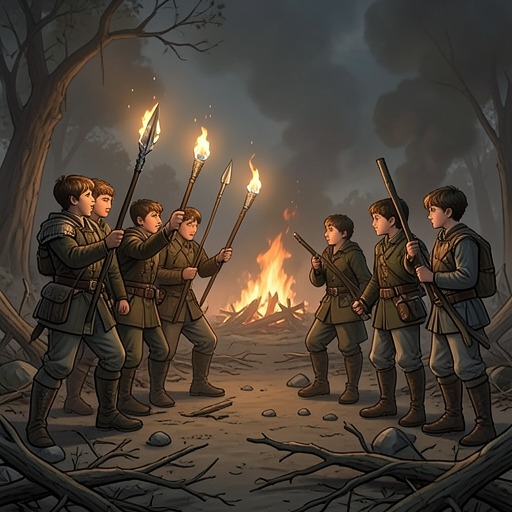
Ralph's Party Goes to Castle Rock to Demand the Glasses
Lord of the FliesRalph’s party’s journey to Castle Rock is a final attempt to recover Piggy’s glasses and defend the conditions for rescue. The expedition carries more than a demand for a stolen object: it tests whether the boys still recognize a common authority, or whether Jack’s power and the hunters’ force have displaced it.
Background and Stakes
Ralph’s claim to leadership began with an assembly and a vote, but the group’s order was never self-sustaining. With no adults on the island, the boys had to decide how to govern themselves. Ralph proposed rules for speaking and made The conch the visible means of holding the floor; Jack, meanwhile, argued for hunters and the meat they might provide. When the boys discovered that the island was uninhabited, the signal fire became their practical hope of attracting a passing ship. Keeping it lit required cooperation between Ralph’s rescue plan and Jack’s hunters.
That cooperation had already failed. At the mountain fire, Jack accepted responsibility for organizing hunters to maintain the signal, but the boys’ attention to hunting and their growing disregard for Ralph’s priorities helped leave the fire unattended. Later, Jack’s group took Piggy’s glasses in a night raid. The theft left Piggy with severely impaired sight and deprived Ralph’s party of the means to make fire. By dawn, Ralph could find no spark in the ashes; the group’s immediate problem was therefore bound to the larger one. Without the glasses, they could not readily relight the fire, and without a visible signal they might wait indefinitely for rescue.
At the small assembly that followed, Piggy insisted that the group decide what to do and recalled that he had voted for Ralph as chief. Ralph, angry that Jack’s party had taken both the fire and the glasses, considered going to Castle Rock looking presentable, as if their appearance might reaffirm that they were not savages. The plan was not simply to negotiate over property: Piggy meant to appeal to what was right, while Ralph intended to insist that rescue depended on maintaining smoke. Sam and Eric joined them, and the four set out carrying spears and The conch, hoping that an appeal to shared rules might still be heard.
The Approach and First Confrontation
The four crossed the beach in a compact group, with Ralph in front, the twins behind, and Piggy between the trailing ends of their spears. He held The conch carefully in both hands and could make out the moving spear butts by looking down and shielding his tired eyes from the sun. The beach had been swept clean after the storm; when they passed the place where the hunters had danced, the charred sticks remained on the rocks, but the sand beside the water was smooth again. Their silence made the journey feel less like a routine visit than a passage toward the conflict they expected at Castle Rock.
Castle Rock’s entrance was a narrow neck beside a dense, nearly impassable tangle of stems and tall grass. Ralph recognized the crushed grass where he had previously explored, the ledge running along the rock, and the red pinnacles above it. Sam noticed a small thread of smoke beyond the rock. Ralph did not treat it as the rescue signal he wanted: he called it a fire of uncertain purpose and moved toward the entrance, directing the twins to follow and keep their spears ready, with Piggy just behind him. The sea could be heard beside the narrow approach; when Ralph kicked a stone, it bounded into the water, and the receding tide exposed a red, weed-covered square far below. Piggy, unable to see clearly through the bright haze, asked whether the way was safe and stayed close to Ralph.
A shout and answering war cry came from the pinnacles, followed by voices behind the rock. Ralph told Piggy to give him The conch and remain still, then blew it toward the guarded entrance. Painted hunters appeared along the ledge with spears, while Roger watched from above. Ralph identified himself and announced that he was calling an assembly. The announcement invoked the old procedure, but the boys guarding the neck did not move aside. Ralph advanced only a couple of steps, then told Piggy to kneel and wait while he faced them; the shell could still summon the idea of a meeting, but it no longer compelled the group to obey.
Roger leaned out to watch, and the hunters sniggered as one gestured at Ralph with a spear. He repeated that he was calling an assembly, then asked where Jack was. A painted boy, speaking in Robert’s voice, said Jack was hunting and had ordered them not to let Ralph’s party in. Ralph explained that he had come about the fire and Piggy’s glasses. Laughter spread among the guards. At that moment the twins darted between Ralph and the entrance, and Jack emerged from the forest with two hunters at his sides, all three masked in black and green. Behind them lay the headless, disembowelled body of a sow. Piggy clung to the rock above the sea, while the hunters’ amusement swelled into a jeer; the meeting Ralph had tried to call had become a standoff at the boundary of Jack’s territory.
The Demand and the Breaking Point
Jack Merridew ordered Ralph’s party to leave, claiming Castle Rock and its tribe as his own territory. Ralph answered that Jack’s hunters had taken Piggy’s glasses, and reminded him that the boys had elected Ralph chief. His appeal to the earlier vote collided with Jack’s insistence on possession: when Ralph said the hunters could have had fire if they had asked, he accused them of approaching like thieves. Piggy, still gripping the rock above the sea, cried out that Ralph should remember why they had come. The practical purpose of the expedition—recovering the glasses and securing fire—was already being overtaken by a struggle over whose claim carried authority.
Jack rushed at Ralph with his spear. Ralph turned aside the thrust and struck Jack across the ear with the butt of his own weapon. They faced each other at close quarters, then used their spears like swords rather than risk the lethal points. Jack’s blow slid down Ralph’s spear and landed painfully on his fingers. The two separated, breathing hard, and challenged one another without closing the distance again. Their restraint did not settle the dispute; it merely left the armed tribe watching as the encounter shifted between a personal duel and a confrontation between rival groups.
Piggy pulled Ralph back to their purpose. Ralph lowered his fighting stance and demanded the glasses, explaining that without them Piggy could not see. He then returned to the signal fire: smoke might catch the attention of a ship and bring rescue, whereas without a signal the boys might wait years for one to pass by chance. He pointed out that the thin smoke beyond the rock came from a cooking fire, not a maintained rescue signal. The distinction was concrete and urgent, but the painted hunters answered the warning with laughter. Ralph insisted that his small party could not keep the fire going alone; his explanation made cooperation necessary precisely when Jack’s group treated the argument as entertainment.
Jack turned from Ralph to command Sam and Eric to return to the tribe. Neither twin obeyed. Jack ordered the hunters to seize them, but they hesitated until he repeated the command. The group then moved nervously around the twins, took their spears, and knocked them down before tying them. Their awkward, excited obedience showed Jack’s power becoming visible in action: he could make the hunters carry out his orders even when the twins’ resistance and Ralph’s presence made the act uncomfortable. Jack pointed to the bound twins as proof that the others did what he wanted. Ralph, seeing them on the ground and the useless cooking smoke beyond the rock, lost his temper and charged Jack; Jack charged back. They struck one another and separated again, both furious, while the tribe’s shrill cheering turned the fight into a spectacle.
Piggy stepped forward with The conch. The cheering shifted to boos, but his raised shell briefly drew the hunters’ attention. He called them a crowd of children and challenged them to choose between rules and hunting, between agreement and killing, between law and rescue and the breaking of what held the group together. His appeal briefly produced silence, though the hunters’ attention was also colored by curiosity about what he would say. Roger, still above them by the lever, continued dropping stones; they fell near Ralph, and the threat from the rock overhead persisted even while Piggy spoke.
As Jack shouted and the tribe gathered into a solid, spear-bristling mass, Ralph and Piggy remained exposed at the narrow entrance. Piggy held The conch out before him as a sign of the order he was still asking the others to recognize. Roger leaned his weight onto the lever. Ralph heard the rock break loose before he saw it, felt the jolt through the ground, and threw himself flat as the great red stone bounded across the neck. It struck Piggy from chin to knee and shattered The conch into white fragments. Piggy was hurled from the ledge and fell onto the red rock in the sea below; when the water withdrew, his body was gone. The paired destruction was decisive: the boy who had argued for rules and the object through which those rules had been called were both removed from the scene, while the armed tribe remained in control.
Aftermath and Significance
With the shell shattered and Piggy gone, Jack announced that he was chief and hurled a spear at Ralph, cutting the skin over his ribs. The tribe advanced behind him, and Ralph fled through the forest while the twins remained among Jack’s hunters. The demand at Castle Rock had not recovered the glasses or restored the signal fire. Instead, the confrontation ended with Ralph driven from the rock, the twins captured, and Jack’s authority asserted through violence rather than a vote or a meeting. The destruction of The conch made that transfer brutally visible: the object Ralph had used to call assemblies no longer existed, and the hunters no longer needed to pretend that its rules could restrain them.
The rescue that Ralph had argued for at the entrance comes only after the conflict has widened into a hunt. As the boys pursue him, the forest fire spreads to the beach, where smoke draws a naval officer to shore. The smoke that brings the adults is not the carefully maintained signal Ralph had wanted the boys to preserve; it rises amid the island’s burning and Ralph’s attempted escape. The expedition’s defeat thus leads into a bitter reversal: the rescue hope that the hunters dismissed is eventually realized, but not through the shared order Ralph tried to defend. The same confrontation that ends the old assembly leaves Ralph exposed to the pursuit that carries him toward the officer and the end of the boys’ isolation.