Roger
Lord of the FliesRoger’s gradual release from restraint makes him one of the clearest measures of how the boys’ society changes: first he keeps apart and tests the boundaries of acceptable behavior, then he joins the hunters’ violence and wields power without explanation or remorse. His actions trace a chilling passage from concealed impulse to open authority.
Identity and Early Conduct
At the first assembly, Roger is a slight, furtive boy whom nobody knows. He keeps to himself with an intense air of avoidance and secrecy, gives his name, and falls silent again. When a vote for chief is proposed, he is the first to suggest it, helping turn the boys’ general desire for a leader into an election. The intervention is brief, but it places him at the edge of the group’s emerging political order: observant enough to recognize a way forward, without seeking attention for himself.
Roger’s reserve appears more ominous in his encounter with Henry on the beach. After watching the younger boy absorbed in controlling tiny sea creatures with a stick, Roger throws stones toward him, repeatedly aiming to miss. The stones land around Henry, but Roger does not cross the roughly six-yard space around him; the narrator identifies that boundary with the restraints of parents, school, policemen, and law. When Henry notices the splashes, Roger hides behind a palm bole. His conduct is neither an innocent game nor an open attack: he tests how far he can go while the old prohibitions still hold.
From Boundary Testing to Shared Violence
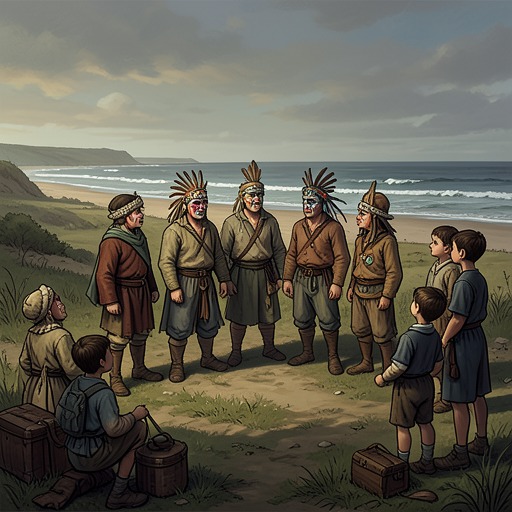
The next step in Roger’s change comes through Jack’s face-painting. Jack explains the disguise as camouflage for hunting, using white clay, red clay, and charcoal; Roger understands and nods. When Jack completes the stark pattern and sees an unfamiliar figure in the water, he dances and laughs, while Roger watches. The scene places Roger close to the mask’s first transformation of its wearer: the hunters’ paint makes violence easier to perform by hiding the face that would otherwise be recognized. Roger does not lead this ritual, but he joins the group it is gathering. Later, when Jack calls him to climb the mountain in search of the beast, Roger answers and sets out with Jack and Ralph. The other boys turn back, leaving this tense three-person expedition to ascend through darkness and ash.
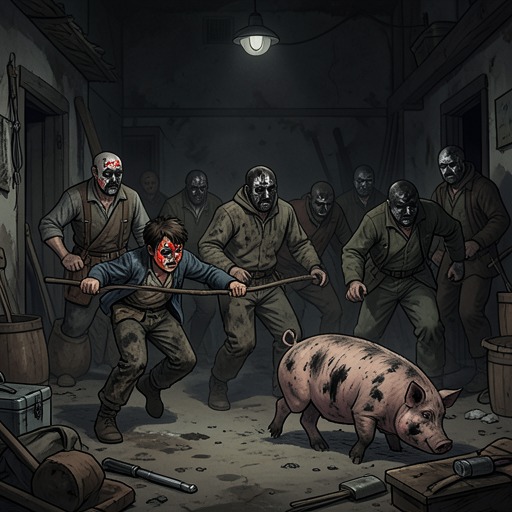
Roger’s participation in collective violence becomes unmistakable during the mock hunt of Robert. As the boys form a ring around him, Roger fights to get close; Ralph jabs at Robert with a spear, and the group’s game grows painful enough for Robert to cry out and struggle in real fear. The episode matters for Roger because it shows how readily play can become an occasion for bodily harm. Later, during the hunt for the sow, the change is no longer contained by the pretense of a game. Jack stabs downward with his knife while Roger finds a place for his spear and pushes with his whole weight, inch by inch, as the animal screams. The boys’ attack ends in the sow’s death, and Roger is among those who share in the killing’s excitement.
By the time Roger reaches Castle Rock, he has entered the tribe’s new structure of force. A sentry challenges him at the narrow approach, and Roger answers that he could not be stopped if he chose to come. Robert points out the log and lever set beneath a boulder, a device that could send it thundering down onto the neck of land. Roger admires the arrangement and learns that Jack has ordered Wilfred tied up and beaten without giving a reason. The news brings him to a still, absorbed realization of what authority without explanation can permit. He then climbs down to join the tribe, where Jack sits before the boys in face-paint and Wilfred remains nearby, newly beaten and untied. Roger is no longer merely testing the limits set by the old world; he is learning how to operate within a world where power itself supplies permission.
The Boulder and the End of Restraint
At Castle Rock, Roger’s capacity for violence becomes decisive. As Piggy raises the conch and tries to make the tribe hear an argument for rules and rescue, Roger remains above the confrontation with one hand on the lever. He has already been dropping stones toward Ralph and Piggy; now, in a state of delirious abandon, he puts his full weight on the mechanism. The boulder crashes across the narrow approach, strikes Piggy, and sends him falling to his death. The conch bursts into white fragments. Roger’s act destroys both a person and the visible emblem of the assembly’s authority, clearing the way for Jack Merridew to declare himself chief and turn the tribe against Ralph.
The aftermath shows that the violence has become a means of rule, not merely a sudden eruption. When Jack Merridew demands that Sam and Eric join the tribe, he prods Sam with a spear, but Roger advances on the twins with what the narration calls a nameless authority. Their earlier refusal to join has become helpless terror: they lie looking up as Roger approaches, while the group’s power is enforced through threat and submission. The boy who once threw stones only up to the boundary imposed by the old world now helps make fear itself an instrument of authority.
Narrative Significance
Roger’s arc is marked less by a stated motive than by the changing scale and consequence of his actions. At first, he throws stones close enough to disturb Henry but keeps his aim outside the space still protected by the rules of the old world. Later, at Castle Rock, the small projectiles he drops toward Ralph and Piggy give way to a boulder released with his full weight. The contrast makes the destruction of restraint visible: what began as a test of a boundary becomes an act with fatal consequences.
The narration also withholds the kind of explanation that might make Roger’s violence seem exceptional or momentary. He is repeatedly watchful and often silent; when he acts at Castle Rock, the scene presents force itself as sufficient. His advance on the captive twins after Piggy’s death extends that change beyond a single killing: menace now helps secure obedience. Through Roger, the boys’ breakdown of social limits takes bodily form, moving from hidden impulses to violence that openly enforces authority.