Royal Navy
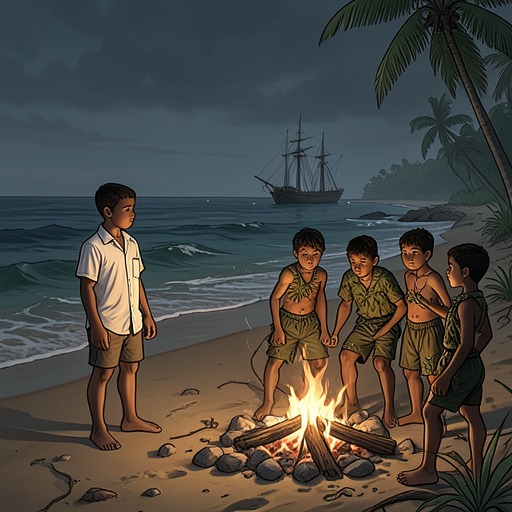
Lord of the FliesThe Royal Navy connects William Golding’s wartime experience with the novel’s fragile belief in adult protection. Golding served in the Navy during the Second World War, but within Lord of the Flies the institution is not an active rescue force: it survives chiefly in Ralph’s confidence that his father, a naval commander, will come for the stranded boys, a confidence confronted by the prospect that nuclear war has destroyed the world they expect to return to.
Golding’s Naval Service
Golding joined the Royal Navy in 1940 and saw action against battleships, submarines, and aircraft. He was present at the sinking of the Bismarck and ended the war as a lieutenant commanding a rocket ship. These biographical details establish a concrete connection between the author and the military world that the novel evokes; they do not, by themselves, establish a direct one-to-one correspondence between his service and any particular episode in the fiction.
The Navy as a Promise of Rescue
For Ralph, naval authority is first a reassuring family fact. In the lagoon, he tells Piggy that his father is a commander in the Navy and expects him to rescue them when he gets leave. His assurance rests on a recognizable chain of adult knowledge and action: someone at the airport will know where the boys are, and Ralph’s father will be able to find them. Piggy’s insistence that the pilot spoke of the atom bomb breaks that chain. If the adults are dead and nobody knows where the island is, the Navy cannot serve as the dependable route home that Ralph has imagined. The boys’ isolation is therefore not simply geographical; it is a collapse of the authority and communication systems on which rescue would depend.
The contrast returns as Ralph’s leadership weakens. He insists that the boys had agreed to keep the signal fire burning, while Jack Merridew draws them toward food, protection, and the pleasures of joining his tribe. Ralph’s appeal to the fire carries the hope that a ship may pass and that the outside world remains reachable. The naval rescue imagined at the beginning has no direct representative among the boys; its practical substitute is the signal they must maintain themselves, and their failure to do so makes Ralph’s promise increasingly precarious.
Wartime Language Recast on the Island
The Navy’s military context also meets the boys through Jack’s approach to hunting. As he paints his face with white clay, red clay, and charcoal, Jack explains the disguise through wartime dazzle camouflage and the way living things conceal themselves. The method is not a naval operation, but the comparison places military technique within the boys’ improvised pursuit of prey. Once the painted face becomes a mask, Jack’s self-consciousness gives way to excited aggression: a visual language associated with concealment and combat becomes part of the island’s hunting culture.
The contrast between Ralph and Jack sharpens during their dispute over work. Ralph presses for shelters and continued attention to the signal fire; Jack describes the compulsion to track and kill and argues that the hunters need meat. Their conflict is not a literal contest between the Navy and a rival force, but it sets rescue-oriented responsibility against a martial identity built around hunting. The organization itself remains offstage, while its images and expected authority are repurposed by boys whose society is coming apart.
Institutional Presence and Its Limits
The Royal Navy consequently occupies two different positions in the evidence. In Golding’s biography it is an actual wartime institution in which he served and held command. In the novel’s island episodes it is distant: Ralph invokes his father’s rank as a guarantee of rescue, while military imagery supplies Jack with a model for disguise and hunting. The boys do not receive help from the Navy during these scenes. Its importance lies instead in the gap between the orderly adult world Ralph expects and the abandoned conditions in which the boys must act for themselves.