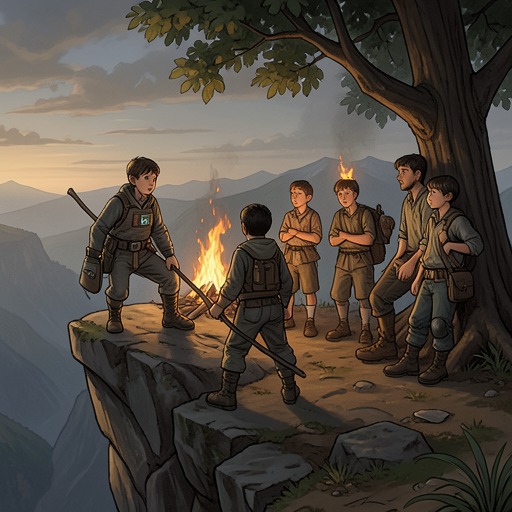
Signal-fire duty
Lord of the FliesSignal-fire duty is the collective responsibility to maintain a smoke signal that could lead rescuers to the boys. Its purpose is simple and urgent: while hunting can provide meat, only a visible signal offers a chance of leaving The island. The duty therefore tests whether the boys can preserve a common plan when immediate fear, exhaustion, and the appeal of hunting pull them in other directions. Its final reversal is stark: the fire that brings rescue is not a carefully maintained signal, but the blaze set during the hunt for Ralph.
Establishment and Purpose
At the first assembly, Ralph explains that the boys must look after themselves because there are no grown-ups. He identifies hunting as a way to obtain meat, but treats rescue as a separate need: the boys must keep a fire on The mountain in case a ship passes. This makes fire-keeping a public responsibility rather than a private convenience, and connects the boys’ daily labor to the possibility of returning home.
The first great effort exposes how difficult the task is. The boys pile wood into a towering blaze, but its height and heat do not make it an effective signal: there is flame, but no smoke. Piggy points out that they have not made a usable fire, and the boys are exhausted by the attempt. Simon notes that Piggy helped by lending his spectacles to start it. The difference between a spectacular fire and a functional signal becomes central to the duty: visibility and control matter more than sheer size.
Ralph responds by proposing that particular boys be responsible for watching the fire. Jack agrees to divide the choir into groups of hunters and assign them turns, with green branches to be added when a ship appears so that the smoke will thicken. The assembly accepts this arrangement. Jack also proposes letting the fire burn out for the night, on the grounds that smoke would not be seen in darkness and it could be relit in the morning. The plan gives the duty a schedule, but also establishes a vulnerability: its success depends on the boys actually returning to the task when the time comes.
Rules, Fear, and Competing Priorities
The duty is bound to the boys’ effort to make rules and hold orderly meetings. Ralph insists that a fire may be seen from the horizon and that a ship could appear at any time; he also argues that the conch should confer the right to speak wherever the boys meet, including on the mountain. The conch is thus associated with the authority to discuss and organize their common obligations. Jack initially endorses rules and the rescue signal, presenting the hunters as responsible for keeping the fire going. But agreement in assembly does not guarantee sustained cooperation.
As fear of the beast grows, the boys’ attention shifts from rescue to immediate safety. After Ralph, Jack, and Simon see what they take to be a large beast at the fire, Ralph doubts whether they can fight it and says they cannot keep the signal fire there. Piggy proposes a practical alternative: build a fire near the bathing-pool and the platform, away from the mountain. Ralph accepts, even though he recognizes that smoke from this lower position will be less visible. The relocation preserves the duty while conceding that fear has made its original location untenable. The boys gather nearby wood, much of it damp and rotten, and work with energy that increasingly carries a suggestion of panic.
The change also reflects a narrowing of the boys’ shared priorities. When Jack’s group raids the camp for fire, Ralph tries to recover the central point of the meeting: without smoke, they cannot be rescued. Yet the boys are drawn toward Jack’s feast and the attraction of meat and hunting. Ralph’s reminder that the fire is the most important thing does not settle the issue. The signal has to compete not only with fear of the beast but with the immediate rewards of the rival group.
Labor, Fatigue, and Breakdown
Once the fire is on the beach, keeping it alight remains difficult. Ralph and the others need to gather wood repeatedly, including rotten pieces from near the forest, and the fire consumes their labor quickly. Sam and Eric complain of tiredness; one twin says he cannot carry more, while Ralph struggles to restate why the work matters. Piggy supplies the answer: smoke is how they can be rescued. Ralph remembers that the boys cannot depend on radios or boats arriving by chance; they must make smoke themselves.
Night makes the strain more apparent. The boys estimate that two people would have to mind the fire for twelve hours a day, but they cannot gather more wood in darkness. Piggy suggests lighting it each morning, since nobody will see smoke at night. Ralph agrees to let it go out for that night. This is presented as a response to limited labor and visibility, not a rejection of rescue. Yet every interruption leaves the obligation more dependent on a renewed choice to resume it.
The collapse of the assemblies exposes the weakness of that arrangement. Jack declares that the rules do not matter and promises that the hunters will pursue the beast. Ralph insists that rules are all the boys have, but the meeting breaks apart into hunting cries, fear, and disorder. The conflict is not merely over who leads: it separates a long-term cooperative task from the immediate excitement and group solidarity of the hunt. Even when the boys understand the signal’s purpose, they no longer reliably act together to sustain it.
Failure and Ironical Fulfillment
The duty’s failure appears in small, material details: dwindling fuel, wet wood, exhausted boys, and the dark hours in which no smoke can be seen. Ralph repeatedly tries to bring their attention back to rescue, but the effort is undermined by fatigue and by the competing priorities of Jack’s hunters. Fire remains a shared necessity in principle, while the labor needed to preserve it becomes harder to secure in practice.
At the end, the rescue signal is fulfilled through a terrible reversal. Jack’s tribe hunts Ralph and sets the forest alight; the flames race toward the beach, consuming shelters and palms. Ralph, fleeing through the smoke and fire, reaches the open sand and encounters a naval officer. The officer explains that the ship’s party saw the smoke. The boys are rescued not because the community maintained its signal-fire duty, but because the violence intended to flush Ralph into the open creates a vast, visible blaze.
That ending completes the fire’s double meaning. Earlier, fire is a deliberate instrument of hope whose success depends on discipline and collective care. In the final pursuit, it is an uncontrolled weapon of destruction that nevertheless performs the signal’s function. The boys’ original plan is vindicated in outcome but not in practice: smoke does lead rescuers to The island, while the cooperative order meant to produce it has collapsed.