Simon Is Killed in the Dance
Lord of the FliesSimon’s death is the moment when the boys’ fear of an imagined beast becomes violence against a living person. He approaches the hunters’ ritual carrying the truth about the dead parachutist, but the storm and the crowd’s frenzy overwhelm recognition; after the killing, the tide bears his body away from the island.
Fear Before the Dance
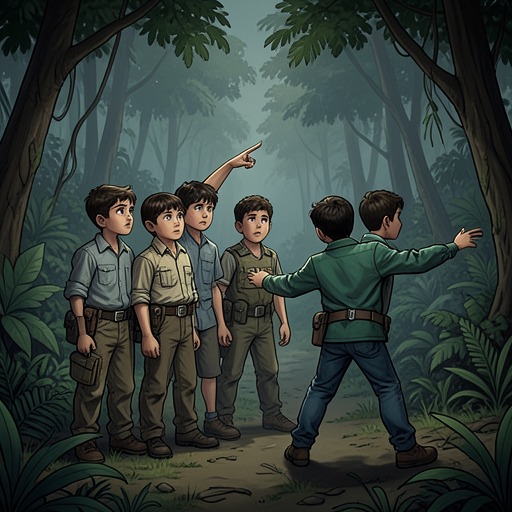
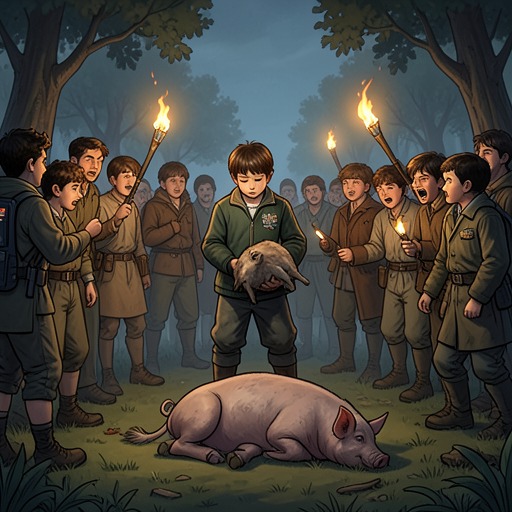
The killing is prepared by a fear that the boys repeatedly discuss but cannot settle. During an assembly, Simon hesitantly allows that there may be a beast, then struggles to express the more disturbing possibility that the threat comes from within human beings. His effort is met with interruption and laughter rather than understanding. The scene establishes the gap that will prove fatal: Simon has intuited something important, but the group has no shared language for hearing it. That insight becomes sharper after Jack’s hunters kill a sow and leave its head as an offering to the beast. Simon remains alone by the grisly gift while the others run toward the beach. In the ensuing vision, the Lord of the Flies tells him that the beast is not something the boys can hunt and kill, but part of them. Simon loses consciousness before he can carry this knowledge back to the others. The head’s revelation gives the coming encounter its tragic irony: the boy who recognizes the source of the fear will be attacked when he tries to speak against it. By then, Jack has broken from Ralph’s group and established a rival tribe. His hunters raid Ralph’s camp for burning branches, then invite the others to a feast where they can eat meat. Ralph and Piggy remain troubled by the dwindling signal fire, while the offer of food and the appeal of hunting pull the boys toward Jack. Simon’s private discovery therefore stands against a public order increasingly shaped by appetite, fear, and allegiance to the hunters.
The Dance and the Killing
As a storm gathers at the beach, Jack turns the boys’ unease into a ritual. He calls them to dance, and Roger first acts out the pig, charging at Jack while the hunters raise spears, the cooks take spits, and the others carry clubs of firewood. The littluns run and jump around the ring. Ralph and Piggy, though aligned with the signal fire and the rules it represents, find themselves drawn into the circle too: under the threatening sky, its enclosing bodies offer a momentary sense that terror can be contained. The chant, “Kill the beast! Cut his throat! Spill his blood!”, settles into a pulse. The boys’ repeated movement turns a performance of hunting into a collective physical intensity, while a second circle of littluns repeats the pattern beyond it.
Lightning splits the sky; thunder crashes, and the frightened littluns scatter. One breaks the ring, and a figure crawls out of the forest into the opening. Simon is trying to cry out about a dead man on a hill, but the storm makes his warning indistinguishable from the noise and the group’s expectation of a beast. The ring becomes a horseshoe around him. As the chant grows louder, the boys strike, bite, and tear at the person in their midst; Simon falls on his knees, arms folded over his face, and struggles forward through the blows before tumbling over the rock’s steep edge onto the sand. The crowd follows and continues attacking. The killing is not a deliberate decision made by one boy alone: fear, darkness, the storm, the hunting ritual, and the synchronized chant converge until the group treats Simon as the threat it has been rehearsing against.
Aftermath and the Tide
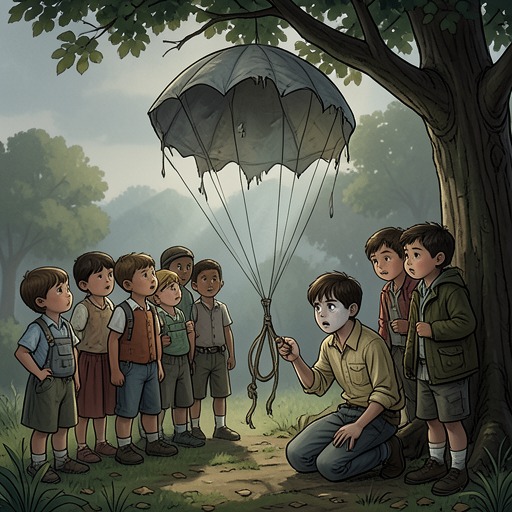
The storm breaks the crowd apart, but it does not undo what has happened. Simon lies still on the pale shore as the rain pours down from the mountain and the boys scatter. Above them, the parachute catches the wind: its dead passenger slides, rises, and spins through the wet air, brushes the treetops, then drifts over the lagoon, across the reef, and out to sea. The body that had been mistaken for the beast is carried away while Simon remains behind, his blood spreading inch by inch across the sand. The scene links the killing to the truth Simon had tried to bring back: the figure on the hill was a dead man, not a monster, but the boys’ frenzy has already made Simon another victim of their fear.
As the rain ceases and the night clears, the narration shifts from the boys’ panicked movement to the slow advance of the tide. Phosphorescent water gathers around the bloodstains; small bright creatures move at the edge of the shallows and surround Simon’s head. The tide lifts his body slightly, releases a bubble from his mouth, and turns him gently toward the open sea. His hair, cheek, and shoulder catch the water’s silvery light, transforming the aftermath into a quiet, almost ceremonial passage that sharply contrasts with the crowd’s blows, bites, and tearing. Nature neither explains nor repairs the murder: it carries Simon away from the shore and the society that killed him, while leaving the truth he discovered unheard.
From Frenzy to Command
The later confrontation at Castle Rock shows violence taking a more deliberate form. When Ralph and Piggy demand the return of Piggy’s glasses and appeal to the need for a signal fire, Jack Merridew orders Sam and Eric to be seized and tied. The tribe acts on his command; Jack then points to their obedience as proof of his authority, while Roger advances on the bound twins with a power the narration presents as nameless. This coercion differs from the storm-driven attack on Simon: the earlier crowd mistook a person for a beast, whereas here the violence is directed openly at captives who resist joining the tribe.
That contrast sharpens the significance of Simon’s death without suggesting that the boys understand what they have done. His attempt to bring back the truth about the figure on the hill ends in a killing, and the later scene offers no collective recognition or correction; instead, obedience and force have become instruments of rule. The distinction between a feared beast and human violence has collapsed not because the boys have identified the truth, but because their own actions increasingly make the human threat visible.