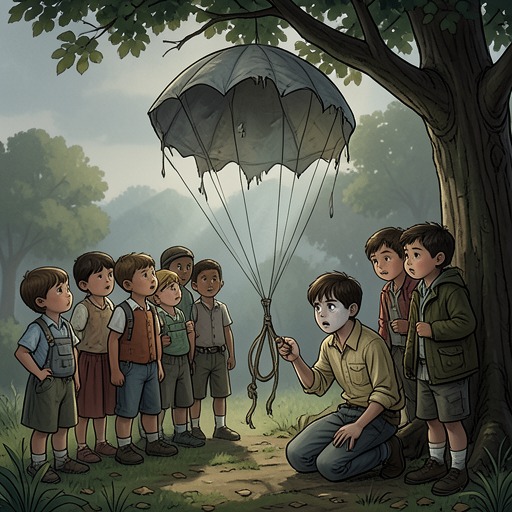
Simon discovers the truth about the beast
Lord of the FliesSimon’s discovery overturns the boys’ central fear: the beast is not a creature hunting them but a dead parachutist whose body and The parachute have been animated by the wind. He frees the body from the rocks and recognizes the signs of the boys’ relocation, but the truth does not reach them. On his descent he is killed in their ritualized attack, and the wind carries the body out to sea, removing the evidence just as the boys’ terror has made its discovery impossible to communicate.
Fear and the search for an explanation
The boys’ fear of the beast has grown alongside the weakening of their common order. At an assembly, Jack Merridew rejects the force of Ralph’s rules and promises that, if there is a beast, the hunters will find and beat it. The gathering breaks apart into excitement and mock hunting, leaving Ralph uncertain whether to use the conch to call the boys back. Meanwhile, the signal fire remains tied to the hope of rescue: Ralph argues that it must be watched, because a ship might appear beyond the horizon and smoke could summon help.
Jack’s face paint offers a different kind of response to danger. Using white clay, red clay, and charcoal, he makes a mask that turns his face into that of an apparent stranger; behind it, he dances and laughs with a bloodthirsty intensity. Later, after the hunters kill a sow, Jack has its head mounted on a sharpened stick as a gift for the beast. Simon remains behind with this grisly offering. His encounter with the sow’s head culminates in a collapse, after which he lies among the creepers, bleeding from the nose. This is the immediate physical and psychological background to the discovery: Simon approaches the supposed beast after an ordeal that has left him weak and disoriented.
Recognition on The mountain
When Simon wakes, evening has advanced and the flies still crowd the sow’s remains. He leaves the clearing and makes his way through the forest toward higher ground, staggering but continuing. On The mountain, he sees a hunched figure rise and bow as the wind catches the blue material of The parachute. The lifelike movement has helped make the dead man appear to be something alive; when the parachute collapses, the figure slumps forward and the flies settle again.
Simon crawls closer and understands how the appearance has been produced. The lines, rocks, and material hold the body in place, while wind repeatedly lifts and drops it. He sees the remains of a man beneath the rubber and canvas and is sick. Then, rather than fleeing at once, he takes the lines in his hands and frees them from the rocks, releasing the body from the wind’s repeated indignity. The revelation is concrete and natural: the beast is a dead man, and the movement that frightened the twins has a physical cause.
From the same vantage, Simon notices that the fire near The platform appears to be out or at least making no smoke. Farther along The beach, beyond the little river and near a great slab of rock, a thin stream of smoke rises. He sees that most, perhaps all, of the boys are there. The relocated fire makes sense to him as evidence that they have moved away from the beast. The observation links his discovery to the failed rescue signal: the boys have changed their camp in response to a danger that is actually the parachutist, while the means by which they might have been seen by a passing ship has been displaced.
The attempted warning and the fatal misrecognition
Simon understands that the body is harmless, but that knowledge carries an urgent consequence: the others must be told. He starts down The mountain, though his legs give way and his progress is only a stagger. The weather remains oppressive, with building clouds and thunder overhead. By the time he reaches the boys, they have gathered in a dance led by Jack Merridew. The storm’s flashes and noise intensify the scene, while the chant and circling movement turn fear into a shared, repetitive action.
Simon tries to tell them about the dead man on the hill. But he emerges from the forest into the ring at the moment when the boys are already calling for the beast’s death. They interpret the approaching, stumbling figure as the threat they expect. Their sticks strike him; the crowd breaks after him and tears at him with teeth and claws. Simon’s attempt to deliver the truth is swallowed by the collective violence generated by the false belief. The crucial reversal is stark: the only boy who has seen that the beast is a dead human being is killed as the beast himself.
Aftermath and significance
After the boys scatter in the rain, Simon’s body remains on the shore. The wind fills The parachute, lifts the dead parachutist, and carries him down through the air, across The lagoon, over the reef, and out to sea. The natural mechanism Simon recognized therefore continues to produce the very movement that had sustained the boys’ fear, while the body itself disappears from view. The discovery has occurred, but it has neither corrected the group’s belief nor survived as evidence that could correct it later.
The episode joins two failures of communication. Simon sees what the boys cannot recognize, while the boys’ ritual gives their fear a force that overwhelms an individual’s attempt to speak. At the same time, the relocated fire marks the practical cost of believing in the beast: the boys have moved away from the original signal point, and Simon sees smoke rising from their new position rather than from the fire near The platform. His knowledge exposes the natural explanation behind the haunting movement, but it arrives too late to restore either the rescue signal or the group’s capacity to hear the truth.