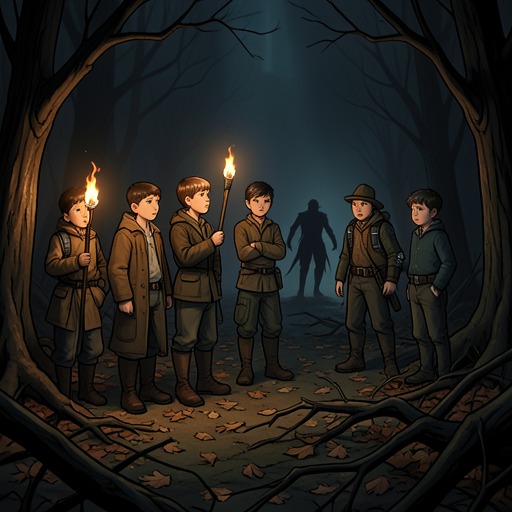
Sow Hunt and Offering to the Beast
Lord of the FliesThe sow hunt and offering to The beast mark a decisive turn in Jack Merridew’s break from Ralph’s group: a hunt for food becomes a display of leadership and a ritual response to fear. The hunters kill a nursing sow, then set aside its head as a gift to the imagined threat. The violence briefly binds the hunters together, but the offering also gives their belief in The beast a tangible, disturbing object.
Background and Defection
After leaving Ralph’s group, Jack Merridew gathers a small band near the beach and declares that he will be chief. The boys accept his claim readily. He tells them to forget The beast, yet soon proposes leaving part of the kill for it so that it may leave them alone. The contradiction is central to the expedition: the group dismisses the fear in words while organizing its actions around appeasing it.
Jack’s plans also challenge the authority of the conch and the labor of maintaining the signal fire. He intends to draw more older boys away from Ralph’s meetings by promising a hunt and feast. His followers agree to go into The forest with him, where he quickly finds signs of a pig. The hunt thus begins as both a practical search for meat and a means of building a rival community through shared action, excitement, and the promise of a meal.
The Chase and the Killing
The first attack showed how quickly the hunt could turn from skilled pursuit into prolonged violence. Under the trees, Jack Merridew and his hunters found a drove of pigs and singled out the largest sow, which lay apart from the others in maternal repose, her piglets asleep or burrowing against her. At Jack’s signal, the boys drew back their right arms and hurled their fire-hardened wooden spears from about ten yards away. One piglet fled toward the sea with Roger’s spear trailing behind it; the sow was struck by two spears but broke through the advancing line and escaped. The hunters’ first rush had not killed her. It had wounded and frightened her, setting the terms for the pursuit that followed.
The forest made the chase difficult. Jack halted the boys when the darkness and tangled growth obscured the track, then read what they could barely see: a drop of blood, a bent bough, the direction of the sow’s passage. His confidence restored the others’ attention to him, and they followed as he traced her route. The sow’s trailing spears hindered her; when she crashed into a tree, one point was forced farther into her flank. After that, drops of blood made her passage easier to follow. The afternoon wore on in damp heat as the wounded animal staggered ahead and the boys pursued her, absorbed by the trail and the excitement of nearly catching her. Each time she drew close, she found strength to pull ahead again.
At last the sow staggered into a flowered clearing where the heat brought her down. The hunters fell upon her as she squealed, bucked, and struggled beneath them. Roger ran around the heap, thrusting his spear whenever he found an opening, then leaned his full weight into it; Jack Merridew climbed onto the sow and stabbed downward with his knife until he found her throat. Her blood spouted over his hands, and the animal collapsed under the boys. The killing ends the pursuit, but its details resist any simple account of a clean, necessary slaughter: the sow is a mother with piglets, and the chase leaves her wounded and bleeding before the hunters overwhelm her. The scene’s movement from a coordinated ambush to a long pursuit and a crowded, close-range killing makes the hunt a demonstration of the boys’ growing capacity for violence as well as a way to obtain meat.
After the kill, Jack Merridew held out his bloodied hands for the others to see, then smeared the blood across Maurice’s cheeks. The display turned the kill into something the group could share and reenact. Roger’s spear, still lodged in the sow, prompted Robert to describe its position crudely; Robert and Maurice then acted out the pig’s efforts to escape the advancing spear, and the boys laughed. Their laughter follows immediately upon the killing, giving the violence a second life as group performance. Once the joke had run its course, Jack Merridew cleaned his hands on a rock and began to paunch the sow, pulling out her entrails and piling them there while the others watched. He directed the next steps too: the meat would be carried along the beach, while he returned to invite the other boys to a feast. The hunt had produced food, but it had also given Jack Merridew a spectacle with which to draw others toward his leadership.
The Offering and Simon's Encounter
Jack's next decisions turn the kill into a plan for extending his power. He assigns four boys to help raid Ralph's camp for fire, while the others are to carry the sow's meat back along the beach; he will return to the platform and invite the boys to a feast. Before leaving, however, he reserves part of the kill for The beast. At his instruction, Roger sharpens a stick at both ends, and Jack presses the sow's head onto its point, which pierces through the soft throat and into the mouth. The boys draw back as the head hangs above the spilled blood. Jack names it a gift, and the group runs through the forest toward the beach, leaving Simon concealed among the leaves.
Simon cannot simply leave the offering behind. The head's half-shut eyes and fixed grin hold his attention; even when he shuts his eyes, it remains in his mind. The still, oppressive clearing, the pile of entrails blackened by flies, and the flies settling on Simon make the offering part of an encounter that is at once physical and inward. As he looks at the head, Simon imagines it speaking: it tells him to return to the others, mocks the idea that The beast could be hunted and killed, and identifies itself as something within them. The encounter culminates in Simon seeing a vast mouth and losing consciousness. His experience does not make the head an objectively speaking creature; instead, it gives dramatic form to the recognition that the feared threat is bound up with the boys themselves.
The offering therefore answers fear by giving it an object, but it does not bring the safety the boys hope to purchase. Jack's declaration makes the head a gift to an unseen power, while Simon's solitary encounter turns that same object toward an understanding of human violence. The hunters leave the head behind as a propitiation; for Simon, it becomes the disturbing image through which the supposed external beast is recognized as an inward presence.
The Offering’s Failed Exchange
The offering also sharpens the contrast between what Simon can perceive and what the group can hear. At an assembly, he had ventured that the beast might be only the boys themselves; the suggestion was met with savage interruption and laughter, and his effort to explain was reduced to a crude joke. Jack’s later gift gives the fear a visible target, but it does not answer Simon’s insight. Alone with the head, Simon experiences its imagined voice as an accusation that the threat cannot be hunted down because it belongs to the boys. The ritual turns terror into a concrete object of appeasement; Simon’s encounter turns that same object back toward the human source of the terror.
The promised protection fails to separate the boys from the violence they fear. During the storm, the hunters’ chant and dance gather the boys into a circle, and when Simon stumbles out of the forest crying about a dead man on the hill, they mistake him for the beast and beat him to death. The scene completes a grim reversal: the group’s attempt to placate an imagined danger with a sow’s head has helped give fear a ritual form, while the person who has recognized the truth of that fear becomes its victim. The offering is therefore not a resolution but a hinge between the hunt’s staged violence and violence directed at a human being.