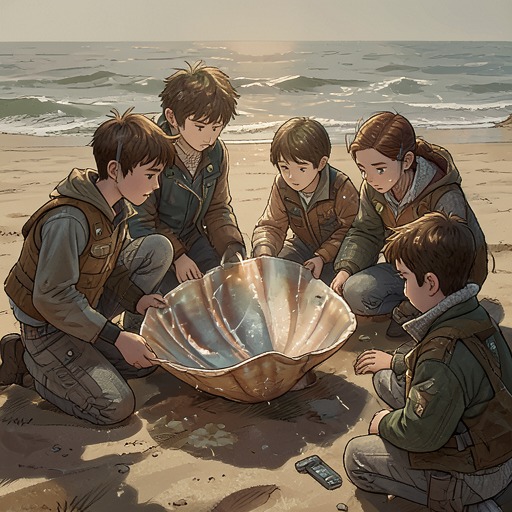
The Conch as a Symbol of Order and Authority
Lord of the FliesThe Conch as a Symbol of Order and Authority is both a practical device for organizing the boys and a fragile emblem of their attempt to govern themselves by common rules. Its power begins in the promise that speech can be heard in turn, and ends when a boulder destroys the shell and Piggy with it. Between those moments, the changing response to the conch traces the difference between authority founded on shared consent and rule enforced by force.
Appearance and Establishment of Its Authority
The shell is described as cream and pink, delicate and shining, a distinct object around which the boys can gather. At their early election, its presence helps set Ralph apart: he had blown it and waited on the platform with it balanced on his knees. The boys’ attention to the “shell” and “trumpet-thing” helped make him recognizable as a leader, even though the text observes that the reasons for the acclaim were difficult to explain. The conch therefore lends Ralph an authority before the group has established any lasting institutions; its appeal rests partly on the fact that it has already brought them together.
At the next assembly, Ralph gives the shell a defined procedural use. Whoever receives it may speak without interruption, with Ralph reserving the right to interrupt. He explains, “That's what this shell's called. I'll give the conch to the next person to speak. He can hold it when he's speaking.” The rule makes speaking order visible and transferable: the right to address the group is represented by an object that can pass from hand to hand. Jack’s excited demand for rules briefly fits within this arrangement, while Piggy uses the conch to quiet the meeting and redirect attention to the practical question of who knows where the boys are. The shell gives procedure a material form, but the authority to interpret and enforce that procedure remains with the boys.
A Shared Rule and Its Limits
The conch’s meaning expands beyond the platform when Ralph insists that it applies on the mountain as well. During the first signal-fire crisis, Jack dismisses Piggy’s right to speak because they are on the mountaintop. Ralph takes the shell back and says, “Where the conch is, that's a meeting. The same up here as down there.” The boys assent, extending the assembly’s rule to the place where they are trying to maintain a signal fire. The scene links two kinds of collective responsibility: the right to speak under a shared procedure and the duty to preserve a fire that might bring rescue.
Yet agreement is not the same as reliable obedience. Jack’s dismissal of Piggy on the mountain shows that the rule can be challenged even while the shell is physically present. Later, at the assembly about the beast, Jack breaks openly with the system: when Ralph invokes his election and Piggy’s right to speak, Jack asks why choosing should matter and declares, “Who cares?” Ralph answers, “Because the rules are the only thing we've got!” Jack counters with the strength of the hunters and the prospect of pursuing the beast. The meeting disperses into noise, excitement, and a mock hunt. The conch still signifies the order Ralph is defending, but its presence no longer guarantees that the group will accept that order.
The Shell in a Divided Society
As the boys’ society separates, the conch remains a portable claim to legitimate assembly. Jack calls a meeting by blowing it, then presents his own account of the beast and attacks Ralph’s fitness to lead. The same object that once helped establish Ralph’s position can be used to convene a rival gathering. Its significance is therefore not simply that it belongs to one leader: its authority depends on what the assembled boys are willing to recognize, and competing leaders can try to occupy the procedure for their own purposes.
After Jack’s hunters steal the fire and Piggy’s glasses, Ralph, Piggy, Sam, and Eric hold an assembly of their reduced group. Piggy says he wants his glasses back and points to the conch as the basis for Ralph to speak. Ralph remembers the missed ship and the lost signal, while Piggy insists that talk must lead to a decision. Their exchange shows the shell persisting as a civic object even after the larger community has broken apart: it still organizes a meeting, but cannot restore the absent boys or undo the theft. Piggy’s impaired sight makes the loss of his glasses immediate and personal; his appeal to the conch turns his demand into a question of what is right, rather than a plea for a favor.
Piggy then proposes carrying the shell to Jack’s camp as a public appeal. He means to confront Jack with the difference between physical strength and justice, and to insist that the glasses be returned because Jack’s side has taken them. Ralph agrees to go with him, and Piggy is proud to be entrusted with the conch, though he will need to be led. On the approach to Castle Rock, Ralph blows it and announces that he is calling an assembly. The painted guards do not attack at once, and the call briefly makes the encounter resemble a formal meeting. But Jack’s order that Sam and Eric be seized is carried out despite the shell’s presence. The boys who guard the entrance have spears, and Jack’s command can turn their collective force against the visitors; the conch cannot make them honor its rule.
Destruction at Castle Rock
At Castle Rock, Ralph uses the meeting to argue for the return of Piggy’s glasses and the maintenance of a proper signal fire. The distinction matters to him: a cooking fire may serve Jack’s tribe, but only smoke rising as a signal might attract a ship. His appeal is directed not just at Jack but at the painted group, whom he asks to choose between rules and hunting, law and rescue. Piggy raises the conch and tries to make his own appeal, beginning, “I got the conch!” For a moment the boys are silent, curious to hear him. Their attention gives the shell a last, limited success as a platform for dissent.
That pause does not hold. The crowd’s booing returns, Jack shouts over Piggy, and Roger leans his weight on a lever above them. The released boulder bounds across the narrow neck. It strikes Piggy a glancing blow and shatters the conch into white fragments; Piggy falls to the rocks below and is swept away by the sea. The shell’s destruction is not merely the loss of a speaking token: in the same instant, the group’s remaining advocate for procedure is killed. Jack announces that the conch is gone and claims the position of chief. The sequence makes the change of power brutally concrete: the fragile object that once marked a meeting has been broken by force, while the crowd that might have upheld its authority stands under a new command.
Meaning and Aftermath
The conch’s authority is neither magical nor self-sustaining. It works when the boys accept a rule that makes one person’s speech temporarily answerable to the group; its force weakens when commands, fear, and group violence displace that agreement. Its repeated presence beside Piggy also connects procedure to his insistence on thought, fairness, and rescue, while the challenges to it show how readily a formal right can be ignored when its audience no longer consents to uphold it.
The object’s end also clarifies the difference between symbolic order and practical deliverance. At the final encounter on the beach, the naval officer says that the boys’ smoke has been seen; the rescue arrives through a signal visible from the sea, not through the conch’s authority. By then the shell has ceased to exist, and the island’s fire has become destructive as well as visible. The contrast does not make the conch meaningless: it shows what it could organize among the boys, and what it could not secure once their agreement collapsed. Its white fragments at Castle Rock mark the end of a shared political language, while the smoke that brings rescue belongs to a different, external authority and to the survival of a signal the boys had repeatedly failed to protect.