The Conch's Symbolic Meaning
Lord of the FliesThe Conch is at once a calling instrument, a procedure for governing speech, and a material emblem of the boys’ attempt to build a common order without adults. Its authority is never inherent in the shell: Ralph’s call gathers the others, and the boys give the object political force by agreeing that its holder may speak. As that agreement weakens, The Conch can still attract attention but cannot compel obedience. Its destruction with Piggy marks the point at which the shared rules it represented are violently swept aside.
The shell becomes a public signal
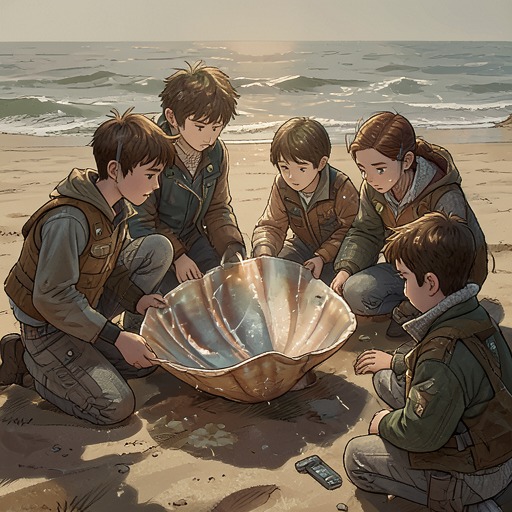
When Ralph takes the shell from Piggy, it shifts from an object to be admired into something the boys can use. Piggy proposes that it call the others to a meeting. Ralph’s first attempts produce little more than air and laughter, but when he blows from his diaphragm the shell gives a deep, harsh note that carries through the forest and echoes from the mountain. Birds rise from the trees and an animal squeals in the undergrowth; then children begin appearing along the beach. Ralph continues blowing until the scattered boys have assembled.
The shell’s physical presence helps make the call recognizable. It is described as deep cream touched with fading pink, about eighteen inches long, with a spiral and an embossed surface. In Ralph’s hands, its sound gives the newly stranded children a shared point of attention. The first gathering is therefore not simply called by an order from a leader: it begins through a signal that anyone within hearing can answer. The Conch makes a meeting possible before the boys have agreed on who should direct one.
That distinction matters when the choir arrives under Jack Merridew. Dressed in black cloaks and moving in formation, the boys initially expect a grown-up with a trumpet; instead, they find Ralph with the shell. The contrast places a new kind of authority beside the choir’s existing discipline and Jack’s command over it. During the election, Jack claims leadership through his position as head boy and chorister, but the boys choose Ralph. Their attention to the boy who blew the shell helps explain the result: The Conch has already marked Ralph as the person around whom the gathering formed. It does not erase Jack’s standing, however; Ralph gives him charge of the choir, which becomes a body of hunters.
A procedure for speech and collective rule
At the next assembly, Ralph makes the shell’s political use explicit. He proposes that whoever holds The Conch has the right to speak without interruption, subject to the chief’s authority. The object thus regulates not only who gathers but how the gathered boys are meant to deliberate. Its procedure resembles a schoolroom rule, but it is also an improvised agreement: no adult enforces it, and its effectiveness depends on the boys accepting the holder’s turn to speak.
That agreement is connected to practical survival. Ralph announces that there are no houses, people, or boats in sight and that the boys must look after themselves. They need hunters for meat, but they also need shared decisions and a maintained signal fire in case a ship passes. At a later meeting on the mountain, Ralph insists that the same meeting rule applies there: where The Conch is, there is a meeting. The shell therefore links discussion to the boys’ other common obligations, including watching for rescue. Its promise is not that a shell can rescue them, but that a group able to listen and coordinate may keep the possibility of rescue alive.
The procedure is vulnerable from the start. At the mountain meeting, Piggy holds The Conch and tries to make the boys listen about the danger of neglecting the fire. Jack tells him that it does not count on the mountain and orders him to be quiet, despite Piggy holding it. The group eventually agrees to rules and to a rota for tending the fire, but Jack’s dismissal exposes the gap between a rule being announced and a rule being honored. The Conch can mark a claim to speak; it cannot by itself make others accept that claim.
Its authority under pressure
As fear grows, the shell becomes a test of whether procedure still has force. During the assembly about ghosts, Piggy takes The Conch and protests that he did not vote for ghosts. Ralph tries to restore order, but Jack challenges both the rule and Ralph’s right to give orders. Ralph answers that the rules are all they have; Jack rejects them and promises that the hunters will pursue a beast if one exists. The meeting breaks apart into noise and movement. The object remains present, but the boys no longer share the restraint that would make its authority effective.
The struggle over leadership repeats this failure in public. Jack uses a meeting to accuse Ralph of cowardice and poor leadership, then asks the boys to raise their hands against him. No one does. Faced with the silence, Jack lays The Conch carefully in the grass, weeps, and declares that he will no longer be part of Ralph’s lot. The failed challenge shows that the shell still belongs to the shared political scene: Jack uses a meeting to contest Ralph’s position. But his departure also shows that the result need not settle the rivalry. He leaves to establish a separate group, taking followers and authority with him rather than accepting the assembly’s existing order.
When Jack and his painted followers later appear at Ralph’s camp, Piggy still holds The Conch on the platform as Jack announces his own tribe and invites the boys to a feast. The contrast is now between two forms of belonging: the fragile public meeting organized around the shell and the new group organized around hunting, food, and Jack’s command. The shell remains visible, but it no longer gathers the boys into one community.
The last claim and its destruction
At Castle Rock, Ralph, Piggy, Sam, and Eric bring The Conch into a confrontation with Jack’s tribe. Ralph demands Piggy’s spectacles and argues that a continuing signal fire is their best chance of rescue. The appeal joins the shell’s former principles—speaking publicly and making claims on behalf of the group—to the practical need to keep hope of rescue alive. The painted boys’ laughter and the renewed fighting show how little shared ground remains.
Piggy raises the shell and, for a moment, the booing ebbs. The boys are curious enough to hear him, so The Conch can still produce a brief silence and give him a hearing. But the pause offers no protection. Roger releases the great rock above the group; it strikes Piggy, who falls to his death, and The Conch explodes into white fragments. The paired destruction is both physical and political: Piggy, one of the shell’s most persistent defenders, is killed, while the object that enabled their meeting rule ceases to exist. Jack immediately claims to be chief and attacks Ralph with a spear. Authority has shifted from a contested agreement to open coercion.
The final rescue sharpens the contrast. A naval officer reaches the beach after seeing smoke from the burning island; The Conch is no longer available to call an assembly or represent a common rule. The shell’s trajectory runs from signal, to civic procedure, to a failing claim for attention, and finally to fragments. It had never guaranteed wise decisions or equal respect, as Piggy’s earlier humiliation and Jack’s interruptions make clear. Its significance lies instead in the boys’ temporary effort to make authority answerable to a shared process—and in the violence that follows when that process loses their consent.