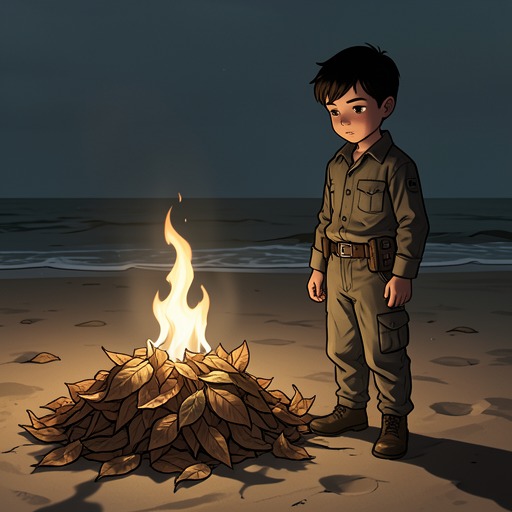
The Island Engulfed by Fire
Lord of the FliesThe Island Engulfed by Fire is the final, destructive transformation of the boys’ refuge: a blaze used to flush Ralph from hiding spreads through the island and brings the rescue its makers could no longer secure by keeping a signal fire. Its meaning reverses across the story. Fire begins as a shared means of making smoke for a passing ship; in the hunt, it becomes a weapon against one boy and a force that consumes the landscape. Yet the smoke again draws adult attention, so destruction and rescue arrive together.
From Signal to Failed Duty
The boys’ first plans for survival already tied fire to collective order. At their second meeting, Ralph explains that The island is uninhabited: the explorers saw water all around and no houses, smoke, footprints, boats, or people. Since no adults are present, the boys must care for themselves, find food, and make themselves visible to anyone searching. Jack Merridew presses for hunters, while Ralph establishes a procedure for speaking with The conch. The fire is therefore not an isolated practical device. Keeping it alive is one of the responsibilities meant to hold their new society together.
The first attempt on The mountain exposes the difference between flame and a useful signal. The boys pile on wood until the blaze sends a high column of fire and sparks into the air, but when it subsides Ralph notices that it made no smoke. Piggy points out that they have not made a sustainable signal, and Simon confirms that Piggy helped by lending his spectacles to start it. The spectacle-assisted ignition makes Piggy’s practical contribution visible even as Jack Merridew dismisses him for sitting out the work. Ralph then proposes assigning specific boys to tend the fire, reasoning that a ship might appear at any time. He insists that The conch should govern discussion on The mountain as well as at the meeting place. Jack Merridew agrees to divide the choir into groups for fire duty and lookout, but also suggests letting the fire go out for the night and restarting it later. The exchange establishes the fragile gap between declaring a common duty and actually maintaining it.
Order Gives Way to the Hunt
As the boys’ assembly breaks down, the signal fire’s importance becomes a test of competing kinds of leadership. Piggy protests that the boys have let fires go out while turning to hunting and fear of the beast. Jack Merridew rejects the force of the rules, declares that the boys are strong and can hunt, and leads them into a noisy, disorderly scattering. Ralph hesitates to use The conch to call them back: if they do not return, he fears they will not keep the fire going and will never be rescued. Piggy warns that failing to call them may leave them behaving like animals anyway. Their exchange makes the fire more than a source of warmth or smoke; it is the practical obligation on which the hope of rescue, and the authority of their agreed rules, depend.
The final blaze emerges from the opposite use of fire. With Ralph hiding in The forest, the hunters move through the undergrowth and use smoke to force him out. He sees smoke seeping through branches, then realizes that the hunters have smoked him out and set The island on fire. From his concealed place beneath a dense mat of creepers, he has weighed hiding against climbing a tree or attempting to break through the cordon. Now the fire narrows those choices: smoke darkens the sunlight, the ground vibrates, and the blaze advances while the hunters’ calls mark the tightening pursuit. What once was supposed to remain in one place as a signal is now an island-wide pressure that makes concealment increasingly impossible.
The Blaze and Ralph’s Escape
When Ralph bursts from hiding, a hunter tumbles under his blow, but others are already approaching. Ahead, a bush erupts into flame; the advancing fire blocks his path and drives him sideways through The forest. The hunters run and cry out around him, while the fire races along his other side. In the rush toward The beach, Ralph forgets his wounds, hunger, and thirst, reduced in the narration to fear and flight. A shelter catches fire, the heat beats at his shoulder, and the water comes into view as the pursuing cries close behind. The blaze has turned the hunt into a moving enclosure: Ralph is pressed between armed pursuers and burning ground, with little space left to choose his route.
He reaches the sand expecting further terror, but encounters a naval officer instead. Behind the officer, a cutter waits with two ratings holding its bows and another rating in the stern-sheets. The officer explains that they saw the smoke. The fire that had been used to make Ralph visible to the hunters has also made the boys visible from offshore. Even as flames reach the coconut palms by The beach and consume them, another flame swings up the palm heads at the platform; the sky is black with smoke. The rescue arrives not after the island is safe, but while its destruction is still proceeding around the boys.
Consequences and Significance
The officer asks what the boys have been doing and whether anyone has been killed. Ralph answers that there were two dead, and that they are gone. The officer looks at the painted boys and the burning island, then says they should have put up a better show. Ralph can only begin to explain that it was different at first, when they were together. The contrast between the expected conduct of British boys and the scene on the beach makes the rescue a reckoning as well as an escape. The blaze has exposed the distance between the organized society the boys initially tried to maintain and the violence that has overtaken them.
Ralph’s restraint finally breaks. He remembers the island as it was before, Simon’s death, and Jack Merridew’s actions; then he sobs, and the other boys begin to shake and weep with him. His grief gathers the losses into a single ending: he weeps for the end of innocence, the darkness of man’s heart, and Piggy’s fall. The fire therefore does not simply destroy the boys’ shelter or bring a ship within sight. It becomes the material sign of a social collapse already visible in the broken rules, the abandoned signal duty, and the hunt. At the same time, its smoke accomplishes what the earlier, carefully planned signal could not. Rescue comes through a conflagration set amid the boys’ violence, and the surviving boys leave only as the world they made burns behind them.