The beach
Lord of the FliesThe beach is the island’s exposed edge, joining the forest and mountain to the sea. Its role changes with the boys’ fortunes: in the dawn after a terrifying sighting it offers no certainty of safety; after Simon is killed, it becomes the place where the violence’s human cost lies in view; and at the end, Ralph reaches it in flight and encounters a naval officer. The shoreline thus gathers the story’s reversals into a single setting, from fear and bloodshed to the possibility of rescue.
Setting and Early Refuge
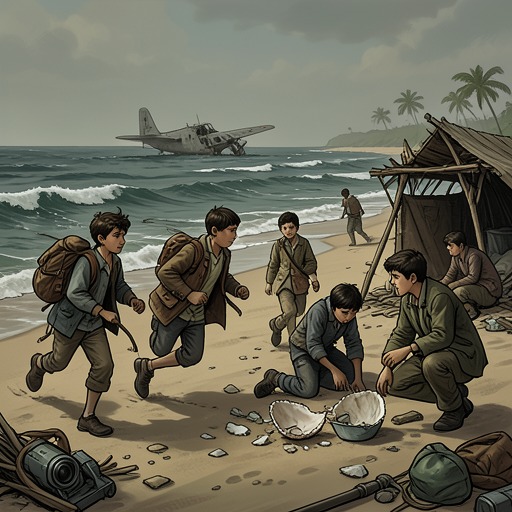
At dawn, the beach is pale beneath the dark mountain. Ralph and Piggy look toward the height where Ralph believes they saw a creature, while Jack Merridew draws a circle in the sand. The contrast is sharp: the shore is open to the rising light, but the mountain and the boys’ memory of the night keep danger present. The conch is visible among the trees, yet it cannot settle what to do. Ralph fears that the supposed creature is beside the fire, leaving the boys unable to maintain their signal; the beach is a place to discuss their predicament, not a guarantee of safety.
The change from night to morning briefly alters what seems possible. Ralph says they are brave while there is light, but asks what will happen after dark. His fear is linked directly to rescue: if the signal fire cannot be kept, the boys may not be seen. The beach therefore holds both the immediate relief of daylight and the continuing vulnerability of their position on the island.
Simon’s Body on the Shore
During the storm, Simon emerges from the forest trying to tell the boys about the dead man on the hill. The gathered boys mistake him for the beast and attack him in a ring of sticks, teeth, and blows. He falls down the rock to the sand beside the water, and the crowd surges after him. When the rain breaks over the island, the group eventually scatters, leaving Simon’s body near the sea.
The storm’s force does not erase what has happened. As the rain ceases and the tide advances, Simon’s body remains on the pale beach, with blood staining the sand. The water at the edge of the lagoon glows with phosphorescence, a striking natural brightness beside the body and its spreading stain. The setting makes the consequences of the boys’ collective frenzy visible rather than allowing the violence to remain an episode in the forest or on the mountain.
The same storm moves The parachute from the mountain toward the shore and out over the reef. Its figure rises and falls in the wind before being carried across the lagoon and out to sea. This movement contrasts with Simon’s still body: the storm displaces the apparent shape of the beast, while the evidence of the boys’ killing remains on the sand.
The Shore and the Rescue
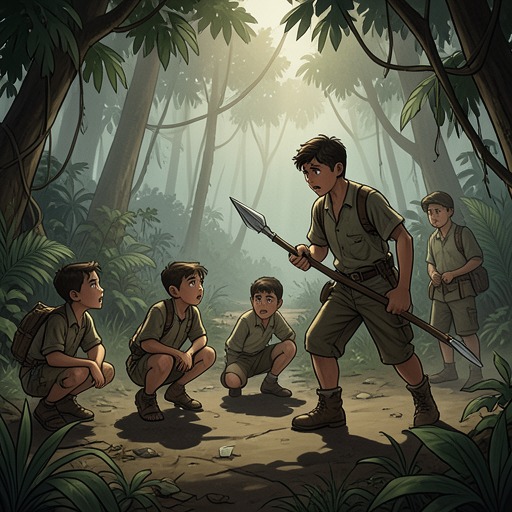
At the end, Ralph runs through the forest as Jack Merridew’s hunters pursue him. Fire flares across his path, a shelter burns, and he stumbles onto the open beach, rolling in the warm sand before getting to his feet. There he faces a naval officer in uniform. Behind the officer, a cutter has been hauled up on the shore, with two ratings holding its bows and another carrying a sub-machine gun in the stern. The hunters’ cries falter and die away.
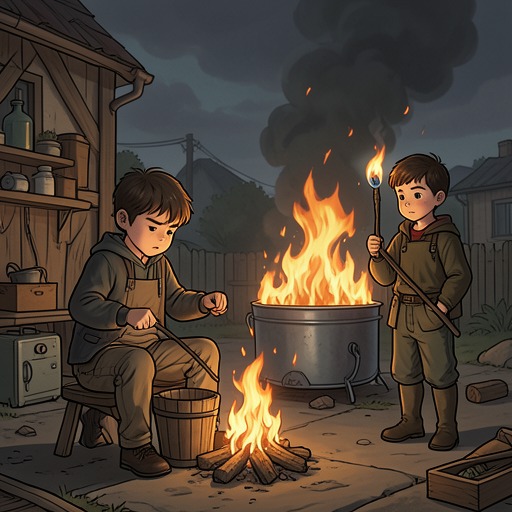
The officer sees Ralph and then a silent semicircle of younger boys, streaked with coloured clay and holding sharpened sticks. When he asks whether any adults are with them, Ralph indicates that none are. The officer says they saw the smoke and asks what the boys have been doing. By then, the fire has reached the coconut palms at the beach and is swallowing them; another flame reaches the palm heads by the platform, while smoke has brought the cutter to shore. The signal’s arrival is inseparable from the island’s destruction: the fire that has made the boys’ final pursuit possible has also made their presence visible.
Narrative Significance
The beach repeatedly converts events elsewhere into consequences that can be seen and confronted. The mountain sighting is carried down to the shore as fear about the beast and the failed signal; the killing in the storm ends with Simon’s body on the sand; and the final chase breaks into the open when Ralph reaches the cutter and officer. Each return changes the beach’s meaning without making it secure in advance.
At the close, the shore marks a sudden interruption of the boys’ violence by adult authority, but the burning palms remain in view. Rescue arrives not in a restored or untouched landscape, but at the edge of an island being consumed by fire. The beach is therefore both threshold and witness: the place where the boys’ isolation is broken, and where its cost is still visible.