The beast
Lord of the FliesThe beast is an uncertain presence on The island: first a small boy’s report of a snake-like creature, then a fear shared and reshaped by the group, and eventually a dead parachutist mistaken for a monster. Its changing forms make it both a practical danger in the boys’ minds and a measure of their weakening confidence in reason and collective order. The physical source of one decisive sighting is eventually exposed, but the fear does not disappear with the explanation.
First Reports and Failed Reassurance
The beast enters the boys’ conversation when a six-year-old boy with a mulberry-coloured birthmark is pushed before the assembly. Frightened and unable to speak after the older boys laugh at him, he communicates through Piggy that he wants to know what they will do about a snake-like thing. Piggy interprets his account: the creature was enormous, appeared in The forest, and had come in the dark. The child says it returned and wanted to eat him; in the morning, it had turned into rope-like shapes hanging in the branches.
Ralph treats the report as a nightmare and argues that an island this small cannot support a snake. The laughter that first greeted the child fades when he insists the creature might come again that night. Jack offers reassurance of a different kind: if there were a snake, the hunters would find and kill it. His response denies the creature’s existence while promising force against it, an uneasy combination that lets the possibility remain alive. Ralph, meanwhile, repeats more emphatically that there is no beast, but his certainty has no evidence behind it, and the assembly’s growing silence shows that reassurance has not settled the matter.
The fear acquires a daily life beyond the first report. Ralph and Jack notice that The littluns wake screaming and talk in their sleep. Simon recalls the earlier talk of the snake-like thing; Jack dismisses the boys as foolish, yet admits that when he is hunting alone in The forest he can feel as though something is behind him and he is being hunted. He immediately qualifies the feeling as irrational. That qualification does not erase it: the older boy who promises to hunt the beast has himself felt its imagined pursuit.
Fear Takes New Forms
At a later assembly, Jack rebukes The littluns for their fear but also reports that some of his hunters have spoken of a dark animal. He claims to have searched The island without finding one. Piggy likewise insists that no beast can live in The forest, invoking reason, medicine, and scientific knowledge. Yet his account of rational confidence breaks at its conclusion: he allows that the boys might become frightened of people. The distinction between a dangerous creature and a danger arising among the boys has entered the discussion, even as the group tries to laugh it away.
A boy named Phil describes a nightmare in which he fights the twisting shapes in the trees, wakes outside his shelter, and sees something large moving among the trees. Ralph calls it sleepwalking, but Phil insists he was awake when he saw the figure. Another report shifts the imagined habitat from land to water. After Percival, exhausted and overwhelmed at the assembly, falls asleep, Jack tells the others that he said the beast came out of the sea. Maurice recalls his father’s warning that the sea may contain unknown animals, including enormous squid. The suggestion sparks argument rather than resolution: even boys who say they do not believe in a beast concede that they cannot know everything about the sea.
Simon makes the assembly’s most unsettling proposal. Hesitantly, he says there may be a beast, then tries to explain that it may be something within the boys themselves. The assembly answers with jeers and laughter, and his attempt to give the fear a human source collapses in the noise. The idea nevertheless changes the terms of the question: the threat may not be an animal to track but something bound up with human nature. At the same meeting, Jack vows that if a beast exists, the hunters will pursue it. His promise turns fear into a justification for organized violence, while the meeting itself breaks into noisy disorder and a mock hunt.
The Mountain Sighting
The twins, Sam and Eric, give the fear its most vivid apparent confirmation. At night, tending the fire on The mountain, they see a shape in the darkness as wind blows through the camp and catches fabric. They flee over the rocks. When they report what happened, they describe a furry figure with movement behind its head like wings, eyes, teeth, and claws; Eric’s face bears scratches from bushes encountered during their flight. Their account is sincere, and the injuries make their terror visible to the other boys, but neither establishes that the shape was a living animal.
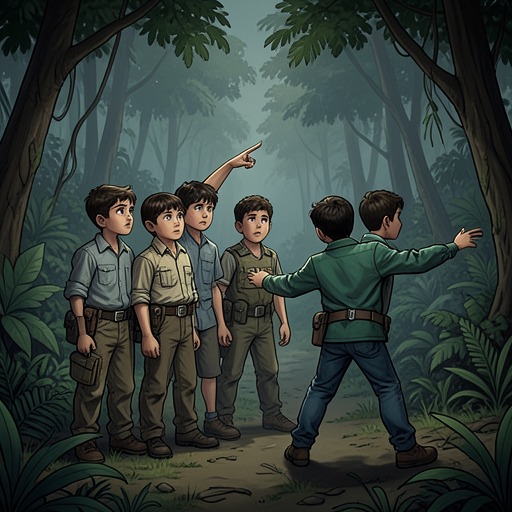
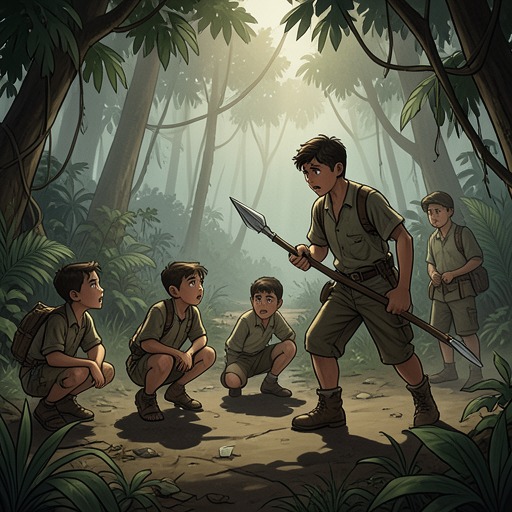
The story changes the group’s behaviour. Boys arrive at The platform carrying spears, and the circle that had faced inward turns outward, as if the weapons could form a fence against the threat. Jack urges a real hunt. Ralph admits that he is frightened but challenges the reliability of the sighting and points out that the beast leaves no tracks. He also insists that the boys must consider the fire and the possibility of rescue. After Jack confirms that a rocky promontory remains unexplored, Ralph directs the party toward it and then plans to search The mountain and relight the fire.
The expedition does not resolve the fear. Later, Ralph and the others climb The mountain and see a humped shape that seems to sit up and turn a ruined face toward them. They flee in panic, leaving their sticks behind. The scene gives the boys an apparent visual encounter, but its darkness and distance prevent them from identifying what they have seen. When Ralph returns, he describes teeth and large black eyes; even he can offer no explanation of what the figure is. The failure of sight to produce knowledge instead makes the beast seem larger and more powerful.
The Physical Source and Simon’s Discovery
Simon eventually reaches the summit alone and finds the source of the mountain shape. The figure is a dead parachutist held and moved by its tangled lines; the wind lifts and bows the body, while the collapsing parachute makes it appear to move. Simon examines the lines, bones, teeth, and decayed body, then frees the figure from the rocks so that the wind will no longer jerk it into a lifelike posture. The discovery supplies a natural explanation for the sighting, but it is a disturbing one: the apparent monster is a human corpse, brought to The island by the war beyond it.
From the summit, Simon sees that the fire near The platform appears to be out, while smoke rises from a different place along the beach. He understands that most, perhaps all, of the boys have shifted camp away from The mountain because they fear the beast. He recognizes that the body is physically harmless, though horrible to look at, and that the others need to hear the truth. Weakened by his climb, he staggers down to tell them. His knowledge arrives not through the hunters’ search but through solitary observation and the effort to approach what the others have fled.
The explanation does not make the boys’ earlier terror foolish. The parachutist’s body really does move in the wind, and the twins encounter it at night, under frightening conditions. But the distinction between a corpse and a living predator matters: the figure is not hunting them, and its movements do not express intention. Their fear supplies that intention, turning wind-blown fabric and a fallen body into a watching, pursuing beast.
Persistence and Significance
Although Simon discovers the body, the beast continues to shape the group’s beliefs and decisions. Jack tells his followers that the beast may have come disguised and might return, and insists they should leave The mountain alone and offer it the head of a kill. His account folds the physical discovery into a continuing supernatural threat rather than letting it dispel fear. The boys’ uncertainty makes the story useful to the tribe: danger can be declared present even when no one can explain what it is or how to find it.
When Simon confronts The Lord of the Flies, the pig’s head tells him that it is the beast and that it is part of him and the others. This encounter gives a voice to the possibility Simon had struggled to express at the assembly: the source of terror cannot simply be hunted down and killed because it is connected to the boys themselves. The scene does not make the physical parachutist unreal; it distinguishes the corpse that explains the mountain sighting from the deeper, human violence represented by the beast.
By the time Sam and Eric warn Ralph that Jack’s tribe will hunt him, fear has become inseparable from a real threat posed by other boys. The beast has travelled from a child’s account of a snake-like creature to an unseen presence in the trees, a possible monster at sea, a parachutist mistaken for a predator, and a name for the darkness within the group. Its changing identity exposes the limits of the boys’ explanations, but also the consequences of their need for one: fear can be denied, mocked, or given a target, and under Jack’s leadership it becomes a reason to hunt.