The breakdown of the assembly and Jack’s defiance
Lord of the FliesThe breakdown of the assembly and Jack’s defiance marks a decisive failure of the boys’ attempt to govern themselves by shared rules. As fear of the beast turns into an argument about ghosts, Ralph’s authority and the conch’s protection of orderly speech prove unable to contain the meeting. Jack rejects the rules outright and offers hunting and force instead; the assembly dissolves into disorder, while Ralph is left to weigh the danger of losing the boys against the danger of abandoning the signal fire.
Background and Stakes
The meeting’s collapse reverses principles the boys had established at their first assemblies. With no adults on The island, Ralph had presented their situation as one in which they would have to care for themselves. He proposed a chief and a procedure in which the conch passed to the next speaker, who would not be interrupted. The rules were meant to make discussion possible, not merely to decorate it: the boys needed to decide how to organize themselves and maintain the possibility of rescue.
That practical purpose became especially clear when the first signal fire on the mountain threatened to become a blaze rather than a controlled rescue signal. Ralph argued that the boys needed designated fire-watchers because a passing ship might take them off The island. He also insisted that the conch’s authority applied at the mountain as well as at the meeting place. The crisis therefore tests more than Ralph’s personal standing. It tests whether the group will accept a common procedure when fear and immediate desires pull it elsewhere, and whether the obligation to keep the fire going can survive competition from hunting and the excitement surrounding the beast.
Fear Overwhelms Deliberation
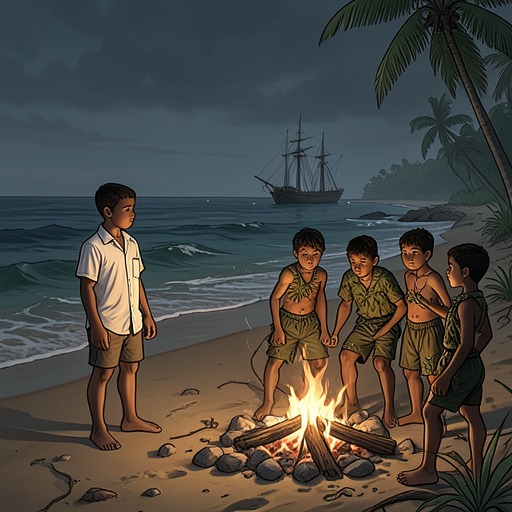
At the later assembly, talk of ghosts and the possibility of a beast coming from the sea spreads through the gathering. Piggy insists that he does not believe in ghosts, while Jack becomes angry and insults him. In the darkness, the boys’ uncertainty is intensified by the setting: the wind stirs the palms, nearby trunks make an eerie sound, and the littluns huddle together. Ralph says the discussion should have been left until daylight and tries to return the gathering to the rules, but he acknowledges that the carefully planned meeting has broken down.
Ralph calls for a vote on whether ghosts might exist. The question gives the group a formal way to register its fear, but it does not settle what the boys should do or restore agreement. When Piggy protests that he did not vote for ghosts, he tries to shift attention back to what the adults would think of their conduct: hunting, letting fires go out, and now arguing about spirits. The appeal to adult judgment exposes how far the group has moved from its earlier confidence in rules, without giving Piggy any means to make the others comply.
Simon’s attempt to speak makes the meeting’s confusion more revealing. He hesitantly allows that there might be a beast, then struggles to express the possibility that the threat might be within the boys themselves. The assembly answers with shouts and laughter, and his effort to explain falls apart under their reaction. His intervention does not offer a workable decision about the fire or the beast; instead, it briefly opens a more disturbing explanation that the frightened group cannot hear. The discussion then veers back to ghosts, interruptions, and competing claims to speak.
Jack’s Challenge to Ralph
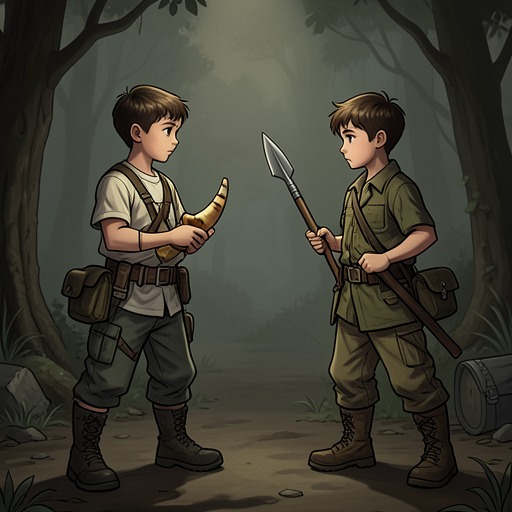
The argument becomes an open contest over authority when Jack tells Ralph to stop directing the boys. Ralph answers that he was chosen, but Jack questions why an election should make any difference and attacks Ralph’s abilities as a hunter and singer. The exchange pits the assembly’s earlier choice of a chief against a claim to authority grounded in strength and hunting. Piggy’s presence sharpens the conflict: Jack accuses Ralph of favoring him, while Ralph tries to protect Piggy’s right to speak under the conch’s rule.
Ralph appeals to the rules as the only common structure the boys possess. Jack answers that the rules do not matter and declares that the boys are strong enough to hunt. He turns the fear of the beast into a promise of violent action: if it exists, they will pursue it and beat it. Then he gives a whoop and runs down to the sand. The gesture makes his defiance more than an argument. He leaves the assembly and draws the boys away from the place where the conch and Ralph’s procedure might still command their attention.
Ralph does not immediately blow the conch to summon them back. He fears that if the boys ignore it, the group will have proved unable to sustain the fire and may never be rescued. Piggy urges him to be tough and make them return, but also warns that not calling them will hasten their descent into animal behavior. Ralph’s hesitation exposes the trap: the conch’s authority depends on the boys recognizing it, and using it when they might refuse could publicly confirm its failure. Meanwhile, the dispersed boys gather on the sand, where their mock hunt, chanting, laughter, and terror continue without the meeting’s restraints.
Aftermath and Escalation
The assembly does not produce a stable settlement. Ralph remains chief, but Jack has demonstrated that he can challenge that office and attract followers by offering the hunt. Ralph’s concern about the fire and Piggy’s concern about the collapse of order remain unanswered. The event thus makes the difference between agreeing on rules and possessing the means to enforce them unmistakable: the boys have a procedure, but no accepted authority strong enough to keep fear and excitement within it.
Later events deepen the conflict first exposed in the meeting. Jack’s hunters present a sow’s head as a gift for The beast, and Simon’s encounter with it gives explicit form to the possibility he could not explain in the assembly: the threatening force is not simply an animal that can be hunted down. Later, during a storm, Ralph and Piggy join the boys’ circle dance as the chant of killing the beast rises; Simon, trying to communicate what he has discovered about the dead parachutist, is mistaken for the beast and killed. These later scenes do not resolve the argument from the assembly; they show how fear and collective excitement can turn its unresolved question into violence.
The conch’s eventual destruction at Castle Rock gives the earlier breach a material culmination. When Piggy appeals to the shell while confronting Jack’s tribe, Roger releases the great rock; it kills Piggy and shatters the conch. The symbol that once helped the boys regulate speech no longer exists, while Jack claims the chief’s authority by force. The assembly’s collapse is therefore an early and consequential break in the boys’ political order, not its final one. The possibility of rescue returns only when the fire set during the hunt for Ralph produces smoke that draws a naval officer to the beach, an outcome that contrasts starkly with the group’s earlier inability to keep its rescue signal under collective control.