The choir and hunters
Lord of the FliesThe choir and hunters are the group that first arrives at the assembly in disciplined formation, led by Jack Merridew. Their transformation from school choir into hunters gives Jack Merridew a ready-made constituency and a practical source of power. As their uniforms give way to face paint and their collective discipline serves hunting and coercion, the group’s changing identity traces the collapse of the boys’ common order.
Identity and Introduction
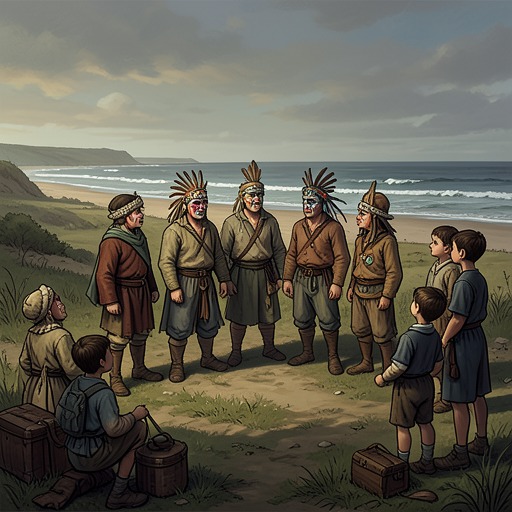
The group first appears marching along The beach in two parallel lines, dressed in black cloaks marked with a silver cross and square caps bearing silver badges; Jack Merridew’s badge is gold. Their clothes and formation make them conspicuously distinct from the other boys. The tropical heat and their journey leave them sweating and exhausted, but they halt when Jack Merridew orders them to stop. The display suggests an institution built around obedience, even before the boys have established what authority will mean on The island.
That discipline proves imperfect. The choir protests when Jack Merridew commands them to stand still, and one boy collapses. Jack Merridew treats the fainting as familiar, recalling that it has happened before, and allows the group to sit. The boy is Simon, who later joins Ralph and Jack Merridew on the first expedition. The group also includes Maurice, described as broad and grinning, and Roger, who keeps apart and gives his name quietly. Their different temperaments are present from the outset, but the uniform initially makes them look like a single body.
From Choir to Hunters
At the first election, Jack Merridew claims that his position as head boy and chapter chorister makes him the proper choice for chief. The choir raises its hands for him, while most boys outside it elect Ralph. Ralph then gives Jack Merridew charge of the choir and invites him to decide what role it should take. Jack Merridew chooses hunting. This arrangement turns an initial political defeat into an organized leadership role: he does not become chief, but retains command of a group already accustomed to following him.
When Ralph explains that The island is uninhabited and says hunters are needed to provide meat, the new role appears to serve the group’s shared survival. Jack Merridew and the other boys recall a pig they failed to kill on their first expedition. But the group’s hunting purpose soon competes with other collective needs. While Ralph and Simon work on shelters, Jack Merridew admits that he continued tracking alone because he thought he might kill. The hunters return from expeditions but spend time swimming; their pursuit of meat does not reliably translate into the labor needed to shelter everyone.
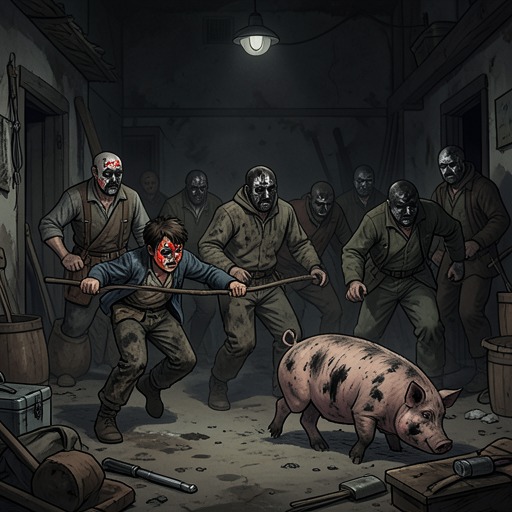
The group is also assigned responsibility for the signal fire. Jack Merridew agrees to divide the hunters into groups to maintain it, with the altos and trebles taking turns, and proposes that green branches be added to produce smoke when a ship appears. Yet the duty is fragile: during a successful hunt, the hunters let the fire go out, and a ship passes without seeing a signal. The pig they bring back is tangible proof of the hunt’s success, but the missed rescue makes the cost of their divided priorities equally concrete.
Division and Changing Allegiance
As conflict over rules and leadership deepens, the hunters become the base from which Jack Merridew challenges Ralph. At an assembly, Jack Merridew argues that Ralph is not a proper chief and tries to put his removal to a vote. When the boys do not raise their hands, Jack Merridew lays down The conch and declares that he will no longer be part of Ralph’s lot. He leaves to hunt and invites anyone who wants to hunt with him to follow. The split is not simply a disagreement about tasks: the group once defined by its shared uniform and assigned office now helps make rival allegiance possible.
The contrast between their early ceremonial appearance and their later presentation is sharp. When Jack Merridew returns with painted hunters, the paint conceals shame and self-consciousness and helps him address the boys as a separate group. He announces that his followers live by a flat rock, hunt, feast, and may admit newcomers. Two painted companions help him invite the others to join. The former choir’s coordinated identity has not disappeared; it has been redirected from school discipline toward loyalty to a new chief and the attractions of meat and feasting.
Violence and Consequences
At Castle Rock, Jack Merridew’s tribe faces Ralph and his companions, who have come to demand Piggy’s glasses and insist that a signal fire be kept burning. When Jack Merridew orders Sam and Eric to be seized and tied, the painted group hesitates, then surrounds and overpowers the twins. Jack Merridew presents their compliance as evidence that they do what he wants. Group pressure has become a means of making an order effective, where the earlier assembly depended on agreement and a speaking turn governed by The conch.
The confrontation ends in the destruction of that shared symbol and Piggy’s death. While Piggy holds The conch and argues for rules and rescue, Roger releases a great rock; it strikes Piggy and The conch shatters. Jack Merridew declares himself chief, attacks Ralph, and the tribe advances until Ralph runs. In the aftermath, Jack Merridew and Roger force Sam and Eric to join the tribe: Jack Merridew prods Sam with a spear, and Roger approaches the twins with an authority that no longer needs the assembly’s consent.
Narrative Significance
The choir and hunters connect the book’s opening image of order to its later scenes of organized violence. Their first obedience is real, but it is not a guarantee that their discipline will support common rules: the same capacity to form ranks, accept commands, and act together can serve a signal-fire rota or a coercive chief. The group’s changing duties also dramatize a conflict of consequences. Hunting supplies food and belonging, while neglect of the signal fire weakens the possibility of rescue; at Castle Rock, collective obedience becomes a direct threat to those outside the tribe.
The group is therefore not merely Jack Merridew’s background or a fixed set of schoolboys. Its history shows how a recognizable institution can be repurposed as authority shifts: first a choir, then hunters entrusted with practical responsibilities, then a faction whose painted members enforce Jack Merridew’s commands. By the time the naval officer reaches The beach, boys with coloured clay on their bodies and sharp sticks stand silently as the fire consumes the palms. The hunters’ transformation belongs to the larger collapse of the society they initially seemed equipped to organize.