The conch’s first call
Lord of the FliesThe conch’s first call is the moment a beautiful object becomes a public instrument: Ralph’s blast gathers the stranded boys and helps make their first assembly, and his election as chief, possible. What begins as an improvised summons also establishes a pattern that will shape the boys’ attempts at order: the shell can bring them together, but it cannot ensure that they will continue to listen to one another.
Finding and sounding the shell
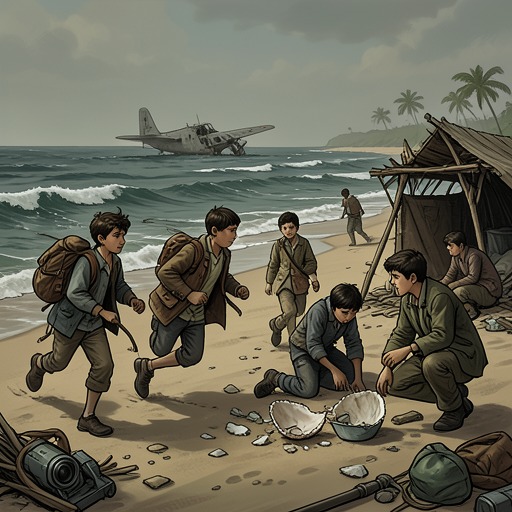
Ralph and Piggy first notice the shell among weeds in the lagoon. Piggy recognizes it as a conch and explains that someone he knew used one to call; Ralph, meanwhile, pulls it from the water with the help of a palm sapling. It is eighteen inches long, deep cream with fading pink at its edges, spiraled and embossed, with a worn point and a deep tube. Its size and careful pattern give it the look of a valuable object, but its importance quickly becomes practical.
Piggy proposes using it to call the others to a meeting. He cannot blow it himself because of his asthma, so he explains how his acquaintance produced a sound and urges Ralph to try. Ralph’s first attempts make only rushing air and a low, comic noise. The change comes when he uses his diaphragm: the shell gives out a deep, harsh note that travels under the palms, through the forest, and back from the pink granite of the mountain. Birds rise from the treetops, and an animal squeals and runs through the undergrowth. The call is not merely audible; it briefly alters the island around it, stirring its wildlife as it reaches the boys.
Ralph blows again, and the note climbs into a more penetrating blare before his breath fails and the sound sinks away. He follows with short blasts. The effort visibly affects him: his face darkens with exertion and his heart shakes his stretched shirt. Piggy, watching the shore, spots a child approaching. The shell’s sound has made a signal out of Ralph’s breath, turning two boys’ discovery into an invitation others can recognize.
The boys assemble
The first boy to reach the platform is Johnny, about six years old, with torn clothes and fruit smeared on his face. Piggy helps him up and asks his name while Ralph continues blowing. Johnny settles in front of Ralph, reassured that something purposeful is happening. Other boys appear singly, in pairs, and in small groups, emerging from the heat haze along the beach or from nearby undergrowth. Three very young children who had been eating fruit in the forest arrive close by; more follow.
They take their cue from Johnny, sitting on fallen palm trunks and waiting. Piggy moves among them, asking their names and trying to remember them. Their varied clothing—some are naked or half-dressed, others still wear school clothes—makes visible how abruptly this gathering has been assembled from separate lives. Ralph keeps sounding the shell until voices from the forest draw nearer. The final pair to reach the platform are the twins Sam and Eric, who fling themselves down, panting and grinning. The call has gathered not a prepared community but a scattered group of children who do not yet know what they must do together.
From summons to authority
The meeting makes the need for organization explicit. When Jack Merridew asks whether any grown-ups are present, Ralph answers no; Jack concludes that the boys will have to look after themselves. Piggy explains that Ralph called the meeting so they could decide what to do. Names are exchanged, although Jack Merridew objects to being called Jack and insists on his surname. In the same gathering, Piggy’s private confidence in Ralph is exposed when Ralph reveals the nickname Piggy had entrusted to him; the boys laugh, leaving Piggy outside their brief circle of sympathy.
Ralph raises the question of a chief. Jack Merridew claims the position on the grounds that he is a chorister and head boy, but Roger proposes a vote. The boys’ enthusiasm for the shell and the act of voting gives the assembly both a signal and a procedure. Ralph is chosen: the choir supports Jack Merridew, while the boys outside it vote for Ralph, and Piggy finally raises his hand as well. Ralph’s possession of the shell has helped distinguish him before the election, even though Piggy has supplied much of the practical understanding behind its use. The first call thus leads directly from physical discovery to a decision about leadership.
The call’s lasting and fragile meaning
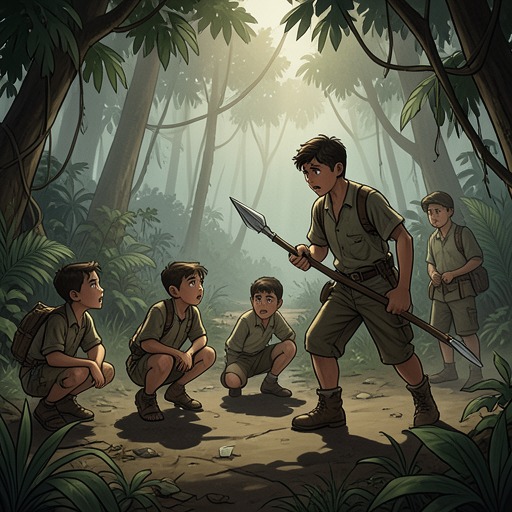
At a later meeting, Ralph makes the shell part of a speaking rule: whoever holds it may speak without interruption, subject to Ralph’s authority. On the mountain, when the first signal fire has failed to produce smoke, Piggy invokes the shell to claim a hearing, but Jack Merridew argues that it does not count there. Ralph responds by insisting that the same meeting rule should apply on the mountain as below. The dispute shows the difference between having a rule and having the power to make others observe it.
That difference becomes decisive when a later assembly breaks apart. Jack Merridew rejects the rules as the boys scatter into disorder, and Ralph hesitates to sound the shell again because he fears they may not return. The first call had seemed to prove that a common signal could gather them; now the very possibility that it will go unanswered threatens their shared purpose. At Castle Rock, Piggy holds out the shell while arguing for rules and rescue. Roger releases a great rock, which strikes Piggy and shatters the shell into fragments; Piggy falls to his death. The contrast completes the object’s arc without erasing what its first sound accomplished: the conch began as a means of calling a community into being, but its authority depended on the boys’ willingness to recognize it.