The election of Ralph as chief
Lord of the FliesThe election of Ralph as chief creates the stranded boys’ first formal leadership and gives their attempt at self-government a public starting point. It is neither a straightforward victory for the most obvious candidate nor a choice founded simply on practical competence: the boys’ noisy vote settles on Ralph, while the conch and Ralph’s presence help make him seem set apart. His offer to give Jack Merridew command of The choir and hunters turns defeat into a provisional partnership, but the election’s authority will later be challenged and its central emblem destroyed.
A Chief for a Group Without Adults
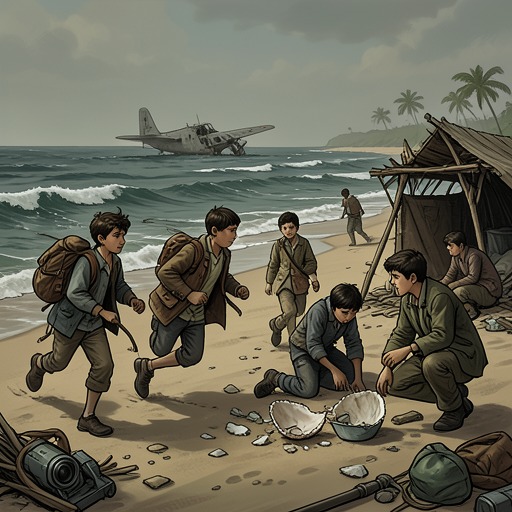
The question of leadership arises as the boys confront the absence of grown-ups and the need to decide how they will be rescued. Ralph proposes having a chief to make decisions. Jack Merridew immediately claims that he ought to lead, citing his position as head boy and chorister and even his ability to sing C sharp. His confidence rests on a familiar school hierarchy; he presents leadership as something his previous status entitles him to.
The scene does not make Jack Merridew’s claim absurd. The account identifies him as the most obvious leader, while the intelligence already displayed among the boys is largely attributable to Piggy. Yet being able to think through the problem and being accepted as chief prove to be different kinds of authority. Roger proposes a vote, and the boys take to the idea with enthusiasm. Their clamor shifts from wanting a chief to acclaiming Ralph, without any clear argument establishing why he should win.
Why the Boys Choose Ralph
Ralph’s appeal is conveyed through presence as well as procedure. He is physically imposing and attractive, and there is a stillness about him that distinguishes him in the circle. More obscurely, he is associated with the conch: he had blown it to gather the boys and sat waiting on The platform with the shell balanced on his knees. The object gives a visible focus to the assembly, and the boys’ call to choose the boy with the shell links Ralph’s personal authority to the instrument that brought them together.
The division of the vote makes the result more specific than a simple rejection of Jack Merridew. When Ralph asks who wants Jack Merridew as chief, The choir and hunters raise their hands. When he asks who wants him, every boy outside the choir except Piggy raises a hand; Piggy then raises his grudgingly. The boys applaud Ralph’s election, while Jack Merridew blushes with mortification, starts to rise, and sits down again. The outcome is a collective choice, but it leaves Jack Merridew’s organized following visibly distinct from the wider group.
A Provisional Settlement
Ralph responds to the defeat with an offer rather than an attempt to exclude his rival. He tells Jack Merridew that The choir and hunters belong to him and invites him to decide what role they will take. Jack Merridew chooses hunting. As the color drains from his face, their immediate antagonism softens: Ralph and Jack Merridew smile at one another with shy liking. The compromise gives Jack Merridew a recognized sphere of command while keeping Ralph at the head of the larger community.
That arrangement also gives leadership a practical dimension. When Ralph explains that the boys need hunters because there are pigs on The island, Jack Merridew’s group can supply meat. The election thus distributes responsibility as well as status: Ralph is chief, and Jack Merridew leads The choir and hunters. Their initial agreement does not remove the conflict between the priorities of rescue, shared work, and hunting, but it temporarily contains that conflict within a common structure.
Authority Tested and Undone
The election’s meaning becomes clearer as the boys try to make their order work. At the first assembly after the mountain expedition, Ralph proposes rules for taking turns to speak, with The conch passed to the next speaker and interruptions limited. Later, after a fire burns without producing smoke, Ralph insists that the signal must be maintained because a ship might appear; he argues that the conch marks a meeting on the mountain as well as at the assembly place. These efforts show the elected chief trying to turn the initial public choice into rules and shared duties, not merely issue commands.
But the vote cannot by itself make those rules enforceable. As fear and disorder over the beast overtake an assembly, Jack Merridew rejects the authority of the rules and leads the boys away into hunting and excitement. The contrast is sharp: Ralph invokes the rules as the only thing the boys have, while Jack Merridew claims the power to hunt and promises force against the beast. The election has created a recognized office, but the boys’ willingness to obey it has begun to fracture.
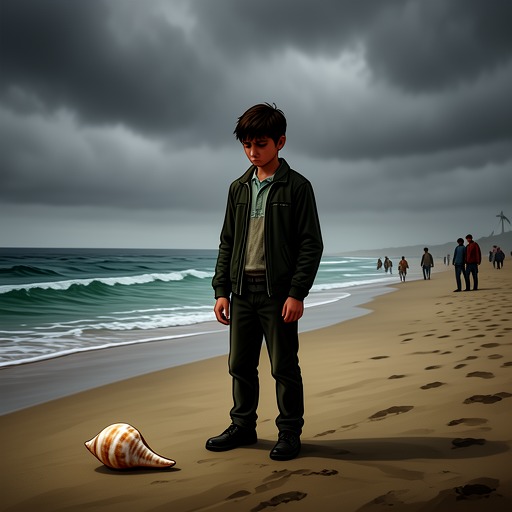
The final destruction of the conch makes that fracture physical. At Castle Rock, Piggy holds the shell and appeals to rules, agreement, and rescue while Roger releases a great rock. It strikes Piggy and the conch explodes into fragments. Jack Merridew then declares himself chief and throws a spear at Ralph. The scene does not erase the earlier election; it shows the difference between authority grounded in collective recognition and power asserted through violence. When Ralph is driven through the burning forest and reaches the beach, a naval officer has arrived after seeing the smoke. Rescue ends the boys’ isolation, but the route from their first vote to that arrival has exposed how quickly their chosen order could be displaced.