The first island expedition
Lord of the FliesThe first island expedition is the boys’ first sustained attempt to read and master their surroundings. Led by Ralph, with Jack Merridew and Simon beside him, the journey confirms that The island is isolated and appears uninhabited, gives the boys their first comprehensive view of its terrain, and sets hunting alongside exploration as a practical response to their predicament. Its movement from playful fellowship to a failed attempt to kill a piglet also introduces a tension that will recur: the island can be surveyed and named, but it does not simply yield to the boys’ intentions.
Departure and the choice of explorers
After Ralph, Jack Merridew, and Simon leave the platform, Piggy trails behind and asks to come with them. Jack dismisses him, and Ralph backs the exclusion, telling Piggy to return and take names. When Piggy protests that Ralph had disclosed the name he had asked the boys not to use, Ralph recognizes that he has hurt him and offers an apology, but still assigns him a separate task. The expedition begins, then, with a division: three boys go to explore while Piggy remains responsible for recording the group.
The contrast between Piggy’s humiliation and the explorers’ mood is sharp. On the low-tide shore, where a strip of weed-strewn sand lies almost firm underfoot, Ralph, Jack Merridew, and Simon laugh and talk excitedly. They are conscious of the glamour of the moment, and Ralph’s headstand, followed by the others’ laughter, belongs to an afternoon in which discovery still feels like play. Jack calls them explorers; Ralph proposes going to the end of The island and looking around its apparent corner. Their shared movement gives them a temporary sense of friendship and possibility, even as Piggy’s exclusion shows that the group’s first adventure is not equally open to everyone.
The route and the climb
At the end of The beach, the boys find that the coast does not turn around a corner as Ralph had hoped. It bends in a slow curve, with rocks growing rougher toward The mountain. Rather than turn back, they choose what Ralph judges to be the easiest ascent: less dense jungle and more exposed pink rock. Their progress makes exploration physical work. Narrow tracks wind upward beside cliffs, and the boys edge along them with their faces to the rock; when Jack wonders what made a track, Ralph suggests people, but Jack says animals. The undergrowth then forces them to thread through tangled creepers, using the slope and intermittent flashes of light to find a way higher.
On the upper rocks, the boys discover that one large stone can be moved. They sway it back and forth until it passes its point of balance, crashes through the air, and smashes a deep hole in the canopy of The forest. The noise, flying birds, and shaking trees briefly make their experiment feel like a great feat. The episode shows them treating the landscape as something to test and alter, but the result is not a useful route or shelter: it is a rockfall that tears through the forest below. Afterward, the way to the summit is easier. They pass a hollow filled with blue rock flowers, whose overflow hangs down toward the trees, while butterflies rise and settle in the air.
The view from The mountain
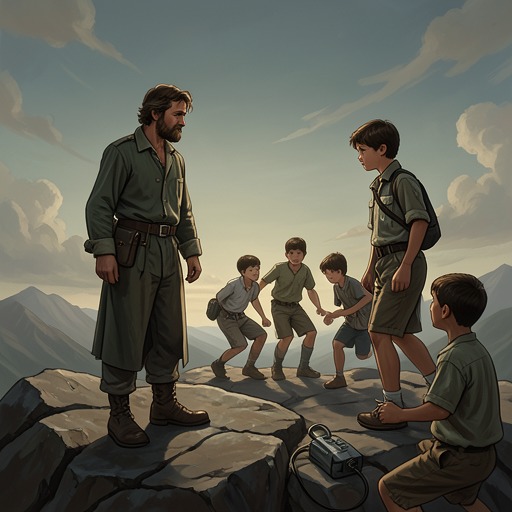
At the top, the boys no longer have to infer that they are on an island. From a height, with water visible in every direction and no mirage obscuring the view, they see a circular horizon. The island’s roughly boat-shaped form becomes legible: a steep, rocky side lies behind them, while a more gradual, tree-covered descent extends ahead toward a dense green flat and a pink tail of land. A separate rock stands almost detached across The lagoon, like a fort facing them.
The view also gives the boys a first practical map. A coral reef lies perhaps a mile offshore and runs parallel to what they take to be The beach; inside it, rocks and weed show through peacock-colored water, while beyond it the sea is dark blue. Looking back toward their landing place, they can see the scar left by the crash, splintered trunks, and the strip of palms between the damage and the sea. They can also pick out The platform and the small figures near it. Ralph traces a route down the slope and through a gully toward the scar, identifying what he considers the quickest way back. The height turns the landscape into something they can survey and navigate, not merely a succession of unfamiliar obstacles.
Their observations provide grounds for believing that no one else lives there: Ralph notes the absence of village smoke and boats, and the view reveals no houses, people, or other signs of habitation. The boys respond not only with relief or caution but with a sense of possession. They celebrate the island as theirs and plan to find food, with Jack immediately proposing that they hunt and catch things until someone comes for them. Simon says little, but nods along. The expedition thus connects what they have seen to the practical question of how they will live: the empty horizon offers no visible rescue, while the island itself must supply what they need.
The piglet and the expedition’s limits
On their descent, the boys pause to examine unfamiliar bushes. Their waxen buds look like candles, but Ralph points out that they cannot be lit; Jack dismisses them as inedible and urges the others onward. Soon they hear squeaking and the hard strike of hooves. They find a piglet caught in a curtain of creepers, struggling against the elastic strands. The animal’s appearance turns the idea of hunting into an immediate test: here is living prey, not an abstract resource or a plan for later.
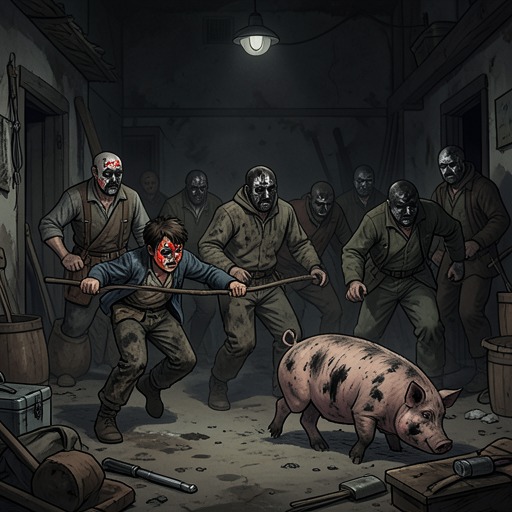
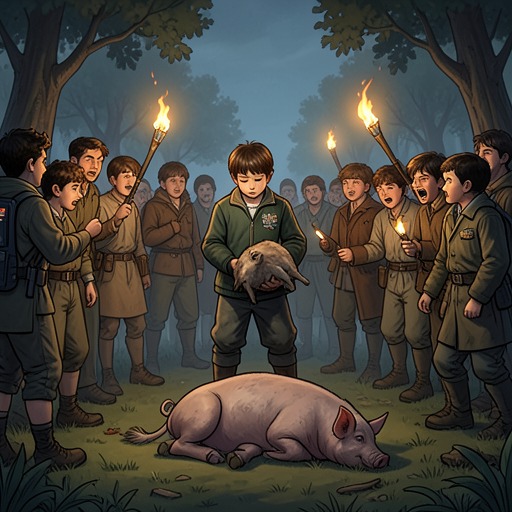
Jack draws his knife and moves to kill it, but hesitates. The piglet breaks free before he can strike and disappears into the undergrowth. At the later meeting, the boys remember the squealing animal and Jack’s failure to kill it; he drives his knife into a tree and challenges the others with the promise that next time will be different. The expedition therefore returns no meat, but it has shown the boys that Wild pigs are present and made hunting a stated aim. It also exposes the distance between wanting to hunt and being able to kill.
Consequences and significance
The expedition’s findings shape what happens next. At the assembly, Ralph reports the evidence for an uninhabited island and explains that, without grown-ups, the boys will have to look after themselves. The earlier panorama supplies the basis for that conclusion; the encounter with the piglet supplies the immediate example behind the proposal for hunters and meat. Exploration becomes an argument for organizing life on The island rather than an adventure separate from it.
The boys’ initial confidence also stands in contrast to the later fate of their attempts at order. When Ralph and Jack Merridew argue over rules and hunting, Jack insists that the boys are strong and can hunt, while Ralph warns that rules are all they have. Later, when Roger releases the boulder at Castle Rock, the object kills Piggy and destroys the conch. These later events are not part of the expedition, but they sharpen its significance: early on, the boys test their power against stone and trees in shared excitement; later, violence against people replaces playful experiment, and the group’s common authority collapses. The expedition’s first image of The island as a place that belongs to the boys thus carries both promise and irony. They have found a world to explore, but not a world they can control simply by claiming it.