The first signal fire and the forest blaze
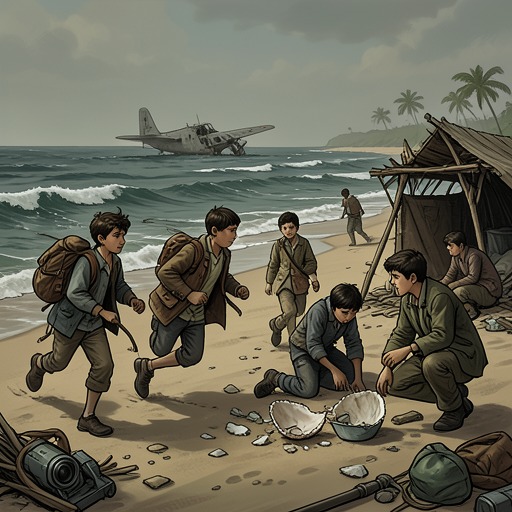
Lord of the FliesThe first signal fire begins as a plan to make the boys visible to passing ships and becomes a forest fire they cannot control. On The mountain, the boys transform a shared hope of rescue into a spectacle of flame: their first ignition depends on Piggy’s glasses, while the fire they build spreads beyond its intended pile and consumes part of The forest. The episode establishes a lasting tension between rescue and destruction.## Causes and Preparation Ralph proposes the fire after explaining that the boys are on an uninhabited island and that no one knows where they are. A ship might pass without seeing them, so smoke from The mountain could make their presence known. Jack Merridew seizes on the proposal and leads the excited crowd away from the meeting, with Ralph following and Piggy left behind before he, too, sets off carrying The conch.
The boys find a steep slope where dead wood has accumulated beneath the trees. They haul it uphill in a collective effort: Sam and Eric find a promising log, and Ralph, Jack Merridew, Simon, Roger, and Maurice help move it. The work briefly makes Ralph and Jack Merridew companions, sharing the burden and laughing as they reach the pile. Younger boys contribute, too, though some lose interest and turn to searching for fruit. The scale of the heap grows faster than the boys’ practical preparation for lighting it.
When the pile is ready, neither Ralph nor Jack Merridew knows how to start a fire. Jack Merridew can only vaguely describe rubbing sticks together, and Roger demonstrates an imagined bow drill. The moment punctures the confidence of the mountain expedition: the boys have gathered an enormous amount of fuel without having matches or a reliable method of ignition.## Ignition and the Spread Piggy arrives from The forest with The conch under his arm. When Ralph asks for matches, Piggy has none. Jack Merridew points to Piggy’s glasses as a way to focus sunlight, and the boys surround Piggy before he can withdraw. Jack Merridew snatches the glasses from his face despite Piggy’s frightened protests that he can hardly see without them. Ralph uses the lenses to concentrate the declining sun on a piece of rotten wood.
Smoke rises, and Jack Merridew blows on the smoldering wood until a small flame catches. The boys cheer as it climbs from a twig to a branch. Ralph gives Piggy his glasses back, but Piggy says his sight is reduced to blurs. The first success has therefore already come at a cost to the boy whose spectacles made it possible. It also leaves Ralph and the others with a fire they have not learned how to manage.
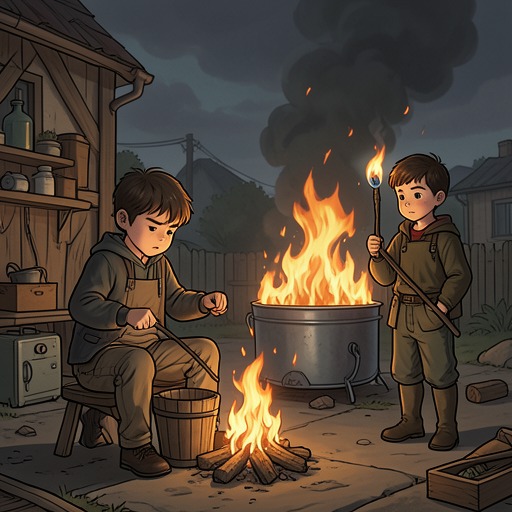
The pile burns fiercely. Its rotten, tinder-dry wood produces a towering flame, and the boys scatter to fetch more fuel, treating the fire as an immediate task in itself. The blaze soon diminishes as the heap collapses. Ralph realizes that it produced flame but not the sustained smoke needed for a signal. Piggy points out that the boys have not made a useful, maintainable fire; Jack Merridew dismisses his criticism because Piggy did not help gather wood. Simon, however, recognizes that Piggy did help by providing the glasses.
Ralph proposes that some boys be assigned to tend the fire, and insists that The conch and its speaking rule apply on the mountain as well as at the meeting place. Jack Merridew agrees to divide The choir and hunters into groups responsible for tending the fire and keeping watch. He suggests a weekly rotation between the altos and trebles, but also decides that the fire can be allowed to go out at night and restarted when needed. The decision gives the appearance of an organized duty while underestimating what the boys have actually set in motion.## From Signal to Forest Blaze As the boys discuss how to make smoke, Piggy looks down the slope and notices smoke rising from several points among the creepers and dead or dying trees. Flames have escaped the woodpile and reached the surrounding vegetation. The fire spreads from brush to trunks, then leaps between trees as wind carries it onward. What the boys had treated as a manageable pile of fuel becomes a blaze advancing through The forest.
The fire’s scale changes the mood on The mountain. At first, the boys cheer; as the flames spread across roughly a quarter of a mile square, their excitement gives way to awe. Piggy’s earlier warning that they should have been more careful becomes immediate. He points out that the burning wood was their available firewood, and says he is scared. The others laugh at him, while Ralph, absorbed by the fire, initially turns away from Piggy’s repeated claim to speak under The conch. The blazing forest draws their attention more powerfully than their agreed rules.
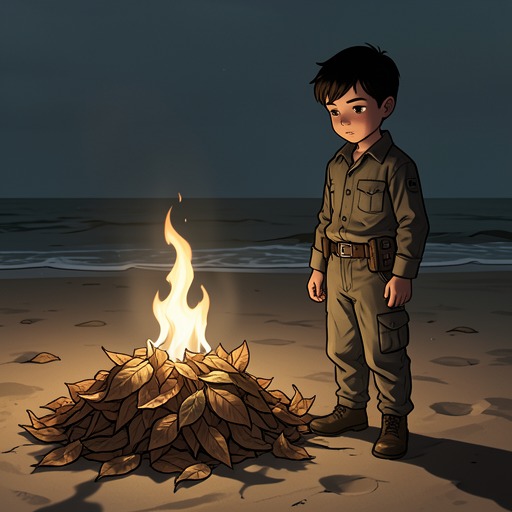
The episode’s central reversal is practical and political at once: the boys successfully create fire, but fail to make the controlled signal they intended. Their shared labor and quick agreement produce action, not judgment; once the fire escapes, they can only watch. The intended beacon for rescue has become a danger on the very island where they must survive.## Later Consequences and Significance The first blaze foreshadows the fragility of the rescue plan. The boys’ commitment to maintaining a signal fire is soon challenged by the pull of hunting and by the breakdown of collective discipline. Later, when a ship passes, The signal fire is out; Piggy reminds the assembly that they had allowed it to fail while the boys went hunting. The initial fire’s failure to produce dependable smoke thus anticipates a more consequential failure to keep the rescue signal alight.
The fire’s later meaning turns again near the end of the story. Jack Merridew’s group sets fire to The island in order to drive Ralph out of hiding. Ralph flees through the burning vegetation toward the beach, where an officer from the Royal Navy has arrived. The officer has seen the smoke, and the destructive blaze inadvertently leads to the boys’ rescue. The first signal fire and the final conflagration are not the same event, but their contrast completes the fire’s trajectory: a deliberate beacon is mishandled, while an act of pursuit and destruction becomes the signal that brings help.
The first blaze is therefore more than a failed practical exercise. It connects the boys’ hope of rescue to their capacity for damage, and shows how quickly a collective undertaking can outrun its rules, its leaders, and the knowledge needed to control it. Piggy’s glasses can kindle a flame, but neither the glasses nor the boys’ enthusiasm can make that flame serve its intended purpose.