The mountaintop signal fire
Lord of the FliesThe mountaintop signal fire begins as a plan to make the stranded boys visible to passing ships, but its history exposes how difficult it is for them to sustain a common purpose. Its flames offer hope of rescue; its smoke depends on organized labor, attention, and rules that the boys repeatedly fail to uphold. When the fire goes out as a ship passes, that failure becomes a concrete consequence of the conflict between Ralph’s priorities and Jack Merridew’s hunting party.
Purpose and First Lighting
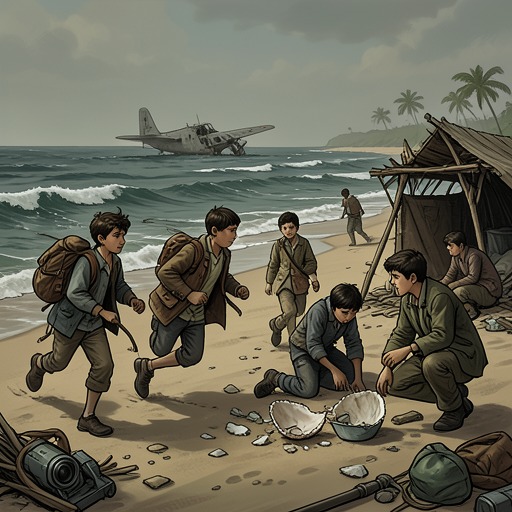
After establishing that The island has no other people, Ralph tells the assembly that the boys want to be rescued and must help a ship find them. He proposes a fire on The mountain, where its smoke might be seen from the sea. The boys rush after Jack Merridew toward the summit, turning a plan announced at a meeting into an impromptu collective undertaking. The fire is meant not simply to provide warmth but to serve as a visible signal—and its usefulness therefore depends on keeping it going when no one is watching.
At first, the boys have gathered a large heap of dead wood but do not know how to ignite it. Ralph and Jack Merridew admit that they have no matches, and Roger demonstrates an imagined method of rubbing sticks. Piggy arrives carrying The conch, and Jack Merridew proposes using Piggy’s glasses as burning lenses. The boys seize the glasses before Piggy can back away. Ralph directs the lenses toward the declining sun until its focused image falls on rotten wood; smoke rises, Jack Merridew blows on the tinder, and a small flame catches. Piggy protests that he can hardly see without his glasses, while the boys celebrate the fire. Their means of calling for rescue thus depends on an object taken from one of their own group, making the signal’s hopeful beginning inseparable from disregard for Piggy’s needs.
From Bonfire to Shared Duty
The flame quickly exceeds the purpose for which the pile was built. The dead wood is tinder-dry, and the fire climbs into branches, throwing heat and sparks across the summit. Boys race for more fuel, but the blaze soon diminishes and the pile collapses. Piggy points out the practical distinction between a large, bright flame and a useful signal: the boys have made a fire that produces little smoke and cannot readily be maintained. Maurice suggests green branches as a way to make smoke, while Ralph insists that any passing ship might be their chance to get off The island.
Ralph responds by proposing designated fire-watchers and extending the meeting rules to the summit: where The conch is, the boys should have a meeting. Jack Merridew publicly supports rules and offers to divide the choir, now his hunters, into groups to tend the fire. The hunters are to take turns by vocal groups, with the altos responsible one week and the trebles the next; green branches can be added to increase the smoke if a ship appears. This arrangement makes the signal fire a shared obligation rather than an occasional burst of excitement. Yet the first fire has already spread beyond control: smoke appears among the dead and dying trees, and flames crawl through the forest. What began as a deliberate signal becomes an enormous, destructive blaze, greeted first with cheers and then with awe. The episode establishes the fire’s double capacity: it can call for rescue, but fire-making without restraint can endanger the very community it is supposed to help.
The Missed Ship
The signal fire’s decisive failure comes when a ship appears on the horizon. Ralph spots smoke and initially believes the ship will see the boys’ own signal. Piggy cannot see the smoke clearly, but Ralph watches the vessel as its outline and a possible funnel emerge beneath the distant cloud. Simon and Maurice follow Ralph’s gaze toward the summit, where the fire should be. Ralph runs inland, with the others following, and calls for Piggy’s glasses in case they must relight it.
The fire is completely out. A pile of unused fuel remains ready, but the watchers are gone. Ralph looks back toward the sea and sees the ship’s smoke receding; the smoke he first noticed belonged to the vessel, not a signal from the summit. His calls for the ship to return bring no response. Piggy reaches the summit out of breath, and Ralph’s anger fixes on the failure of the fire-watch: the ship has passed while the signal was dead. The loss is more than a missed opportunity. An agreed duty has not been carried out, and the boys’ inability to maintain their rescue plan now has an irreversible result.
The lapse also sharpens the conflict between Ralph’s leadership and Jack Merridew’s priorities. In a later assembly, Piggy recalls that the boys have let fires go out while going hunting, and Ralph tries to defend the rules that might prevent such failures. Jack Merridew rejects their authority, insisting on the strength of the hunters and their readiness to pursue the beast. The signal fire therefore remains a practical stake in the argument over who should lead: Ralph’s appeal to collective discipline is tied to rescue, while Jack Merridew’s challenge directs the group toward hunting and force.
Rekindling and Reversal
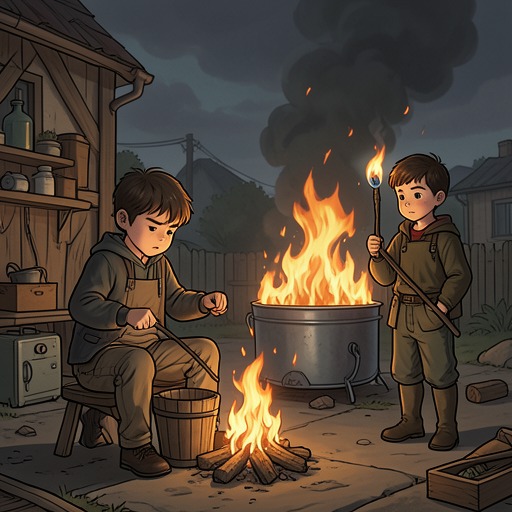
The fire is not simply abandoned after the missed ship. During a night watch, Sam and Eric find the signal fire nearly extinguished. One twin thinks it is out; the other blows on the smoldering spot while they fetch tinder and dead wood. They coax the glow back into flame and build a small shelter of wood around it, remarking that they had been close to losing it. Their work restores the fire through a modest act of maintenance, in contrast to the earlier summit blaze: the signal survives not through a crowd’s excitement but through the twins’ effort to preserve an ember.
Later, during Ralph’s flight from Jack Merridew’s hunters, the forest and a shelter burst into flames as the hunt drives him toward the open beach. There a naval officer and his men have arrived; the officer says they saw smoke. The passage associates smoke with the boys’ discovery and rescue, but the fire consuming the forest and beach is not presented as a deliberate, maintained signal from the summit. The rescue thus arrives amid a final reversal: fire again makes the boys visible, but now it is part of a destructive blaze rather than the controlled signal they had planned.
Significance
Across its appearances, the fire shifts between collective intention, uncontrolled spectacle, neglected duty, painstaking repair, and destruction. Its promise is straightforward: visible smoke might bring a ship. Making that promise real, however, requires sustained cooperation, and the missed ship shows the cost when the boys’ agreed responsibilities yield to other pursuits. The contrast between the great first blaze and the twins’ careful rekindling also distinguishes dramatic enthusiasm from the less visible labor that a shared undertaking requires.
The fire’s connection to Piggy’s glasses adds another measure of the group’s order. The lenses make ignition possible, but the boys’ treatment of Piggy shows that practical dependence does not automatically produce respect or fair cooperation. Meanwhile, the failure of the watchers turns the difference between rules and actual obedience into a matter of rescue rather than ceremony. The mountaintop signal fire is therefore both a material device and a recurring test: it keeps the possibility of return in view, while revealing how easily that possibility is endangered by disorder and divided loyalties.