The plane crash and stranding
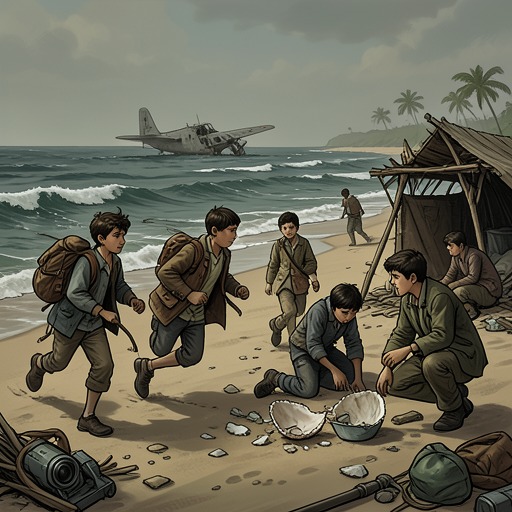
Lord of the FliesThe plane crash and stranding make a distant war the immediate condition of life for Ralph, Piggy, and the other boys: cut off on an uninhabited island, they must try to govern themselves without knowing whether anyone can find them. The crash is not narrated as a continuous action scene. Its cause and aftermath emerge in fragments, and the boys’ first efforts to build order unfold inside the uncertainty it leaves behind. Their eventual rescue does not undo the catastrophe; it exposes how far the isolated community has moved from the expectations of the world that sent them away.
The Crash and the Discovery of Isolation
Ralph and Piggy meet in the wreckage of the boys’ arrival. Piggy, shorter and very fat, emerges from tangled undergrowth in a greasy wind-breaker, searching for safe places to put his feet. Through his thick spectacles, he asks where the man with the megaphone is. Ralph has no answer beyond the possibility that the land is an island and that no adults may be there. Even at this first exchange, their different responses are plain: Piggy tries to establish what happened and who might return, while Ralph is drawn toward the water and the freedom implied by the absence of grown-ups.
Piggy supplies the first account of the disaster. He remembers that the boys were attacked and saw flames coming from another part of the plane; the pilot had been in the cabin at the front, not in the passenger tube. The tube has since been dragged out to sea by the storm, and falling tree trunks made the wreckage dangerous. Piggy fears that some children may still have been inside it. Ralph later tells the assembled boys that the plane was shot down in flames. The crash is thus tied to a war on a scale the boys cannot control, while the disappearance of the aircraft and its occupants leaves no immediate adult authority or known route home.
The uncertainty becomes more severe when Piggy explains that the pilot spoke about an atom bomb. He concludes that everyone else may be dead and that nobody knows where the boys are. Ralph first assumes his father, a Navy commander, will come to rescue them; Piggy’s questions expose that this hope has no secure basis. The boys cannot rely on a known destination, a functioning airport, or an adult who knows their position. Their isolation is not simply the absence of adults in the present: it is the absence of any confirmed connection to the outside world.
From Stranding to a Makeshift Society
At the first meeting, Ralph and the boys begin turning the emergency into a collective problem. The group identifies itself by names, including Simon, Roger, and Jack Merridew, and considers how to choose a chief. Jack Merridew claims authority through his position as head boy and choir leader, but Roger proposes a vote, and the boys acclaim Ralph. Piggy’s contribution to the discussion is more substantial than his position in the group suggests, even as the boys’ laughter over his nickname isolates him. The election offers a procedure for authority where the crash has removed the adults who would ordinarily provide it.
The boys’ next assembly makes the connection between survival and organization explicit. Ralph reports that the explorers found no houses, smoke, footprints, boats, or people on the island. The boys have seen pigs, so hunting can provide food, but the lack of people also means they must look after themselves. Ralph proposes using the conch to regulate speaking: the holder may speak without interruption, subject to Ralph’s authority to intervene. Jack Merridew enthusiastically calls for rules. These arrangements are improvised responses to the stranding, not institutions backed by adults; their force depends on the boys continuing to recognize them.
A signal fire gives their hope of rescue a practical form. Ralph argues that a ship might pass the horizon and that smoke could bring it to the island. When the first fire burns with flame but produces no smoke, Piggy points out that the boys have not made a useful signal. Simon recalls that Piggy helped by letting them use his spectacles. Ralph then calls for designated fire-keepers and insists that the conch’s authority should apply at the mountain as well as at the meeting place. The episode shows the boys attempting to convert a fragile, individual resource into a shared duty. It also shows how quickly that duty depends on compliance: the signal is useful only if someone maintains it and the group treats the rule as binding.
The Failure of Common Rules
As fear and conflict grow, the order created in response to the crash loses its grip. At a later assembly, Ralph tries to preserve the rules and the rescue effort while Jack Merridew rejects the conch’s authority and urges the boys toward hunting. Ralph warns that rules are all the boys have; Jack answers with a declaration of strength and a promise to hunt the beast. The meeting breaks apart into noise and movement. The dispute is therefore more than a contest over who gives orders: it is a conflict between maintaining a common obligation to keep the fire burning and following the immediate excitement of the hunt.
The conch and the signal fire, once instruments for coordinating the stranded group, cannot by themselves enforce cooperation. Ralph fears that if the boys disperse, the fire will not be kept. Piggy argues that if Ralph does not act, they will become like animals anyway. The exchange captures the trap of their isolation: the boys need collective discipline to preserve the chance of rescue, but the absence of external authority leaves discipline dependent on their consent. Their original emergency provides the reason to cooperate; it does not guarantee that they will continue to do so.
Rescue and the Meaning of the Ending
The island’s fire eventually becomes the means by which the stranded boys are found. As Ralph runs from the hunters, flames race through the forest toward The beach. He reaches the sand exhausted and terrified, where a naval officer has arrived in a cutter with two ratings holding it on the shore and another carrying a sub-machine gun. The officer asks whether there are any adults with Ralph, who can only shake his head. Behind him, boys with clay-streaked bodies and sharpened sticks stand silent. The officer sees smoke and asks what the boys have been doing, taking the scene for some kind of war or game.
The rescue turns the boys’ isolation into a sudden encounter with the authority and expectations they had lost. Smoke, intended as a controlled signal, comes from a fire that has spread during the pursuit; the means of rescue is bound up with the violence that made rescue so urgent. The crash begins with a plane shot down in a larger war, and the boys’ final confrontation is also perceived by the officer through the language of war. Their return to adult protection ends their time alone, but the contrast between the officer’s orderly uniform and the silent, armed boys shows what has happened during that interval. The stranding has forced them to create rules, exposed the limits of rules without shared commitment, and made the hope of rescue depend at last on a signal produced by the island’s destruction.