The signal fire and the hope of rescue
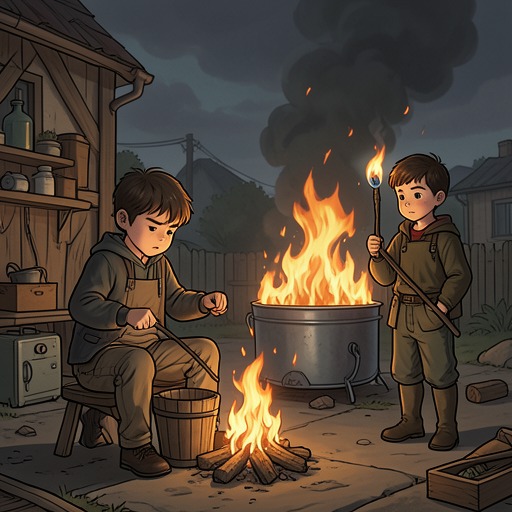
Lord of the FliesThe signal fire is both a rescue device and a test of the boys’ capacity to act together. Its smoke offers a possible route home, but keeping it alive requires attention, labor, and a willingness to put a distant rescue ahead of immediate comfort or excitement. As fear and division grow, the fire is moved, neglected, and deprived of its meaning as a signal; the weakening smoke registers the weakening of the society that depends on it.
Purpose and the burden of keeping watch
The fire’s purpose is practical: a ship might see its smoke and rescue the boys. That possibility gives the work urgency even when rescue remains uncertain. Ralph insists that without smoke they could be left waiting for a ship to pass by accident, perhaps for years. The fire is therefore more than warmth or a source of food. It is the boys’ deliberate attempt to make themselves visible to the world beyond The island.
That aim depends on repeated, ordinary work rather than a single dramatic act. The boys must gather fuel, tend the flames, and keep green branches available to produce smoke. The duty is difficult to distribute fairly: Ralph recognizes that Sam and Eric are often treated as one turn because they do everything together, though that leaves them carrying less than two turns of work. The dispute makes the wider problem concrete. A shared rescue plan cannot endure unless the boys accept shared responsibility for its upkeep.
From The mountain to the shore
The signal fire first depends on a position on The mountain, but that exposed site becomes frightening after Ralph and the others mistake a figure there for the beast. Ralph fears that they cannot fight something so large and admits that, while the boys may be brave in daylight, night changes what they can face. With the supposed beast sitting by the fire, the high site seems to threaten the boys’ safety rather than secure their rescue; Ralph concludes that they cannot maintain a signal fire there.
Piggy proposes a compromise: build a fire lower down, near the bathing pool and The platform. The smoke would not be seen as far away, but the boys would no longer need to approach the feared mountain. Ralph accepts the relocation, weighing diminished visibility against the possibility of tending a fire in a place the group can reach. The choice preserves the rescue plan in altered form, while also showing how fear narrows the practical terms on which the boys can pursue it.
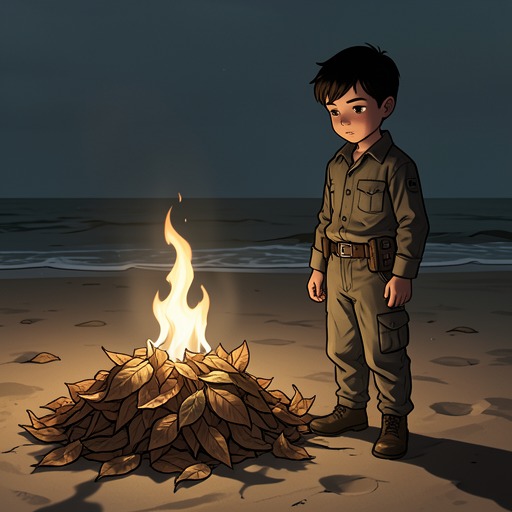
The new fire is made from a pyramid of leaves, twigs, branches, and logs on the bare sand. Piggy removes one lens from his glasses and focuses the sun on tinder, producing smoke and yellow flame. The moment briefly turns the task into a communal celebration: The youngest boys dance and sing, and the nearby fire promises comfort at night. Yet the available wood is damp and rotten, and the boys gather it close at hand to avoid going deep into The forest. The fire’s first success thus contains the conditions of its fragility: its fuel is poor, its visibility reduced, and its maintenance still depends on a dwindling group of workers.
Neglect and the loss of its signal
The initial excitement does not solve the labor problem. The fire grows too large to maintain, then dies down; Ralph realizes that the boys need a new list of people responsible for it, but several older boys have already left. The shortage is not abstract: fewer big boys have gathered wood, and the group cannot confidently assign the work. The signal fire has shifted from a shared achievement to a continuing obligation that the community struggles to meet.
Later, Ralph and Piggy find that the fire has no smoke. Ralph worries that the others do not understand that, without the signal, they may die on The island without rescue. He also fears that he himself may stop caring, as the hunters seem to have done. His anxiety exposes a second kind of failure: the fire can be neglected not only because there are too few hands, but because the purpose it embodies is losing its hold on the boys. Piggy’s answer is to insist on continuing, but the conversation offers no assurance that the labor can be restored.
The contrast between signal fire and cooking fire becomes explicit when Ralph confronts Jack at Castle Rock. Ralph argues that a ship might notice smoke and take the boys home, while the thin smoke from the hunters’ fire is merely cooking smoke and will not serve as a signal. The hunters’ meal satisfies an immediate appetite; the rescue fire asks them to preserve a possibility whose reward is distant and uncertain. Their laughter and silence leave Ralph unable to make that future matter to them.
Fire, force, and the broken community
The fire is also entangled with the boys’ rivalry. After Jack breaks away, he and his hunters raid Ralph’s camp and take half-burnt branches. Ralph identifies the theft as a blow to the rescue effort, since the fire is the island’s most important means of attracting help. Jack, by contrast, presents hunting, feasting, and the freedom to join his tribe as immediate attractions. The dispute is not simply about who controls fuel: it reveals two competing priorities, one organized around remaining visible to rescuers and the other around the rewards of the hunt.
When Ralph later goes to Castle Rock to demand Piggy’s glasses and address the fire, he again explains the danger of relying on an inadequate cooking fire. The confrontation turns the practical argument into a test of authority. Jack orders Sam and Eric seized and tied, and the tribe obeys; Ralph’s appeal to rescue cannot command the same response. The boys who once shared the work of keeping smoke visible now face one another across a division enforced by spears and group obedience.
The signal fire’s significance lies in this gradual reversal. At first, it gives the boys a common task and a reason to preserve their connection with the outside world. Its relocation keeps that hope alive at a cost, and its subsequent neglect exposes how little a plan can accomplish without sustained cooperation. As hunting, fear, and coercion displace collective duty, the rescue signal loses force—not because the possibility of a passing ship has been disproved, but because the boys increasingly fail to organize themselves around being seen.