The unnamed nuclear war
Lord of the FliesThe unnamed nuclear war is the unseen catastrophe behind the boys’ stranding on The island and the reason their familiar expectation of adult protection cannot be trusted. The novel gives no account of the war’s participants or course; instead, it lets fragments of testimony and distant signs establish a world in which violence has reached the children without making its full scale knowable to them.
The War Known Through Fragments
The war enters the story first as something the boys must piece together. Piggy recalls seeing flames coming from another part of the plane as it descended, and tells Ralph that they had been attacked. Ralph offers a hopeful explanation for the pilot’s absence: he thinks the pilot flew away after dropping them and could not have landed on The island in a wheeled aircraft. These are a boy’s recollections and conjectures, not a complete account of what happened to the aircraft or its crew.
The decisive information comes when Piggy explains that the pilot had spoken about the atom bomb. Piggy concludes that everyone is dead, and that nobody knows where the boys are. His claim is not independently confirmed as a factual report about the world’s survivors; it is the conclusion he draws from the information available to him. The narrative preserves that uncertainty. The war is unmistakably catastrophic, but its exact reach and whether any adults remain able to help are beyond the boys’ knowledge.
The Flight That Leaves Them Unfound
The plane’s destruction has a practical consequence as well as a frightening one: the boys have not arrived at their destination, so the people who might have expected them there cannot know where to search. At the first assembly, Piggy presses this point against the assumption that someone at the airport knows their whereabouts. Because the plane never reached its intended destination, he reasons, no one can know where it came down. Ralph then acknowledges that the aircraft was shot down in flames and that the boys may remain on The island for a long time.
This exchange transforms the boys’ predicament from a temporary separation into a crisis of location and communication. Ralph’s father, whom Ralph expects to rescue them, is no longer a reliable link to the world beyond the island. The boys have no known adult contact, and their failure to arrive has severed the ordinary chain by which someone might notice they are missing. The absence of rescue is therefore not merely a delay: it follows from the war’s violence and from the fact that the boys’ whereabouts are unknown.
A World Still Fighting Above Them
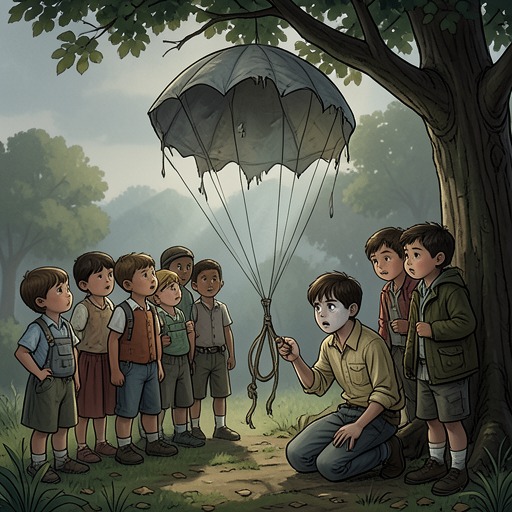
The war does not remain only a remembered explanation. After night falls, the narrative describes lights moving across the sky and going out, while a battle is being fought at high altitude. The fighting is so far away that no faint sound reaches the boys. Then a sudden bright explosion draws a corkscrew trail across the darkness. A figure beneath a parachute descends toward The island, carried by changing winds until it comes to rest among the rocks at the top of The mountain.
The boys are asleep and do not see this arrival. That gap matters: a sign from the world of adults reaches the island, but it cannot yet function as a message they can read. The war’s distant violence instead deposits a new, unexplained presence in the landscape. The sky gives the reader evidence of continuing conflict, while the children below remain unable to connect what happens above them with a clear account of the world they have lost.
The War’s Place in the Boys’ Expectations
The war also shapes what the boys imagine adult life to be. During a later discussion, Piggy looks ahead to the war ending in a year or two and to people travelling to Mars. His confidence in scientific progress sits uneasily beside his earlier conclusion that an atomic catastrophe has killed everyone. The contradiction reflects the limits of his knowledge: he can repeat a hopeful vision of the future even while the boys have no proof that anyone will come for them.
For the boys, adults stand for answers, order, and the ability to put things right. They imagine that grown-ups would meet, discuss their problems, and build a ship rather than quarrel or damage possessions. Yet the war has already made adult authority unreachable and placed their hopes of rescue in doubt. The contrast is not between a fully described military world and island life; the war remains largely outside the frame. Its force is measured instead by the gulf it opens between the boys and the adults they expect to protect them.
Narrative Significance
By withholding the war’s history, the narrative keeps attention on what the children can infer from scattered evidence: flames, the pilot’s reference to an atom bomb, a plane shot down, and a battle whose lights cross the night sky without its sound reaching the island. No authoritative account resolves Piggy’s belief that everyone is dead, or tells the boys what is happening elsewhere. The reader therefore encounters the war partly as the boys do: through fragments whose consequences are immediate even when their larger meaning remains uncertain.
That uncertainty makes the war more than background. It explains why rescue cannot be assumed, why the boys must organize themselves, and why the adult world they invoke is absent when they need it. At the same time, the parachutist’s arrival shows that the island is not wholly sealed off from that world; its violence can still reach them, without arriving as intelligible help. The war thus establishes the central condition of the boys’ society: they are separated from adult protection by a catastrophe whose reach they can sense but cannot see in full.