The youngest boys
Lord of the FliesThe youngest boys are the island community’s youngest and least powerful members. Their days revolve around fruit, sand games, sleep, and the frightening dark; they attend assemblies but rarely shape decisions. Their fears of the beast become a public test of whether the older boys will listen, while their growing exposure to neglect and violence marks the costs of the society’s disintegration.
Age Group and Daily Life
The youngest boys, generally about six years old, occupy a distinct world within the larger group. The older boys recognize them as a separate age group, though the boundary is gradual and a few boys fall between the youngest children and the older ones. The youngest boys eat fruit through much of the day, often without regard to ripeness, and suffer stomach aches and chronic diarrhea. They are deeply afraid of the dark and gather together for comfort, yet play occupies much of their time. On The beach, their games can be absorbed and intricate: they build small sand castles decorated with shells, withered flowers, and stones, then trace paths and walls around them whose significance is clearest from a child’s low viewpoint.
Their life is not simply carefree. They cry for their mothers less often than might be expected, but fear, illness, and homesickness remain close to the surface. Percival Wemys Madison, one of the youngest boys, crawls into a shelter and stays there for two days, talking, singing, and crying. Afterward he is red-eyed and miserable, and plays little. His withdrawal makes visible the strain of adapting to a place without familiar adult care.
Assemblies, Speech, and Exclusion
The youngest boys attend meetings called by Ralph with The conch. Its authority partly connects him, in their eyes, to the adult world; the assemblies also entertain them. That participation does not give them equal influence. They are present in the collective, but the older boys control most decisions and may treat a child’s attempt to speak as an interruption or a joke.
At the first meeting, a small boy with a mulberry-colored birthmark is pushed forward by other children. He resists, panics when the assembly laughs, and begins to cry. Piggy urges that he be allowed to hold The conch, but by the time the boy has it, the laughter has taken away his voice. Piggy listens and explains that the child has seen a huge snake-like beast in The forest. Ralph reassures him that no such creature lives on an island of this size, and the older boys laugh at the report. The child’s fear is heard, then dismissed: the procedure of giving him the shell cannot by itself make the assembly attentive or protective.
The birthmarked boy is not seen again after the evening of the great fire. Later, when the boys try to count the youngest children, Ralph recalls him and knows that at least one child is missing; no further accounting is made. The narrative does not establish what happened to him. His absence nevertheless hangs over later meetings, where the group’s inability or unwillingness to keep track of its youngest members becomes part of the broader failure of care.
Fear and the Burden of Being Heard
Fear passes among the youngest boys in reports, memories, and dreams. At a later assembly, a young boy recounts waking outside a shelter after a nightmare about twisting things in the trees, then seeing something large and frightening among them. Ralph calls it sleepwalking, but the boy insists that he was awake when he saw the figure. The distinction matters less to the assembly than the fear itself: uncertainty about the beast becomes a shared problem that rational assurances do not settle.
Percival Wemys Madison’s appearance at the same discussion shows how distress can overwhelm the meeting’s rules. Asked for his name, he recites his full name and home address, including his telephone number, then breaks into sustained crying. His words reach back toward the ordered life he has lost, but he cannot turn them into a practical request for help. Other youngest boys begin crying with him, as if his private sorrow has given form to theirs. Maurice distracts them with a clumsy comic fall, and laughter returns; the moment offers relief, not a solution to the insecurity underneath it.
Responsibility Amid the Breakdown of Order
The older boys’ arrangements depend on the youngest boys while often giving them little say. When the first signal fire burns too fiercely and then fails to produce smoke, the youngest children have helped carry small pieces of wood up The mountain. Later, the boys agree that designated groups will tend the fire and keep watch for a ship. The signal fire represents a shared hope of rescue, but maintaining it competes with hunting and the attractions of play. The youngest boys can be recruited into collective work without being able to determine how the work is organized or sustained.
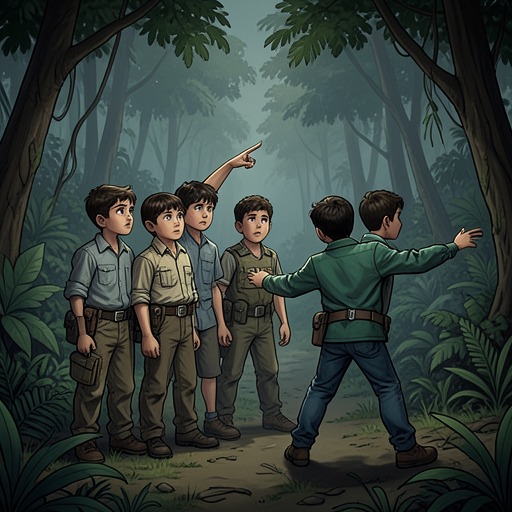
As belief in the beast intensifies, their safety becomes an explicit point of dispute. Piggy proposes staying in a confined place in case the beast approaches; Ralph objects that they would still need food and the fire, and insists that someone must look after the youngest boys. Jack Merridew dismisses them, while another boy says Piggy should be left to guard them. The exchange reduces care to an assignment made by older boys, even as Piggy’s damaged sight is raised as a reason he cannot manage danger. Protection is discussed, but the youngest boys have no comparable authority over where they go or what risks the others take.
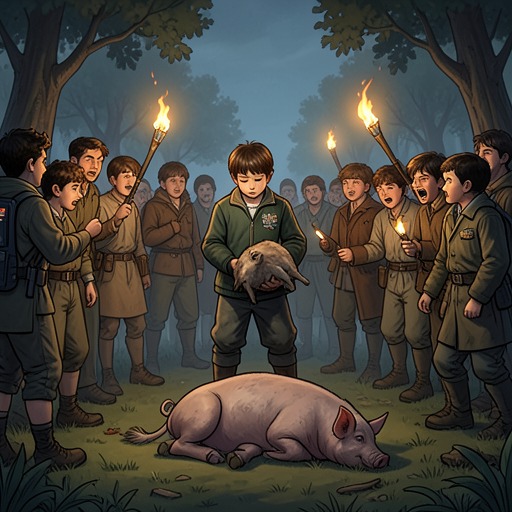
The conflict reaches the assembly itself when Jack Merridew rejects The conch and promises that the boys will hunt the beast. The meeting breaks into chanting and a mock hunt; the youngest boys who have had enough stagger away, howling. Their retreat registers the physical cost of a frenzy that the older boys experience as excitement and the frightened children cannot control.
Exposure and Narrative Significance
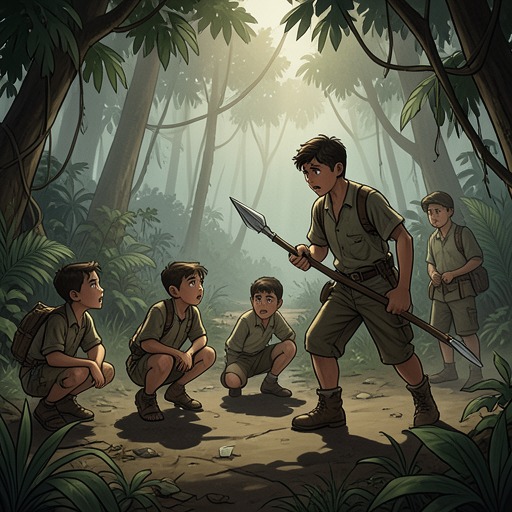
By the final pursuit of Ralph, the youngest boys are no longer merely frightened spectators of disorder. When the naval officer reaches The beach, he finds a silent semicircle of small boys streaked with colored clay and carrying sharpened sticks. The rescue arrives as the island burns, and the officer sees children whose appearance and weapons contradict the innocence associated with their age. Some are tiny; one child who approaches him cannot finish speaking. Percival Wemys Madison, once able to recite his address, can no longer summon the words that had connected him to home.
Their trajectory gives the island’s political collapse a measure beyond the rivalry of leaders. The youngest boys do not direct the group’s division, decide whether the fire is maintained, or choose the hunt, yet they experience the consequences in hunger, fear, crying, and exposure to armed crowds. Their games and small routines persist for a time beside the older boys’ increasingly forceful contests, making the change in the island’s social life visible at child scale. In the end, the painted children on the beach are both survivors and evidence: the group has ceased to protect those who depend on it, and rescue finds them only after that failure has become impossible to conceal.