Wild pigs
Lord of the FliesWild pigs are the island’s most consequential animals. First encountered as living creatures struggling to escape the boys, they become both a hoped-for source of food and the quarry through which the hunters discover their capacity for violence. The changing relation between people and pigs helps mark the boys’ movement from tentative restraint toward collective bloodshed.
Presence and First Encounter
The boys find signs of pigs in the forest while exploring The island. Among dark, aromatic bushes with waxen green buds, they hear squeaking and hoofbeats, then discover a piglet caught in creepers. Its sharp cries and desperate struggle make the animal’s fear immediate; it is not merely food imagined at a distance, but a living body resisting capture. Jack Merridew raises his knife, yet pauses before striking. The piglet tears free and vanishes into the undergrowth, leaving the boys staring at the place where they had nearly killed it.
The failed attempt exposes a limit that talk of hunting had concealed. Jack says he had been choosing where to stab, and insists that a pig must have its throat cut to let the blood out before its meat can be eaten. But his hesitation has already shown the difficulty of bringing the blade down against living flesh. He puts the knife back in its sheath, then drives it into a tree and promises there will be no mercy next time. When the boys report the encounter at a meeting, their broken account of the piglet’s squealing escape becomes proof that pigs are present and that hunting could supply meat. The animal’s escape therefore turns an abstract plan into a challenge Jack is determined to overcome.
The Hunt, the Signal Fire, and the First Kill
Later, Jack Merridew tracks a pig through the forest by its warm droppings and the trodden paths under the trees. He raises a spear and hurls it toward movement on a pig-run, but the animal escapes; the hoofbeats recede, leaving him with no meat and the frustration of another failed pursuit. The episode marks a change from the first encounter: Jack now moves through the forest as a hunter, reading signs and acting on them, though the animals remain difficult to catch.
When the hunters finally return with a kill, their triumph carries a cost. A ship has appeared on the horizon while the signal fire on the mountain is out: the boys assigned to tend it have gone hunting instead. Ralph sees the carcass swinging from a stake on the hunters’ shoulders and hears their chant, “Kill the pig. Cut her throat. Spill her blood.” Jack describes how they surrounded the animal and cut its throat, celebrating the blood and the excitement of the hunt. Ralph keeps returning to the abandoned fire and the chance of rescue the boys may have lost; Jack, absorbed in the success of the kill, insists that the fire can be lit again. The pig thus becomes the focus of a conflict between the immediate reward of meat and the shared duty to keep a rescue signal burning.
The carcass also reorganizes the boys around food and status. The meat is roasted over the fire in pieces, and Piggy asks why he has been left out because he did not hunt. Simon gives him part of his own share, prompting Jack to throw meat at Simon’s feet and insist that everyone eat what the hunters have provided. The distribution is not simply a meal: Jack uses the kill to assert the hunters’ importance, while the unequal access to meat exposes who can grant or withhold a place in the group.
The boys then turn the hunt into a game that repeats its violence. They circle Maurice, who imitates the pig, and chant, “Kill the pig. Cut her throat. Bash her in.” Ralph watches with envy and resentment before calling an assembly. The killing has supplied food, but its reenactment makes the hunt a group ritual: the pig’s suffering becomes a pattern the boys can perform together, even as the missed ship has made the cost of their hunting unmistakable.
From Quarry to Sacrificial Image
The pigs remain dangerous as well as vulnerable. During a later hunt, a boar bursts along a track toward Ralph; he throws his wooden spear, striking its snout, and the animal veers into cover. Ralph is exhilarated by the hit and repeats that he wounded it, while Jack points out that the boar also tore his forearm with its tusks. For a moment, Ralph’s success earns him the hunters’ attention and makes hunting seem attractive. Yet the animal escapes, and the encounter ends not in a kill but in rivalry over who faced it and what the hunters should have done.
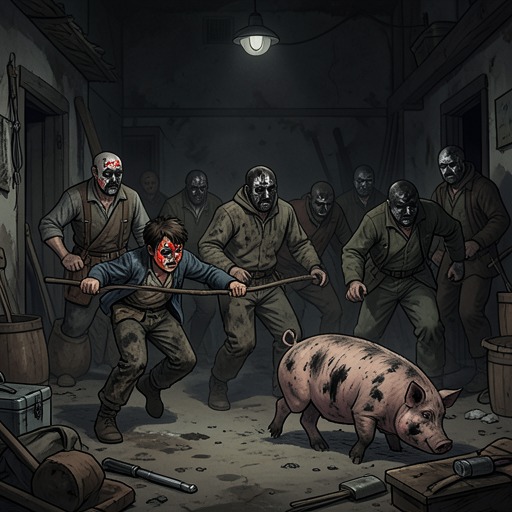
A later kill gives the pig a darker role. After the hunters slaughter a sow, Jack sets its severed head on a sharpened stick and declares it a gift for the beast. The hunters run off, leaving Simon alone with the offering and the flies gathering around it. The head’s fixed grin and the surrounding silence turn a dead animal into an object on which the boys’ fear can settle. In Simon’s feverish encounter, the pig’s head becomes the Lord of the Flies: it tells him, “I'm the Beast,” and insists that the thing the boys hope to hunt is part of them. The offering therefore does not appease an external creature; it gives material form to the violence and fear the boys have already invested in the idea of one.
The pig’s death also supplies a script the boys repeat beyond the hunt. During a storm, they form a circle around Roger, who plays the animal, and chant, “Kill the beast! Cut his throat! Spill his blood!” Ralph and Piggy join the ring, drawn into the group’s apparent shelter as its movement becomes regular and its members act like a single body. When Simon stumbles out of the forest trying to tell them about the dead man on the hill, the circle turns on him and kills him. The pigs are no longer present, but the practiced roles of hunter, prey, and victim have carried over into the boys’ violence against one another.
Food, Fire, and the Animal Body
The kill also has to be turned into food by improvised means. The boys first try to hold the whole carcass over the fire on a stake, but the stake burns faster than the pig can roast. They resort to skewering pieces of meat on branches and holding them in the flames; the cooking is so awkward that almost as much boy as meat is roasted. The scene keeps the pig’s body stubbornly material: hunting may promise a feast, but it does not make food appear ready to eat.
Ralph intends to refuse his share, yet fruit, nuts, and the occasional crab or fish have not made him resistant to hunger. He takes a piece of half-raw meat and gnaws it, an involuntary surrender to the appetite that binds him to the hunters’ success even while he objects to its costs. The pigs therefore matter not only as figures in the boys’ rituals, but as animals whose flesh sustains the group and whose pursuit repeatedly competes with the work of survival.