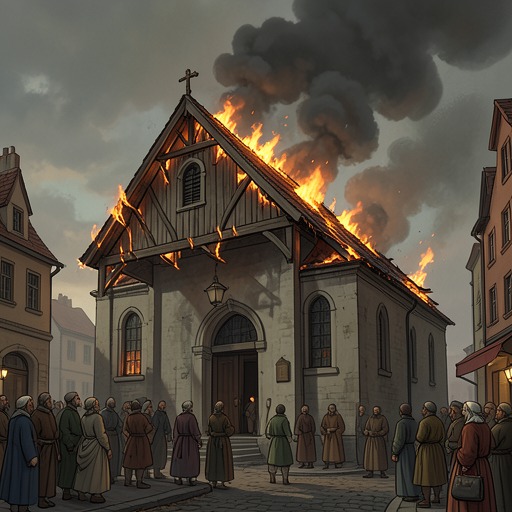
Åsane Church in Bergen
Lords of ChaosÅsane Church in Bergen occupies a place in the book as both a site of Norwegian Black Metal church arson and a continuing point of reckoning with its damage. The account identifies it among the churches for whose burning Varg Vikernes was convicted, records the attempt to recover reconstruction costs, and preserves a prison official’s account of passing its ruins on the way to work.
The church in the arson wave
The book offers little description of Åsane Church’s architecture or ordinary life before the fire. Its significance emerges instead through the sequence of arsons and the investigations that followed. Vikernes later named Åsane Church alongside Holmenkollen and Skjold as one of the three successful church burnings for which he had been found guilty; he also acknowledged one unsuccessful burning. The account places the church within a wider wave of attacks associated with the Norwegian Black Metal scene, while distinguishing the separate group responsible for the Stavanger arson.
The burning also prompted a revealing response from someone close to Vikernes. Recalling a conversation while they were in the mountains, the unnamed speaker said Vikernes did not want to join the others. When asked whether he thought the fire was awful, he said that he considered it completely acceptable. The response astonished the speaker, who nevertheless says they did not then believe Vikernes had been involved. The exchange marks a shift from suspicion about the church attacks to a more specific unease about Vikernes’s attitude toward them, without presenting that reaction as proof of his role.
Ruins and personal memory
The church’s destruction persisted in the landscape as more than a record of the crime. While Vikernes was imprisoned in Bergen, an under-warden told him that he drove past the ruins of Åsane Church every day and thought of him. The official had been married and baptized in the church. The ruins thus connected the condemned act to the ordinary route of a person whose own life had been marked by the building; the account gives that encounter a human scale that legal descriptions of arson and damages cannot supply.
Vikernes recalled being placed in isolation for a year and described the prison experience as a bad one. That detail does not establish that the under-warden’s remark caused his isolation, but it locates their brief encounter within the conditions of his imprisonment and shows how the church remained present there, not only as a charge in a case but as a visible loss familiar to someone working inside the prison.
Compensation and legal aftermath
Åsane Church also figured in the effort to make the convicted arsonists bear the financial consequences of rebuilding. The insurance company Gjensidige pursued claims concerning both Skjold Church and Åsane Church, while the city of Oslo sued Vikernes over the burning of Holmenkollen Chapel. The original demand against Vikernes covered nearly 40 million kroner for rebuilding the churches. The amount was later reduced to exclude the costs of consecrating the rebuilt churches and holding celebrations afterward, but around 37 million kroner remained. Vikernes rejected the charges, leaving the dispute to proceed through the courts again.
Those figures were presented as part of a broader reconstruction burden, not as a separate estimate for Åsane Church. The Norwegian Directorate for Cultural Heritage put the cost of fully reconstructing a destroyed church at between 15 and 30 million kroner, and estimated that rebuilding the totally damaged churches could together reach 300 million kroner, before repair costs for partially damaged churches and artistic decoration were counted. In this context, the claim involving Åsane was one strand in an effort to translate the destruction of churches into a financial obligation.
Place in the book’s account
The book places the Norwegian arsons within a Black Metal story that rapidly exceeded the local scene. A January 1993 front-page report in Bergens Tidende brought the movement to wider attention, and a later international feature in Kerrang! helped introduce Norwegian Black Metal to readers abroad. The author argues that this sensational coverage made the crimes overshadow the music, while also describing Norway’s loosely connected scene as an example that influenced Black Metal activity elsewhere. Åsane Church is not presented as the origin of that international spread; rather, its inclusion among the convictions and compensation claims shows how one local church became part of a much larger narrative about arson, media attention, and the consequences left behind.