Black Metal and the Norwegian church arsons
Lords of ChaosBlack Metal and the Norwegian church arsons became bound together through overlapping acts of anti-Christian defiance, participants’ claims about heathen identity, criminal investigations, and media attention. The fires were not evidence that every musician shared one doctrine or took part in a crime: the scene had no fixed rule book, and its attitudes shifted with the people who shaped it. But for some participants, arson made the conflict with Christianity materially visible, while publicity transformed the crimes into part of Black Metal’s public identity.
A scene with shifting boundaries
Black Metal in Norway was defined by outlook and belief as well as by music. Its members could experiment sonically, but attitudes and public presentation mattered; there was no settled ideological code shared by everyone. The scene’s dramatic personalities influenced what counted as authentic, and its boundaries changed over time. That fluidity is essential to understanding why the church fires could be claimed as representative of Black Metal by some, while remaining actions attributable to particular people rather than to every musician.
Mayhem’s early development illustrates how the scene’s identity was deliberately formed. The band initially had few releases and performances; its second demo and the Deathcrush mini-album in 1987 helped attract serious fans. Øystein Aarseth later adopted corpse paint for concerts and photographs, making a macabre appearance one of Norwegian Black Metal’s recognizable features. By the time of the arsons, Aarseth and Varg Vikernes were also cultivating a militantly sinister public image. The fires therefore entered a culture already invested in provocation and in presenting transgression as a test of seriousness, even though that context alone does not establish why any particular person set a fire.
Arson as claimed retaliation
The book identifies a distinctive anti-Christian interpretation among Vikernes and others convicted of burning churches: they presented their crimes as justified retaliation against Christianity. In this account, the fires answered a longer religious history. Some Black Metal musicians portrayed the Christian destruction or conversion of older sacred places as an earlier act of violence against Nordic traditions, and interpreted attacks on churches as vengeance against that legacy. The argument cast the church not only as a religious building but as a sign of Christianity’s presence on what they regarded as heathen ground.
That interpretation was especially explicit in Vikernes’s public position. He denied having burned a church, yet said he would not regret such an act and praised those who had done so. The book connects this sympathy to his Nordic Nietzscheanism: destruction of Christian buildings corresponded, in his view, to a rejection of Christianity and an imagined return to heathen values. His statements are evidence of his endorsement, not proof that he personally committed the arsons. He was accused of burning two churches and held in prison from January to March 1993, but was released because investigators could not prove his connection to those fires.
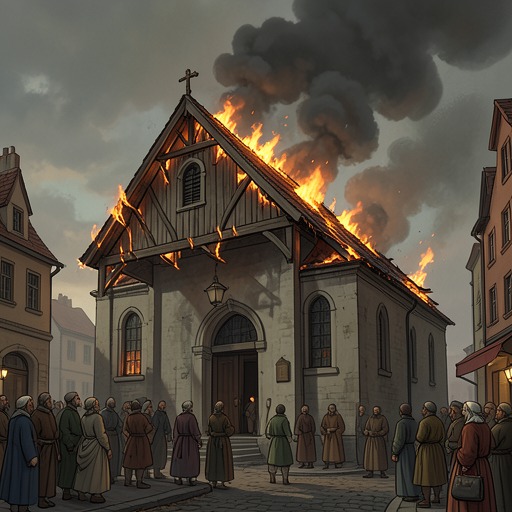
The fires of 1992 included churches at Storetveit, Fantoft, Holmenkollen, Stavanger, Ormøya, Skjold, Hauketo, and Sarpsborg. Fantoft Stave Church was among the remaining stave churches targeted. A member of the fire department died while fighting the fire at Sarpsborg Church, a consequence that makes plain that the attacks were not merely symbolic gestures. The book also places the church burnings within a broader pattern of revenge-motivated arson, while noting that the Scandinavian cases were largely unprecedented. That comparison helps explain the offenders’ stated logic without reducing the crimes to a general rule about either arsonists or Black Metal musicians.
Publicity and the making of a menace
The relationship between the crimes and the scene’s reputation was shaped in part by reporting. On January 20, 1993, Bergens Tidende published a cover story that brought Black Metal to the attention of mainstream audiences in central Norway. Vikernes’s image dominated the front page, and the coverage gave him an opportunity to construct a public persona around fear, evil, and an alleged conspiracy. The article also repeated a claim that he had burned eight churches and killed a man in Lillehammer; the book identifies the killing as a crime for which Bård Eithun was later imprisoned. The episode demonstrates how crimes associated in the public mind with the scene could be merged in coverage with claims about an individual, regardless of whether those claims accurately assigned responsibility.
International coverage amplified that association. On March 27, 1993, the British magazine Kerrang! published a cover feature presenting Norwegian Black Metal through church fires, death, and alleged Satanic ritual. Its cover combined Vikernes holding knives with a blazing church and an image of Emperor in corpse paint and medieval-style clothing. The article relied heavily on alleged remarks by Vikernes and Aarseth. In retrospect, participants disputed or qualified many of the statements, describing them as fabricated, misunderstood, misquoted, or taken out of context. Yet the feature brought Norwegian Black Metal to an international audience, with the lasting consequence that criminal acts could overshadow the music itself.
The publicity also had a subcultural effect. Researcher Asbjørn Dyrendal later argued that mass-media attention helped Vikernes build a near-mythological image and acquire street credibility. According to his account, coverage intensified internal competition to become the scene’s dominant personality, even as the subculture retained dynamics of its own. The resulting cycle joined crime, self-presentation, and reporting: a sinister image made transgression legible as a claim to status, while sensational coverage enlarged the audience for that image. This is a documented interpretation of media influence, not evidence that news stories alone caused the arsons.
Meaning, responsibility, and aftermath
The fires became a potent symbol because they connected a concrete attack on Christian buildings with Black Metal’s anti-Christian rhetoric and its use of dark, aggressive imagery. The music’s appeal also rested on factors beyond arson: it combined dark mysticism, mythological associations with the Viking Age, aggressive sound, and an image that could signal outsider status. Those elements help explain why some young listeners identified with the scene, but they do not make musical affiliation an explanation for an individual crime.
Nor did the scene’s connection to the arsons end with the fires themselves. Authorities suspected Black Metal musicians, and some were arrested and sentenced. A later Norwegian police report examined the organization of the scene around the investigations and how police had penetrated the subculture. Meanwhile, the press continued to frame Black Metal through the crimes and the provocative claims of its most prominent figures. The association was thus produced by several forces at once: the actions of particular offenders, their anti-Christian justifications, the scene’s unsettled but conspicuous identity, and media narratives that turned separate events into a national and international menace.