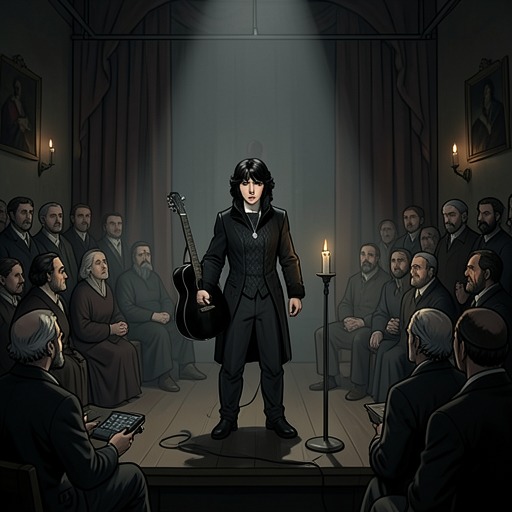
Black Sabbath
Lords of ChaosBlack Sabbath helped define Heavy Metal’s dark public vocabulary: a lurching, Blues-based sound, lyrics concerned with insanity, war, and alienation, and album imagery that brought demons into mainstream pop culture. Its occult reputation was real as an aspect of the members’ interests and presentation, but the book draws a distinction between that reputation and the band’s lyrical outlook. The group’s importance to Black Metal lies less in a shared doctrine than in the forceful precedent it set for joining heavy music to transgressive imagery and an oppositional mood.
Sound and Public Image
Black Sabbath slowed the contemporary Blues-based Rock framework to a sinister pace. Against the cheerful sentiments still associated with hippie culture, the band presented songs about insanity, war, and alienation. Ozzy Osbourne’s haunting vocal style and the group’s heavy sound made that departure audible as well as thematic: the music did not simply describe darkness but built its identity around it. The band’s covers extended that identity beyond the songs. Demons attacking sleeping people, including on Sabbath, Bloody Sabbath, brought Satanic imagery to an apex in mainstream pop culture of the early 1970s. The images helped make the band legible as an embodiment of the dark current, even for listeners who did not share or investigate its members’ occult interests.
Occult Interest and Its Limits
Members of Black Sabbath spoke about the occult, and Ozzy Osbourne later pursued the subject in his solo career with Mr. Crowley, a song devoted to Aleister Crowley. Yet the book cautions against treating these associations as evidence that Black Sabbath’s own lyrics present a serious Satanic philosophy. A closer reading, it argues, finds something nearer to Christian fear of demons and sorcery than to an affirmative Satanic doctrine. Geezer Butler’s account supplies a personal context for the band’s engagement with the subject. Raised Catholic, he described having been intensely religious as a child and becoming interested in religious questions and the Devil. In London around 1966–67, black-magic magazines opened a new perspective for him; reading Dennis Wheatley and material about astral planes also seemed to explain experiences he had had since childhood. His reading widened to include different kinds of magic, and he became increasingly drawn to its darker side. That interest became part of Butler’s surroundings: he put inverted crosses and images of Satan on his walls and painted his apartment black. But his account also marks a limit. As his involvement deepened and frightening things began to happen, he considered whether to commit himself completely and leave Jesus and God behind, then declined. The episode complicates any simple picture of the band as doctrinally Satanic: fascination, experimentation, fear, and refusal coexist in Butler’s recollection.
Audience and Cultural Reach
The book describes Black Sabbath’s flirtation with evil as reaching fans through a haze of barbiturates and Quaaludes, helping cement the group’s image as a band attuned to darkness. Like Led Zeppelin, Sabbath found that its sinister reputation took hold and remained attached to it. The comparison concerns the persistence of the public image, not an identical musical or religious position. Despite lacking press respect or support, Black Sabbath filled arenas around the world. The book presents the scale of that reception alongside the intensity of the performances: young fans gathered to have their eardrums battered by the music’s volume, experiences it characterizes as rituals of sound. This was a potent contradiction in the band’s career: a group marginalized by the press could still command large audiences, while its ominous imagery traveled well beyond any settled account of what its members believed.
Place in Black Metal’s Lineage
The book places Black Sabbath within a musical ancestry that runs from the Blues-inflected Rolling Stones and the mystical Hard Rock of Led Zeppelin through Sabbath’s heavy, doom-laden sound, then onward through Venom and Mercyful Fate to Bathory and Black Metal. In that genealogy, Sabbath contributes a crucial precedent: heaviness joined to a dark imaginative world. The account does not claim that the band itself was a Norwegian Black Metal group or that its lyrics supplied the later scene with a unified ideology. That distinction matters because Black Metal in Norway is described as residing in belief and outlook as much as in sound, without a fixed rulebook; its shifting boundaries were shaped by the scene’s prominent personalities. Black Sabbath’s significance is therefore foundational but not identical: its slow, sinister music and prominent demonic imagery helped make a darker metal aesthetic culturally available, while the later scene developed its own changing beliefs, attitudes, and musical forms.