Emperor
Lords of ChaosEmperor was one of the young Norwegian bands that helped carry Black Metal beyond its earliest circle, emerging from the countryside of Telemark and moving away from Death Metal toward the style taking shape around Mayhem. Its history in the account is inseparable from Øystein Aarseth’s influence, the informal hierarchy of the Helvete record shop, and the contrasting recollections of Emperor members Ihsahn and Samoth. Those recollections show a group formed within an intense subculture, but not one governed by a stable doctrine or formal organization.
Identity and Emergence
Emperor appeared as a young group from the Telemark countryside at a time when the Norwegian scene was changing quickly. Its beginnings were linked to the transition from Death Metal: the band Thou Shalt Suffer played that style before changing into Emperor and adopting Black Metal. This shift was part of a broader movement among Norwegian groups toward a music and image identified with extremity, anti-social attitudes, and the rejection of ordinary standards.
The band’s rural origins also complicate the idea that Norwegian Black Metal was exclusively an urban phenomenon. Although the scene’s focal point was in Oslo, members of Emperor and other bands came from small villages rather than the country’s major cities. Emperor therefore belonged to a network organized around shared music, reputation, and contact, not simply around a single city or local venue.
By the account’s later assessment, Emperor had become one of the genre’s most popular groups and one of its most majestic-sounding. That standing grew out of the same scene that had first made the band’s identity a matter of allegiance and recognition. Its development was musical, but the standards by which a group was accepted were also social and ideological.
Aarseth, Helvete, and the Scene
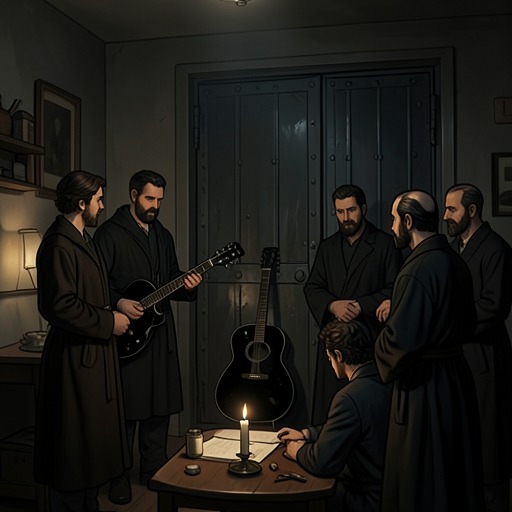
Emperor’s turn toward Black Metal took place under the influence of Øystein Aarseth, the Mayhem musician who became the scene’s central authority. Aarseth opened Helvete, a record shop that was too large and costly to be especially profitable but became a gathering place and a means of shaping the movement. Jon “Metalion” Kristiansen recalled that Aarseth guided young visitors’ understanding of what counted as authentic Black Metal. Bands including Immortal and Darkthrone changed direction under that influence; Thou Shalt Suffer’s transformation into Emperor was another example of the same pattern.
By mid-1991, Emperor was among the bands in contact with Aarseth, alongside Darkthrone, Burzum, Immortal, Thorns, Enslaved, and Arcturus. Aarseth planned to release most of these groups through Deathlike Silence Productions. The circle around the shop was not open on equal terms: Ihsahn recalled that visitors had to be trusted and regarded as serious in their views before they were accepted. People approached Aarseth and the older members with deference, and the shop’s atmosphere could feel powerful and difficult to enter. Some visitors even wore corpsepaint there during the day, making the scene’s visual code part of ordinary public life as well as performance.
This authority depended less on written rules than on proximity, judgment, and reputation. The broader account describes Black Metal as having no fixed rule book: its boundaries shifted, often under the influence of prominent personalities. Emperor’s early formation thus reflects a scene in which belonging was actively granted and negotiated, while the ideals attached to belonging remained unsettled.
Members and Conflicting Accounts
Ihsahn’s reflections provide a record of how those ideals could change within a single participant. He described his younger self as more extreme in dress and public expression, seeking to demonstrate difference and provoke a reaction that would confirm his identity. As he grew older, he developed more rational views and no longer felt compelled to prove either his beliefs or his identity as a Satanist. The change is important to the account’s portrayal of Emperor: membership in the scene did not mean that a person’s outlook remained fixed at its most theatrical or confrontational point.
The book presents Ihsahn as unusually developed in his philosophical views compared with many contemporaries. His outlook is described as bearing a strong resemblance to the outline of Satanism that Anton LaVey set out in The Satanic Bible. Ihsahn also distinguished between a considered philosophy and the early scene’s concentration on being evil. In his account, participants could take those ideals seriously while finding them difficult to live up to. The distinction makes room for both the movement’s self-presentation and the limits Ihsahn later saw in it.
Samoth’s account emphasizes a different aspect: how actions connected to the scene were organized. He described many of them as decisions made on the spur of the moment, rather than the outcome of formal meetings or a command structure. There was, he recalled, a period of unity around strong ideas, but it soon became less serious and too many people knew what was happening. His recollection does not make the actions harmless; it distinguishes their seriousness from any claim that the scene operated as a disciplined organization.
Crime, Public Attention, and Aftermath
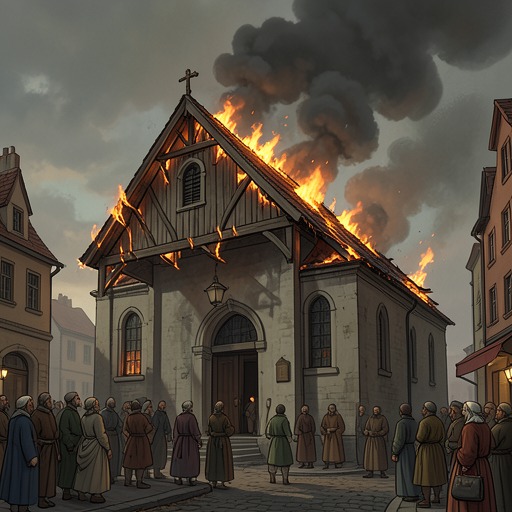
Emperor’s members were drawn into police inquiries as authorities investigated church arson and the killing of a gay man in Lillehammer. In the wake of Varg Vikernes’s interrogation, Samoth and Bård Eithun, known as Faust and formerly Emperor’s drummer, were among those questioned by different police departments. Eithun was guilty of the Lillehammer killing; the account says that those questioned were released after interviews because evidence was scarce. The distinction is crucial: the investigation concerned individuals and crimes associated with the wider scene, not a demonstrated collective action by Emperor as a band.
Ihsahn later described several different reasons people gave for church burnings. Some treated them as symbolic opposition to Christianity; some wanted to prove themselves worthy in the eyes of respected figures; others acted for the shock or simply because they wanted to do something bad. Samoth’s description of informal, improvised activity complements that account. Together, their recollections resist a single explanation for the violence, even as they show how status and recognition could become entangled with it.
When Øystein Aarseth was murdered, Ihsahn heard his name on television and immediately suspected Vikernes, then called Samoth to tell him what he thought had happened. He and Samoth knew that Vikernes and Aarseth were no longer friends and hated one another, though Samoth did not initially think the conflict could have reached that point. Ihsahn recalled being shocked, while also saying Aarseth’s death did not otherwise change things for him. The episode places Emperor’s members close to the personal rupture at the center of the scene’s history without suggesting that the band itself caused it.
Significance
Emperor’s place in this history rests on more than its conversion from Death Metal to Black Metal or its later prominence. The band makes visible the mechanisms by which the Norwegian scene defined authenticity: the influence of Aarseth, the selective welcome of Helvete, the force of visual presentation, and the desire among younger participants to be recognized as serious. At the same time, Ihsahn’s later reflection and Samoth’s account of disorganized activity show why the scene cannot be reduced to a uniform creed or a formal movement.
The band’s story also records the widening consequences of that subculture. Its members were involved in music and in the intimate social network around Aarseth, while police scrutiny and the crimes of individuals brought the scene to international attention. Emperor therefore stands at the intersection of artistic change, contested identity, and criminal history: an influential band whose members’ own accounts preserve both the intensity of the early scene and the differences within it.