Euronymous
Lords of ChaosEuronymous, born Øystein Aarseth, was the founder of Mayhem and a defining organizer of early Norwegian Black Metal. His influence rested not only on music: through the Helvete record shop, he shaped who gathered around the scene and what its members treated as authentic. Mayhem’s slow, sparse releases, its evolving visual style, and Euronymous’s forceful presence all fed a movement whose boundaries were continually set by its most influential personalities. His murder in 1993 ended his life but did not undo the central place he had come to occupy in the scene’s history.
Identity and Early Formation
Mayhem began in 1984, inspired first by Venom and later by Bathory and Hellhammer. Aarseth initially used the stage name Destructor as the band’s guitarist, alongside bassist Necro Butcher, drummer Manheim, and vocalist Messiah. He later adopted Euronymous, a Greek title described in the book as corresponding to a prince of death. The name suited the occult atmosphere around the band, but the account also warns against treating such names as proof of destiny: the apparent fit between a chosen title and a person’s eventual fate remains an unsettling association, not an answerable cause.
Mayhem’s earliest public identity was still taking shape. At its first live show, shortly before Jon Kristiansen encountered the band, it played covers of Celtic Frost, Bathory, and Venom rather than original songs. Its second demo and the Deathcrush mini-album, released in 1987, began to establish a wider reputation and attract serious fans. Aarseth released material slowly, whether because of financial difficulties or because he wanted control over every aspect of production; the band also played few shows. These delays and limits became part of the history of a group that acquired a formidable reputation without relying on frequent performances or a steady flow of records.
The band’s appearance changed along with its music. Early Mayhem members wore black clothes, leather jackets, and black hair, then ordinary elements of their dress rather than a fully codified uniform. Aarseth later adopted corpse paint for concerts and photographs, a black-and-white makeup style that gave the band a macabre appearance and became one of Norwegian Black Metal’s recognizable signatures. The shift illustrates a broader principle of the scene: there was no permanent rulebook, and its aesthetic and ideological boundaries moved as prominent participants asserted new standards.
Helvete and Scene-Making
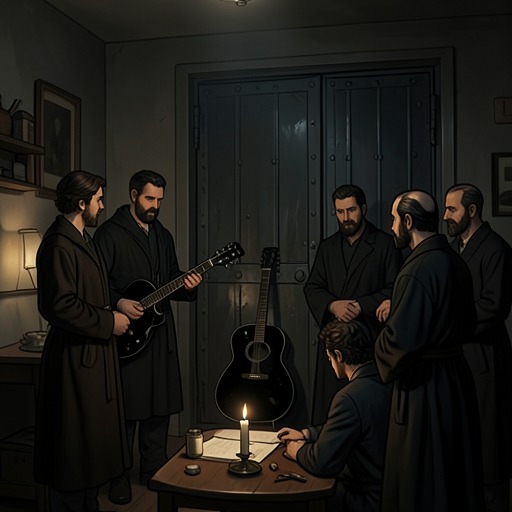
After Dead’s suicide, Euronymous pursued his projects, foremost among them the opening of a record shop called Helvete, or Hell. The premises were too large and expensive, and the shop did not make much money. Its importance was instead social and symbolic: it became a focal point where Euronymous could exercise influence over younger musicians and fans. Jon Kristiansen later described the shop as the point around which the Norwegian scene cohered, emphasizing Euronymous’s power to persuade visitors about what counted as genuine Black Metal and what did not.
By mid-1991, Darkthrone, Burzum, Immortal, Thorns, Enslaved, Arcturus, and, later, Emperor were in contact with Aarseth. He planned to release most of them through Deathlike Silence Productions. The store and label linked a loose collection of bands to a shared center, while access and recognition depended in part on being trusted and regarded as serious. Ihsahn recalled an atmosphere in which visitors sought acceptance from Euronymous and older scene members; the shop felt powerful and difficult, and even the sight of people wearing corpse paint there in daylight could seem excessive. The scene was not simply a sound shared by musicians: it was also a social world with thresholds of belonging.
That influence extended to musical direction. Kristiansen credited Euronymous with introducing members of Immortal and Darkthrone, previously involved in Death Metal, to his version of Black Metal. He pointed to the contrast between Darkthrone’s first album and its second, A Blaze in the Northern Sky, as evidence of the change, and described Immortal’s movement from Death Metal toward Black Metal in similar terms. Emperor’s predecessor, Thou Shalt Suffer, had also been a Death Metal band before the transition to Emperor. These developments did not make Euronymous the sole author of every band’s work, but they show how the shop, his label plans, and his personal judgments helped turn a scattered set of musicians into a scene with a recognizable direction.
Persona, Authority, and Contradictions
Euronymous deliberately made himself a manifestation of the Black Metal aesthetic. He dressed entirely in black, dyed his hair black, wore long, aristocratic mustaches and knee-high boots, and decorated a black leather biker jacket with badges. Though slim and not especially tall, he presented himself as stern and serious; his manner could verge on theatrical pomposity. He maintained this façade for outsiders and younger scene members, making personal appearance part of the authority he claimed for his musical and ideological judgments.
The façade did not describe the whole person. The account contrasts the severe public image with an enthusiastic, almost childlike manner among people he liked. In the shop he could run around with the energy of an overgrown child and bring visitors records from his private collection. For a time he lived in a back room, where he kept records, books, videos, and other possessions. That contrast makes his authority more complicated than a simple performance of menace: the intimidating public figure and the music enthusiast coexisted, even as he chose to sustain the first image before much of the developing scene.
Helvete itself embodied a related tension. Its basement served for photographs, parties, gatherings, and occasional lodging, including for Varg Vikernes during visits to Oslo. Use of the space was gradually restricted after some visitors began taking women there whom they had met while drinking; eventually dampness made the cellar unusable. The shop also drew customers whose musical interests did not imply allegiance to Black Metal’s outlook. As Death Metal grew popular, Helvete sold records by bands such as Metallica and Godflesh to customers outside the scene. Aarseth could make money from those sales while the shop remained the meeting place for a more exclusionary subculture. The commercial shop and the scene’s rhetoric of uncompromising separation therefore occupied the same address.
Dead, Conflict, and Legacy
Dead’s death exposed the gap between Euronymous’s public claims and the personal grief others might have expected. The book describes Dead as an unusual figure whom acquaintances did not speak ill of, but reports that Aarseth appeared to show little sorrow. Instead, he glorified the violent circumstances and used them to deepen Mayhem’s aura of catastrophe. He photographed the body before police arrived, and pieces of the skull became talismanic jewelry among his close associates. Hellhammer also recalled Euronymous taking part of the brain and consuming it so he could claim to be a cannibal; the account says Aarseth had also considered keeping another part of the body, but abandoned the idea because police would ask about it. These acts turned a death within the band into material for its cultivated mythology.
In a 1992 interview with Bård Eithun for Orcustus, Euronymous framed Dead’s death as part of a wider conflict with the music scene Mayhem had rejected. He argued that trend-followers had destroyed the old Black Metal and Death Metal scene, and contrasted the former culture of spikes, chains, leather, and black clothing with a Death Metal that had become normal and even funny. In that account, Dead’s hatred of the world and devotion to that earlier style made his death a symbol in an ongoing war, rather than only a personal loss. The rhetoric reveals how Euronymous used antagonism to define the group: authenticity depended on opposition to what he regarded as normalization.
Euronymous’s lasting importance lies in the way these roles converged. He was Mayhem’s founder, a slow and controlling producer, the proprietor of an unprofitable but influential shop, the planned label’s central organizer, and a tastemaker whose judgments shaped other musicians’ sense of Black Metal. The broader scene had no fixed ideological code, but its direction could be altered by figures able to enforce boundaries and make an aesthetic feel consequential. Euronymous did so through music, access, clothing, and provocation. Mayhem remained internationally associated with its late founder after his brutal stabbing in 1993, while the scene he helped gather around Helvete continued to bear the marks of his influence.