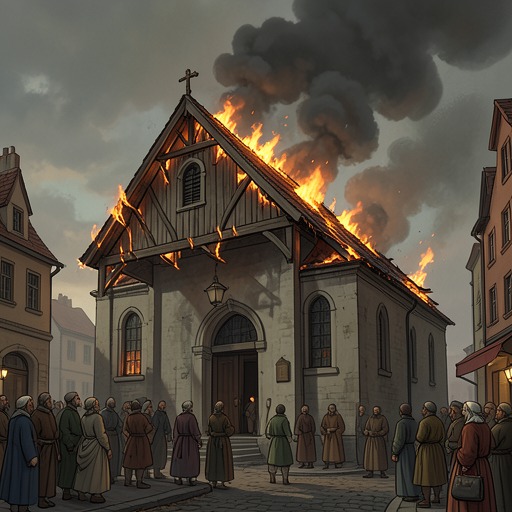
Fantoft Stave Church Fire
Lords of ChaosThe Fantoft Stave Church Fire destroyed one of Norway’s best-known historic wooden churches in the early morning of June 6, 1992. The blaze became a national story and was later treated as the opening signal of a wider wave of church fires, although Varg Vikernes, strongly suspected of setting it, was never convicted of this particular crime. Its significance lies both in the destruction of a landmark and in the competing meanings attached to the site, the date, and the fire’s place in the events that followed.
The Church and Its Setting
Fantoft dated from the twelfth century and had originally stood at Fortun, near the Luster Fjord in central Norway. When it was scheduled for demolition in the late nineteenth century to make room for a new burial ground, it was dismantled and moved to Fantoft, about five miles south of Bergen. The relocation saved the building at a time when many other stave churches were being destroyed before their historical and cultural value was widely recognized. The church also contained old runic inscriptions, connecting its long history to the cultural past later invoked in discussions of the fire.
The building’s form and setting made it especially vulnerable. Its ground plan was slightly altered during reconstruction in 1883, and the exterior was renewed. It stood on a wooded hilltop, screened by dense trees; an account cited in the book notes that the church could remain out of sight until a visitor was nearly upon it. Stave churches were made entirely of wood, and their construction left them exposed to destruction by natural causes as well as deliberate fire. At Fantoft, the concealed approach and isolated hilltop also meant that an arsonist could reach the building without being readily observed. These conditions help explain the site’s vulnerability, but do not establish who set the fire.
The Fire and the Question of Responsibility
The church was fatally set alight early on June 6, 1992. The book describes Vikernes as strongly suspected of the arson, while making clear that no conviction was ever obtained. The distinction matters: the fire became inseparable in public memory from his name, but suspicion and later claims did not amount to proof in court. A photograph captioned as allegedly taken by Vikernes shortly after the arson further illustrates how images and assertions became part of the event’s contested record; the caption itself preserves the uncertainty rather than resolving it.
Vikernes later described the fire as the beginning of what followed, while denying that the subsequent activity was organized as a single campaign. In his account, the Fantoft blaze acted as a trigger: other people saw reports of it and decided to imitate the act, without contact with him. That explanation is his retrospective account, not an independently established chain of command. The distinction between one person’s alleged responsibility for a specific fire and the later spread of similar crimes is central to the book’s presentation of the episode. Fantoft became a point of origin in the narrative, but the evidence does not make every later fire an operation directed by the same group.
Sacred Ground and Competing Interpretations
In explaining why the church mattered to him, Vikernes offered an interpretation rooted in pre-Christian religious history. He said the building stood on holy ground marked by a natural circle and a stone heathen altar, and that a large cross had been planted on the altar before the church was built at the site. This is presented as his account of the location and its religious meaning, not as a neutral description of the archaeological evidence. It shows how he framed the fire as an attack on a Christian structure erected over a sacred place associated, in his view, with an older tradition.
The date also acquired symbolic weight. Vikernes noted that June 6, 793, was the date of the first known Viking raid in Lindisfarne, and emphasized that the raiders came from Hordaland, the county he identified as his own. He complained that this historical association was overlooked while public attention focused on Satanism and the apparent pattern of sixes in the date. His comparison supplied a heathen and Viking frame for the event, in contrast to the Satanic interpretation that dominated much of the immediate public discussion. These explanations reveal the symbolic history he wanted attached to the fire; they do not prove his involvement or establish his motive for setting it.
Public Afterlife
News of Fantoft’s destruction made national headlines, and other churches soon burned in separate incidents. The sequence gave the Fantoft fire a lasting role as a perceived beginning, even as the relationships among those responsible remained disputed. In January 1993, a front-page story in the Bergen daily newspaper placed Vikernes’s image and statements at the center of the growing public story. Its presentation helped shape the way the Black Metal scene was discussed in the media, making the church fires central to a portrayal that joined music, criminality, and Satanism. The article’s dramatic framing was influential, but it should not be mistaken for a judicial finding about Fantoft.
The later account also resists treating the fire as self-explanatory evidence of a Satanic conspiracy. Vikernes maintained his innocence during police questioning and was released in March for lack of evidence; although he repeatedly intimated involvement in Fantoft, the crime remained unproven. The 1998 police report on church fires and Satanically motivated criminal damage reflects the subsequent effort to examine the scene’s structure and the investigations it prompted. By then, Fantoft functioned at once as the loss of a historic building, an unresolved criminal case, and a media symbol used to interpret later violence. Its prominence arose not only from what burned, but from the different and sometimes incompatible stories told about why it burned and what followed.