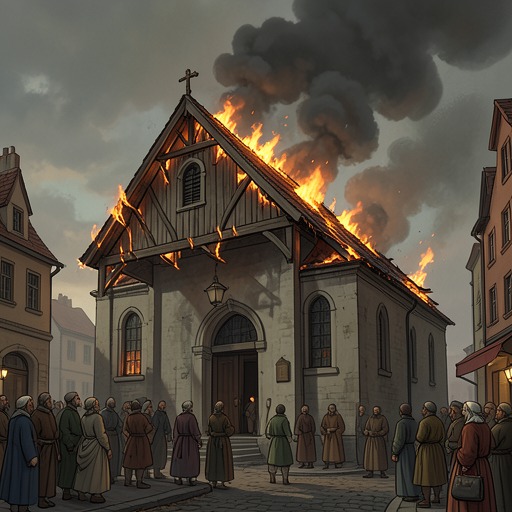
Fantoft Wooden Church
Lords of ChaosFantoft Wooden Church was a twelfth-century Norwegian stave church whose destruction by fire on June 6, 1992, became a defining landmark of the church-arson wave associated with the Black Metal scene. Originally built at Fortun near the Luster Fjord, it was dismantled and moved to a wooded hill south of Bergen rather than demolished. Its history therefore joined two forms of vulnerability: the loss of historic wooden churches to changing land use, and the later danger of deliberate fire. Though Varg Vikernes was strongly suspected of setting the blaze, no conviction was ever made in the case.
Architecture and Setting
Stave churches were built entirely of wood, a construction that made them vulnerable to both natural and human causes of destruction. Their characteristic exteriors could combine steep roofs, sharply rising steeples, darkened timber, and intricate carved portals. Dragon-head forms sometimes projected from the upper gables; interior motifs could preserve traces of older heathen imagery. The result, in the most elaborate examples, could seem at once ecclesiastical and unsettling. Fantoft was described as arguably having the most ominous appearance of any surviving stave church before its destruction.
Its setting intensified that impression while also concealing the building. The church stood on a densely wooded hill, where trees could obscure it until a visitor was close. The secluded location made it easier for an arsonist to approach unseen, while the surrounding timber landscape gave the building a remote presence. That atmosphere should not be confused with evidence about the fire’s perpetrator: the account identifies the location as a practical vulnerability, but does not establish who used it or how the blaze was started.
From Fortun to Fantoft
The church originally stood at Fortun, near the Luster Fjord in central Norway, and contained old runic inscriptions. Toward the end of the nineteenth century it was scheduled for demolition to make room for a new burial ground. At that time, many stave churches were destroyed before their historical and cultural significance was widely recognized. Fantoft was instead dismantled and moved to a site five miles south of Bergen on Norway’s west coast, preserving the building through relocation.
Its reconstruction altered the ground plan slightly, and the entire exterior was renewed in 1883. The move thus saved the church, but did not leave it untouched: the surviving landmark was a historic structure reassembled and modified at a new site. Its wooden fabric remained exposed to the risks inherent in stave construction, and its secluded hilltop position added a further vulnerability. Centuries of survival, followed by rescue from demolition, could not protect it from the fire that destroyed it in 1992.
The 1992 Fire and the Wider Wave
Early in the morning on June 6, 1992, Fantoft was fatally torched. News of the destruction of a major cultural landmark made national headlines. The account strongly identifies Vikernes as a suspect, but emphasizes that he was never convicted for this particular crime. A photograph of Fantoft was later presented as allegedly having been taken by Vikernes shortly after the arson; the attribution is reported as an allegation, not established proof of responsibility.
Fantoft’s burning preceded a sequence of other church fires. Revheim Church was torched on August 1; twenty days later, Holmenkollen Chapel in Oslo burned. Ormøya Church caught fire on September 1, followed by Skjold Church on September 13, and Hauketo Church in October. After a pause of several months, Åsane Church in Bergen was consumed by fire, and Sarpsborg Church was destroyed two days later. A firefighter died while battling the Sarpsborg blaze, a death that some later attributed to the Black Circle. The sequence made Fantoft more than an isolated loss: it became the first major blaze in a widening, highly publicized pattern, though the later fires had distinct circumstances and not every one was established as scene-related.
The wider record also complicates any simple account of a coordinated campaign. At least forty-five to sixty church fires, near-fires, and attempted arsons were reported in Norway; according to Sjur Helseth, head of the Technical Department of the Directorate for Cultural Heritage, roughly a third had a documented connection to the Black Metal scene. Church fires were not unprecedented: one or two churches had burned in Norway on average each year, often because of natural causes such as lightning, while faulty electrical wiring was another known source. The established background of accidental fires does not explain Fantoft’s arson, but it matters to the distinction between the broader count of fires and those linked to deliberate attacks.
Public Meaning and Legacy
Fantoft’s destruction became a reference point for accounts of the Scandinavian arsons beyond Norway. Hendrik Möbus later recalled hearing about the fires shortly after Vikernes burned the church and described the ensuing wave as electrifying. In Sweden, an attempted burning of Christopher Jonsson’s home was described as the first documented Black Metal transgression there and as having taken place under Vikernes’s direction. These later references placed Fantoft at the beginning of a story that crossed national borders, while the evidence about the church itself remains more limited: its arson was never resolved by a conviction.
The fire also changed how the Black Metal scene appeared to a wider public. A January 1993 cover story in Bergens Tidende brought Vikernes to national attention, and a March cover feature in Kerrang! carried sensational reporting about Norwegian Black Metal to an international readership. The latter helped make the scene known abroad, while its claims and framing were later disputed by participants and described as misquoted, misunderstood, fabricated, or taken out of context. Fantoft’s destruction was thus both the loss of a particular historic building and a powerful image through which the press narrated a larger conflict. Its significance rests in that convergence: an old wooden church, rescued from demolition and hidden among trees, became a symbol of a crime wave whose full extent and responsibility remained contested.