Helvete record shop
Lords of ChaosHelvete record shop was both a music business and the physical center of the early Norwegian Black Metal scene. Opened by Euronymous in Oslo a few months after Dead’s suicide, it offered a place to meet, an aesthetic to inhabit, and a standard of authenticity that Euronymous used to influence young musicians. The shop never prospered financially, but its cultural reach far exceeded its sales.
Location and Design
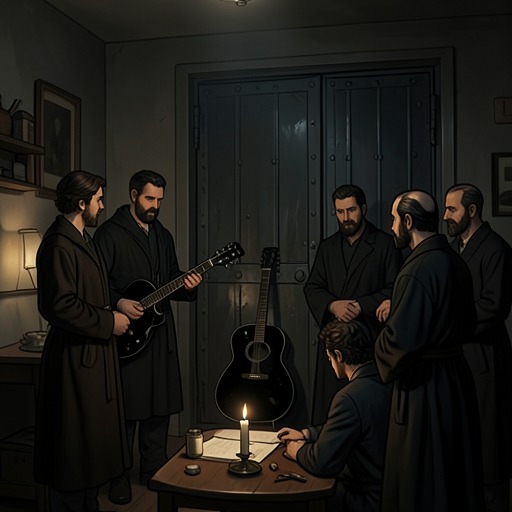
The shop occupied a rented building in the Old Town of Oslo’s East End, an area described as lower-income and with a high proportion of immigrants and young people. Its blackened windows made the premises inconspicuous from the street. Inside, the décor deliberately carried the name Helvete, meaning Hell: a cloaked female mannequin and a skull displayed on the counter established the shop’s dark theatrical identity. Lit candles added to the atmosphere, while more ambitious plans, including tombstones made from polystyrene, were never realized.
The staging was purposeful rather than incidental. Euronymous treated the shop as an expression of Black Metal, and the interior helped turn a specialist retail space into a public performance of the scene’s anti-Christian, extreme aesthetic. The effect was not uniformly solemn: the account notes that Euronymous understood Heavy Metal’s theatrical side, also visible in the Kiss picture discs on the walls. Helvete’s look could be taken as provocation or as spectacle, and the shop’s identity depended on both readings.
Business and Compromise
Euronymous first imagined a specialist shop for metal generally, but as audience tastes shifted toward Death Metal, he adjusted the plan. He intended to sell less uncompromising, more popular records to keep the business going, while reserving the shop’s identity for Black Metal and using its income to order records for that audience. The shelves did not serve only committed Black Metal listeners: during the Death Metal boom, the shop also attracted customers who did not share the scene’s outlook, and it stocked bands such as Metallica and Godflesh.
The commercial strategy never made Helvete a substantial source of wealth. The premises were too large for Euronymous’s limited stock and the rent was too high. He shut off part of the building and operated the store in a smaller section; associates later characterized the unused space and the high rent as reasons the business did poorly. A proposed arrangement in which customers would use torches to see the records remained only an idea. The shop was dark, but visitors did not in practice have to carry torches.
A Meeting Place and Source of Influence
Helvete’s importance lay less in its earnings than in the authority and contact it gathered around Euronymous. Metalion described its opening as the creation of the Norwegian Black Metal scene, connecting that development to Euronymous’s influence over the young people who visited. Musicians who had been listening to Death Metal were introduced to Euronymous’s conception of what Black Metal should be: corpse paint, spikes, an emphasis on death, and extremity. Metalion pointed to Darkthrone’s movement from its first album to A Blaze in the Northern Sky as evidence of that influence; he also described Immortal’s shift from Death Metal toward Black Metal and the transition from Thou Shalt Suffer to Emperor.
By mid-1991, Darkthrone, Burzum, Immortal, Thorns, Enslaved, and Arcturus were in contact with Euronymous, as was Emperor later. Euronymous planned to release most of these groups through Deathlike Silence Productions. The shop consequently linked a network of bands to a record label and to a shared aesthetic, while also serving as the place where newcomers could encounter the people who defined that aesthetic. Euronymous later used the phrase Norwegian Black Circle when speaking to the press about the church burnings that would begin before the end of 1991; the term grew out of a circle of friends and acquaintances associated with the scene, not simply a formal organization housed in the shop.
The store also functioned as a threshold into the scene. Ihsahn recalled an atmosphere in which acceptance had to be earned: visitors were assessed for whether they were trusted and serious in their views, and younger participants showed deference to Euronymous and older scene members. Some arrived in corpse paint during the day, a conspicuous sign that the shop’s visual code had moved beyond performance on stage into ordinary public life. Helvete thus did not merely sell records; it helped sort participants, establish belonging, and make Euronymous’s judgments influential.
Basement and Legacy
A spacious basement extended the shop’s use beyond retail. It hosted photo sessions, parties, and social gatherings, and provided spare lodging for guests or people who lived too far away to return home after a night in Oslo. Varg Vikernes stayed there when visiting the city. Over time, the basement became too damp and clammy to serve its former purposes, limiting the practical use of this informal extension of the scene.
Helvete’s significance rests on the contrast between its weak commercial performance and its strong social and symbolic position. It could not make much money from its oversized premises, yet it gathered musicians, fans, and aspiring insiders around a common space and a contested definition of what counted as authentic Black Metal. The shop gave that emerging scene a place, a look, and a hierarchy of influence; its reach was measured not by the size of its stock or its profits, but by the music and relationships that formed around it.