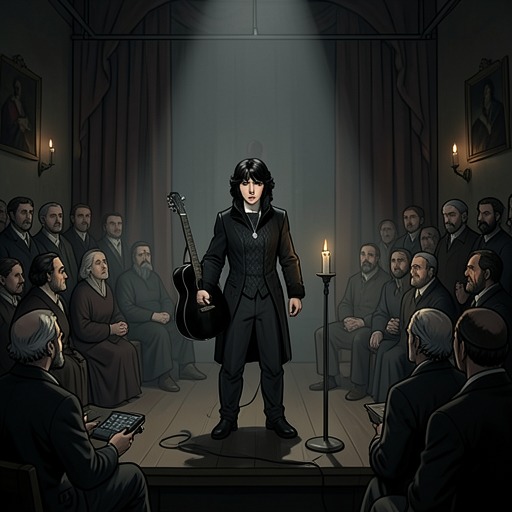
Led Zeppelin
Lords of ChaosLed Zeppelin occupies a place in the book’s account of Black Metal’s ancestry not simply as a hard-rock band but as an early example of music entwined with occult imagery, Norse and Anglo-Saxon folklore, and deliberate mythmaking. Through Jimmy Page’s serious interest in Aleister Crowley, the group’s use of Viking and Satanic themes, and its cultivation of a sinister public reputation, it helped establish a repertoire of images later Black Metal bands would make their own.
Occult interests and cultural setting
In the late 1960s and early 1970s, the countercultural search for spiritual alternatives helped renew public attention to occultism. Within this climate, Aleister Crowley gained prominence beyond that of his own lifetime, in part through the underground films of Kenneth Anger. Mick Jagger and Jimmy Page each contributed music to Anger’s Crowley-inspired films, Invocation of My Demon Brother and Lucifer Rising, bringing the occult into proximity with prominent rock musicians and their audiences.
Page’s engagement went beyond a passing reference. He collected original Crowley books and manuscripts, held a financial share in London’s Equinox occult bookshop, and at one point bought Boleskine Estate, Crowley’s former property on Loch Ness. In an interview, Page described his attraction to Machiavelli’s forceful philosophy and spoke of continuing to study evil and the supernatural. He also presented Crowley’s ideas as relevant to the continuing search for truth and treated magic as a serious subject of study. The account distinguishes this sustained interest from the more casual occult dabbling it associates with Jagger.
Music and mythic imagery
Crowley’s Thelemic religion is described as one strand woven through Led Zeppelin’s albums, alongside Anglo-Saxon and Norse heathen folklore, traditional music, and the mythology of J. R. R. Tolkien. The band’s significance in this history lies in the combination: occult references did not stand alone, but appeared beside older northern European material and fantasy, making the music a vehicle for a layered mythic atmosphere.
The song No Quarter, composed by Page, offers a pointed example. Stephen Davis observed that its music prompted Robert Plant to write lyrics imagining Led Zeppelin as a Viking death squad riding the winds of Thor toward a Satanic fate. In the book’s account, the song compresses several recurring elements—Viking identity, supernatural force, and an ominous destination—into a single image. Led Zeppelin is consequently presented as an early rock group whose themes anticipated concerns that would later become prominent among Black Metal bands.
Performance and the making of a sinister reputation
The group also reinforced its occult associations through performance beyond the records. For a release party, Led Zeppelin staged a mock Black Mass in underground caves that had earlier housed rites associated with Sir Francis Dashwood and the Hellfire Club. The location gave the performance a historical charge: the event presented a contemporary rock celebration in a place already linked, in the narrative, with secretive ritual.
The book describes the band, and Page especially, as understanding the value of a disturbing reputation. Stories that grew around Led Zeppelin included an alleged pact with Satan in exchange for success and claims that Page’s experiments with black magic had brought about drummer John Bonham’s death. These are presented as rumors, not established events. In later years, Page and Plant sought to minimize the association, dismissing Boleskine Estate as an old farm. The contrast between earlier cultivation of sinister associations and later efforts to deflate them shows how reputation could serve as both a deliberate part of the band’s image and a legacy its members subsequently tried to contain.
Place in Black Metal’s musical ancestry
The book places Led Zeppelin in a longer, indirect lineage rather than claiming that the band itself belonged to Black Metal. It traces the genre’s darker inheritance through Venom and Mercyful Fate, back to Black Sabbath’s heavy, doom-laden sound and Led Zeppelin’s mystical hard rock, then further to The Rolling Stones and the blues tradition. In this genealogy, Led Zeppelin contributes a combination of musical force and occult or heathen imagery that later musicians could adapt for a more explicitly extreme style.
That lineage is presented as cumulative: the later genre drew on multiple bands and traditions, not on a single origin. Led Zeppelin’s particular contribution was to make supernatural, northern European, and Satanic motifs part of a conspicuous rock vocabulary, while its theatrical gestures and cultivated notoriety helped bind musical identity to public image. The book therefore treats the band as a significant precursor to Black Metal’s concerns, without equating its beliefs, music, or history with those of the later scene.